
statement of work: Protect Projects and Prevent Scope Creep
Learn how a solid statement of work protects your business, prevents scope creep, and drives project success for Australian freelancers and agencies.
Payly Team
December 7, 2025
Think of a Statement of Work (SOW) as the master blueprint for a project. It’s the foundational document that lays out the entire scope of work agreed upon between you (the service provider) and your client. Everything from the core objectives and specific deliverables to the timeline and total cost gets defined right here.
In short, it’s your project’s single source of truth.
What Is a Statement of Work and Why It Matters

Could you imagine trying to build a house without architectural plans? You might have a vague idea of what it should look like, but getting there would be a messy, expensive journey full of delays and arguments. An SOW is that essential blueprint for your project, making sure everyone involved is working from the same set of plans.
This document formalises the agreement, taking it far beyond a simple handshake or a few emails. It’s where you translate broad ideas into a structured, actionable plan. For Australian freelancers and creative agencies, a solid SOW isn’t just good practice, it's a non-negotiable business tool.
Your Best Defence Against Project Chaos
The main goal of a Statement of Work is to achieve absolute clarity for everyone involved. By locking down the project’s boundaries before a single hour is billed, it becomes your best defence against the common issues that derail projects. Without one, you’re leaving yourself wide open to misunderstandings and disputes.
A strong SOW protects everyone by creating a clear framework that:
- Prevents Scope Creep: It defines exactly what work is included and, crucially, what is not.
- Aligns Expectations: It ensures both you and your client are on the same page about what will be delivered, by when, and what success looks like.
- Minimises Disputes: When disagreements arise about work done or payments due, the SOW is the go-to document for resolution.
- Ensures Accountability: It clearly outlines who is responsible for what, so there’s no confusion about roles.
A Statement of Work forces everyone to think through the project's details upfront. This initial investment in planning is what separates successful projects from those that descend into confusion and conflict.
This proactive approach gets results. Projects in Australia guided by a clear, well-drafted SOW have been shown to have up to 30% higher success rates in hitting deadlines and staying on budget compared to those without. For deeper insights, you can explore the project management landscape in Australia from KPMG.
Ultimately, creating a detailed Statement of Work is about building a foundation of trust from day one and paving the way for a strong, successful partnership.
Breaking Down the Key Components of an SOW

To put together a statement of work that actually protects your project, you need to understand its anatomy. Don't think of it as one big, scary document. Instead, picture it as a collection of distinct but interconnected parts that, when combined, create the full picture.
Each component has a specific job to do. Getting them all right from the start is your best bet for avoiding headaches down the track. Let’s pull apart the essential elements of a top-tier SOW so you can build one that's clear, comprehensive, and leaves zero room for misinterpretation.
Introduction and Purpose Statement
Every great SOW starts with a solid foundation. The introduction sets the scene, clearly identifying who's who in the project (the client and you, the service provider) and giving a quick, high-level overview of the work. This might feel like a formality, but it’s crucial for confirming who is responsible for what, right from the get-go.
Right after the intro comes the purpose statement. This is your project's "why." It's a punchy summary that answers the most important questions, making sure everyone is aiming for the same target.
A strong purpose statement should nail down:
- The Problem: What specific challenge or opportunity are we tackling?
- The Goal: What does the finished project look like? What’s the ultimate objective?
- The Value: How will hitting this goal actually benefit the client's business?
For instance, a purpose like "to build a new website" is far too vague. A much stronger purpose statement for an Australian e-commerce business would sound more like this: "This project will develop a new Shopify e-commerce website to increase online sales by 25% within six months of launch by improving mobile user experience and streamlining the checkout process." See the difference?
Scope of Work
Pay attention here, because this is arguably the most critical part of your entire statement of work. The scope of work is where you provide a detailed rundown of the specific tasks and activities you'll be performing. It’s where you draw a firm line in the sand, defining what’s included in the project and, just as importantly, what’s not.
Crystal clarity in this section is your number one defence against the dreaded scope creep. A well-defined scope leaves no room for assumptions.
For a digital marketing agency in Sydney, the scope might list things like:
- Included: Keyword research, on-page SEO for up to 15 pages, monthly performance reporting, and setting up a Google Business Profile.
- Excluded: Paid advertising campaign management (PPC), social media content creation, and website hosting services.
A detailed Scope of Work isn't about limiting creativity; it's about channelling it effectively. By defining the boundaries, you give your team the freedom to excel within a clear and agreed-upon framework.
This clarity means the client knows exactly what they’re paying for, and your team knows exactly what they need to deliver. Any work requested outside these boundaries can then be handled through a proper change order process, protecting both your time and your budget.
Period of Performance
Every project needs a timeline. The period of performance section sets the project's start and end dates, creating a clear window for everything to happen. This isn’t just about plucking a final deadline out of thin air; it’s about outlining the entire duration for the work.
This section should specify:
- The official start date of the project.
- The projected completion date for all deliverables.
- The total number of business days or hours allocated to the work.
This is a vital piece of the puzzle for managing your resources and the client's expectations. It locks in a realistic schedule that both parties have agreed to, which helps keep things on track and makes it easy to spot potential delays before they become big problems.
Deliverables and Acceptance Criteria
Deliverables are the tangible, measurable things you’ll be handing over to the client when the work is done. But just listing them out isn't good enough. Each deliverable needs to be paired with clear acceptance criteria. These are the rules that define how the work will be judged and what officially counts as "complete" or "approved."
Without them, you're opening the door to endless revision cycles and subjective feedback. The goal is to shift the conversation from a vague "I'll know it's done when I see it" to a concrete checklist for success.
Let's look at an example for a freelance web developer in Melbourne:
| Deliverable | Acceptance Criteria |
|---|---|
| Website Homepage Mock-up | The mock-up must be a high-fidelity design in Figma, responsive for desktop and mobile views, and include the client's new branding guidelines (logo, colours, fonts) provided in Week 1. |
| Contact Us Form | The form must have fields for Name, Email, and Message, include spam protection, and send a confirmation email to the user and a notification to the client's admin email upon submission. |
| SEO Content Strategy | The document must include a list of 50 target keywords, a content calendar for the first three months, and topic outlines for three initial blog posts. |
By defining these elements with this level of precision, your statement of work transforms from a simple to-do list into a powerful project management tool. It becomes the single source of truth that gets everyone on the same page and sets you up for a smooth, successful project.
How to Write an SOW That Prevents Problems
https://www.youtube.com/embed/oacSSamqP6s
Alright, let's move from theory to practice. Knowing what a Statement of Work is and knowing how to write a great one are two very different things. A well-crafted SOW is your project's first line of defence; it’s a proactive tool that snuffs out potential conflicts before they ever have a chance to ignite.
This isn’t about just filling in a template you found online. It’s about strategic thinking, crystal-clear communication, and anticipating the road ahead. The real secret isn't burying your client in legal jargon; it's about making everything so clear that there's simply no room for confusion. Let’s walk through some tried-and-tested advice for drafting SOWs that lay the groundwork for a successful project.
Use Precise and Unambiguous Language
The most common mistake I see? Vague language. It’s the single biggest cause of project disputes. Phrases like "ongoing support," "regular updates," or "industry-standard design" are a recipe for disaster. Why? Because they're completely subjective. My idea of "regular" might be weekly, while your client's is daily.
You have to be ruthlessly specific. Instead of saying you’ll “optimise the website for SEO,” spell out exactly what that means. A better version would be: “Perform keyword research to identify 50 target keywords, optimise on-page elements (meta titles, descriptions, H1 tags) for up to 15 existing pages, and set up Google Analytics tracking.” See the difference? There's no guesswork left.
Every single term, deliverable, and timeline should be defined so clearly that a complete stranger could read the SOW and know exactly what needs to be done, by whom, and by when.
Involve Stakeholders from the Beginning
Never write an SOW in a silo. It’s a classic mistake that sets a project up for failure from day one. This document shouldn't be a decree you hand down to your client; it should be the result of a conversation. Getting clients and key team members involved in the drafting process is non-negotiable for getting everyone aligned and invested.
Bringing people into the fold early helps you:
- Confirm Objectives: You can make sure your interpretation of the project’s goals is perfectly in sync with what the client actually wants.
- Validate Timelines: Your team can weigh in on whether the proposed deadlines are realistic. It’s better to know now that a deadline is too tight than to discover it a week before it's due.
- Clarify Assumptions: This is huge. It helps unearth all the unspoken assumptions you and your client are making before they can cause friction down the line.
When everyone has had a hand in creating the Statement of Work, it transforms from a simple contract into a shared roadmap. It becomes a genuine commitment from all sides to see the project succeed.
Proactively Identify and Address Pitfalls
Seasoned freelancers and agencies in Australia learn to see around corners. They anticipate common problems and build protections right into the SOW. This isn't about being pessimistic; it's about being a professional who protects the project, the client, and their own business.
Think of your SOW as a pre-mortem for your project. By imagining what could go wrong, such as ambiguous scope, unrealistic timelines, or unclear approval processes, you can build in the exact language needed to prevent those issues from ever happening.
This means explicitly stating what's out of scope just as clearly as you state what's in scope. It means detailing a formal process for handling change requests and setting firm, objective acceptance criteria. For instance, instead of leaving revisions open-ended, specify that the client will receive "two rounds of revisions" on a design mock-up, and any further changes will be billed at your standard hourly rate.
This proactive mindset saves countless headaches. When the unexpected eventually happens, you won't be scrambling to figure things out; you'll simply follow the process everyone already agreed on.
Common SOW Pitfalls and How to Avoid Them
Getting this right often comes down to learning from past mistakes, either your own or someone else's. The table below highlights some of the most frequent traps people fall into when writing an SOW and gives you straightforward, proactive ways to steer clear of them.
| Common Pitfall | Potential Consequence | Proactive Solution |
|---|---|---|
| Ambiguous Scope | Constant "scope creep" with requests for extra, unpaid work. | Clearly list all included tasks and deliverables. Add an "Exclusions" section to specify what is not included. |
| Unrealistic Timelines | Burnout for your team, missed deadlines, and a disappointed client. | Break the project into smaller milestones with realistic dates. Get team input on time estimates before finalising. |
| Undefined Approval Process | Endless revision cycles and subjective feedback. | Define specific acceptance criteria for each deliverable and specify the number of revision rounds included. |
| No Change Management Plan | Scope changes cause confusion and disputes over extra costs. | Include a clause that outlines a formal change order process, requiring all changes to be documented and signed off. |
By keeping these points in mind, you shift the SOW from a simple administrative task to a powerful strategic tool that helps ensure your projects run smoothly from kickoff to completion.
What’s the SOW’s Legal Role in Australia?
It's easy to mistake a Statement of Work for just a detailed to-do list or a fancy project plan. But in Australia, it plays a much more serious role. Once an SOW is attached to or even just referenced in a formal contract (like a Master Services Agreement), it becomes a legally binding part of that deal.
This is a crucial point. It means everything you've detailed, the scope, the deliverables, the deadlines, is now an enforceable promise. If things go sideways and there's a disagreement about what was meant to be delivered, the SOW is often the first thing a court or mediator will look at. It's the black-and-white proof of what both parties agreed to.
It's a Commitment, Not Just a Guideline
Think of it this way: your main contract sets up the big-picture legal relationship. It covers the broad strokes like confidentiality, payment terms, and liability. The Statement of Work then dives into the nitty-gritty, outlining the specific project that contract governs. This two-part structure is what gives the SOW its legal muscle.
Because it’s a binding document, getting the details right is your best defence against risk. A well-drafted SOW protects everyone involved by leaving no room for interpretation. When all obligations are clearly spelled out and signed off on, the chance of a costly, time-consuming dispute plummets. Making that agreement official is simple and secure when you use a trusted e-signature solution for your documents.
Keeping Up with Work Health and Safety Laws
Beyond project disputes, a solid SOW is also a key part of your compliance toolkit, especially for Work Health and Safety (WHS) regulations here in Australia. A document that clearly defines tasks, on-site conditions, and who's responsible for what is vital for proving you’ve done your due diligence.
This is particularly true for industries like construction, event management, or manufacturing. The SOW can explicitly state safety procedures, what equipment is needed, and who is accountable for site safety. This isn't just about avoiding accidents; it’s about clearly defining liability. In a country that takes workplace safety as seriously as Australia does, this proactive step is essential.
For anyone needing to get up to speed on national WHS policies, the official Safe Work Australia website is the go-to resource.
The guidance and data on their portal really drive home why clear procedural documents, like an SOW, are so important for staying compliant.
The numbers tell a sobering story. Safe Work Australia reported 146,700 serious workers' compensation claims and 188 workplace fatalities in a single recent year. This highlights a pressing need for absolute clarity on responsibilities. A detailed SOW tackles this head-on by defining who does what and where, details that are critical for keeping people safe. As you can see from recent reports on workplace wellbeing trends, clear project scopes have a direct impact on the work environment.
By setting crystal-clear expectations from day one, your SOW becomes more than a project management tool. It’s a foundational document for legal protection and regulatory compliance, creating a safer, more transparent partnership for everyone.
Using Templates and Examples for Your Industry
Staring at a blank page when you need to write a statement of work can be daunting. But here's the good news: you don't have to start from square one every single time. Using industry-specific templates and real-world examples gives you a massive head start.
Think of it like using a professional checklist. A solid template provides the essential structure, making sure you don't miss any critical details. It gives you a proven framework that you can then mould to fit the unique needs of your project. For Australian freelancers and agencies, this means you can pour your energy into the specifics that really matter, rather than trying to build the document's skeleton from scratch.
Customising SOWs for Common Scenarios
While every SOW needs the same core ingredients, the flavour changes completely depending on your industry. The deliverables for a web developer are worlds away from those of a business consultant. Let's look at how to tailor the language for a couple of common fields.
A digital marketing SOW for a client in Brisbane, for instance, would get very specific about marketing outcomes:
- Deliverables: Monthly SEO performance reports, a content calendar with 12 blog topics, and management of a Google Ads budget of $2,000 per month.
- Scope Exclusions: This SOW does not include social media management, video production, or website redesign services.
On the other hand, a freelance web developer’s SOW would be all about the technical nitty-gritty:
- Deliverables: A five-page responsive WordPress website, integration with a third-party booking system, and basic on-page SEO setup.
- Acceptance Criteria: The website must achieve a Google PageSpeed Insights score of 85+ on mobile and pass all core web vitals.
The most effective SOWs blend a standardised structure with highly customised details. A template gives you the structure; your industry expertise provides the critical details that make it relevant and protective.
These examples show how the key SOW components stop being abstract ideas and become a practical, real-world roadmap for your project. If you want to dig deeper into organising project tasks, our article on creating a work plan template is a great resource for mapping out the specifics.
Ultimately, each example acts as a guide, showing you exactly how to translate your client's goals into a professional, clear, and actionable statement of work.
Streamlining Your SOW and Payment Process
Nailing the perfect Statement of Work is a great first step, but it’s just that, a first step. The real challenge begins when you have to turn that meticulously crafted document into a smoothly run project, from kickoff to final payment. Juggling agreements, chasing signatures, and manually matching deliverables to invoices is a fast track to getting buried in admin.
This is exactly where the right tools can make a world of difference, bridging the gap between the initial agreement and getting paid.
By taking a digital-first approach, you can put the entire lifecycle of your project agreements on autopilot. Think secure SOW management, quick and legally binding e-signatures, and a direct line from your project milestones to your time tracking and invoicing. It creates an unbroken chain from the handshake to the bank transfer.
Connecting Your SOW to Your Invoicing
For Australian freelancers and agencies, this kind of integration is a genuine game-changer. When your statement of work is digitally linked to your time tracking and billing platform, your invoices practically write themselves. Every billable hour and every completed milestone lines up perfectly with the agreed-upon scope, slashing your admin time.
The diagram below maps out a simple workflow for getting started with SOW templates.
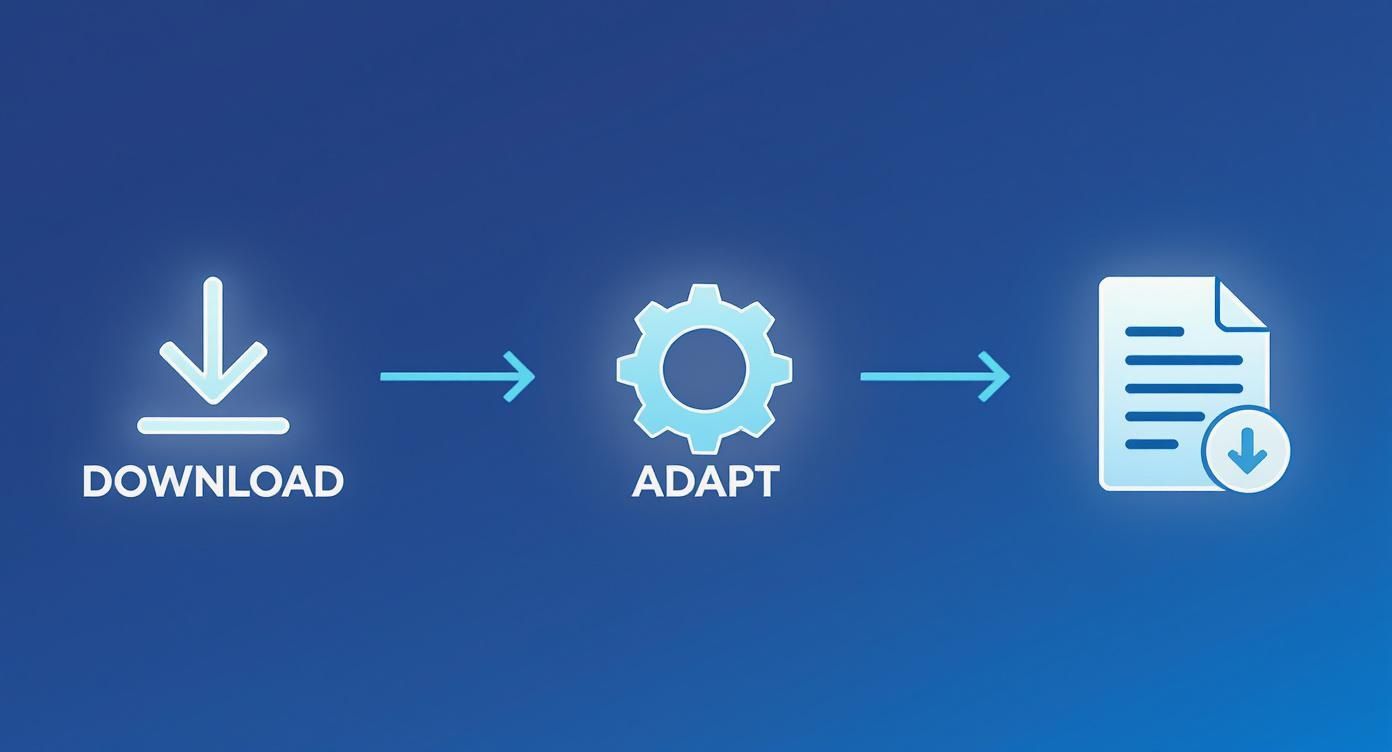
As you can see, starting with a solid template makes it much easier to adapt, draft, and then manage the entire process digitally.
This direct connection ensures your billing is spot on, heading off many common causes of payment disputes before they even start. Instead of arguing over what was or wasn't in scope, the SOW becomes the single source of truth that your timesheets and invoices are built on. It's not just about saving time; it's about building client trust through total transparency. For more tips on this, our guide on how do you send an invoice is a great place to start.
The Growing Need for Efficient Project Management
As projects grow in complexity, so does the need for tools that can keep everything on track. This isn't just a hunch; it's a clear trend in the Australian job market. Recent workforce surveys from KPMG and AHRI found that around 40% of Australian organisations were planning to hire more project and contract management professionals. This is a direct response to the increasing number of projects that rely on detailed SOWs to succeed. You can read more about these workforce trends shaping Australian businesses in the full report.
Bringing your SOWs, time tracking, and invoicing together in one place does more than just save you time. It helps you build a more professional, reliable, and scalable business, one that allows you to focus on doing brilliant work instead of drowning in paperwork.
Got Questions About SOWs? We've Got Answers.
Even after you've got the basics down, a few practical questions always seem to pop up. Let's tackle some of the most common ones we hear from Australian freelancers and agencies, so you can move forward with confidence.
What’s the Difference Between an SOW and a Contract?
Think of it like this: the contract is the house, and the SOW is the detailed blueprint for the kitchen renovation you're about to start.
A contract, or Master Services Agreement, sets up the entire legal relationship. It covers the big picture stuff: confidentiality, liability, payment terms, and how you’ll handle disagreements. The Statement of Work (SOW), on the other hand, zooms in on a single project. It details the what, when, and how of that specific piece of work. In Australia, the SOW is usually attached to the main contract, making it a legally binding part of your agreement.
Can We Change the SOW After It's Been Signed?
Absolutely, but there’s a proper way to do it. Projects are living things; priorities shift, and new ideas emerge. The key is to manage these changes formally. You can't just decide to add a new feature over a quick phone call.
Any change to the scope, timeline, or cost needs to be officially documented in what’s called a "change order" or an "addendum".
Don't see a change order as a failure. It's actually a sign of a well-managed project. It keeps everything transparent and makes sure both sides agree to the new plan, protecting everyone from dreaded scope creep.
This new document has to be signed off by both you and your client. This simple step ensures everyone is on the same page and maintains the integrity of the original statement of work.
Who Actually Writes the SOW?
Usually, the person doing the work, the freelancer or the agency, takes the first stab at drafting the SOW. It just makes sense. You're the expert on what it takes to get the job done, the specific tasks involved, and how long it will realistically take.
But it should never be a solo effort. Writing a great statement of work is a team sport. Your client brings the vision and the business goals; you translate that into a clear, actionable plan. Both of you need to review it, tweak it, and agree on the final version. That way, you’re not just signing a document; you’re confirming a shared understanding of the path ahead.
Ready to stop juggling documents and start streamlining your projects? Payly combines SOWs, e-signatures, time tracking, and invoicing into one powerful platform for Australian businesses. See how much time you could save and start your free trial with Payly today.
Payly Team
Sharing insights and strategies to help service businesses thrive. Follow Payly for more tips on time tracking, invoicing, and business operations.
Related Articles



Ready to streamline your business?
Join thousands of freelancers and agencies who use Payly to track time, send invoices, and get paid faster.