
A Guide to the Essential Elements of Contract Law
Understand the essential elements of contract law in Australia. Our guide demystifies offer, acceptance, and consideration for freelancers and small businesses.
Payly Team
February 8, 2026
If you're an Australian freelancer or run a small agency, getting your head around the essentials of contract law isn't just for lawyers; it's the bedrock of your business. These core elements are what transform a simple handshake or a "yep, sounds good" into an agreement the law will actually back up. It's your best defence against disputes and the key to making sure you get paid.
The 6 Core Elements of a Legally Binding Contract
Think of a contract like a recipe for a cake. You need all the right ingredients in the right amounts for it to work. If you forget the flour or the eggs, you don't get a cake; you get a mess. Contract law is exactly the same. Miss one of these core elements, and your agreement could fall apart when you need it most.
From the first quote you send to the final invoice, each element plays a crucial part. They make sure everyone is on the same page, the deal is fair, and both sides understand this is a serious, legally-binding commitment. Once you nail these concepts, you can draft quotes, work orders, and engagement letters that truly protect you.
To be considered valid and enforceable in Australia, a contract needs to have these six ingredients.
1. Offer
This is the starting point: a clear, definite proposal made by one person to another. It's not just a casual chat; it has to be specific enough that the other person knows exactly what they're agreeing to. For a freelance designer, an offer would be a detailed quote outlining a website redesign for $5,000, including three rounds of revisions and a specific delivery date. It's a straight-up "Here is what I will do for you, and here is what it will cost."
2. Acceptance
Acceptance is the clear, unconditional "yes" to that offer. It has to mirror the offer's terms exactly. If the client replies, "I accept, but can you do it for $4,500 instead?" that's not an acceptance. That's a counter-offer, and it essentially voids the original proposal. A true acceptance would be a simple email back saying, "Yes, we agree to the $5,000 price and the terms outlined. Let's proceed."
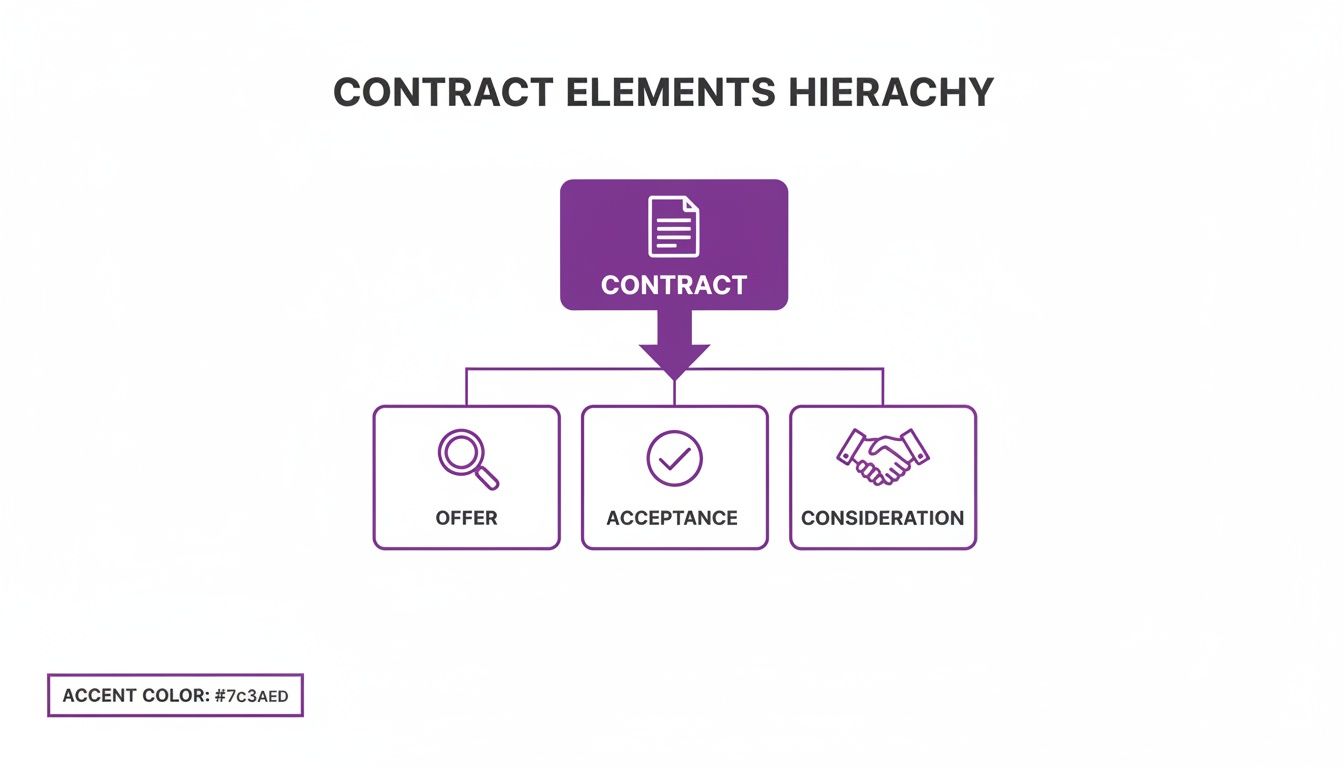
This diagram shows how the offer, the acceptance of that offer, and the consideration from both sides are the absolute pillars of any agreement.
3. Consideration
This is what each party gives up or provides: the "value" exchanged. It can't be a one-sided gift. In law, they call this the "price of the promise." For a freelancer, your consideration is the service you provide (e.g., writing 10 blog posts). The client’s consideration is the money they pay you for that service. Both sides have to bring something of value to the table.
4. Intention to Create Legal Relations
This one sounds a bit formal, but it’s simple: both parties must intend for the agreement to be legally serious. An offer to help a mate move house in exchange for a case of beer probably doesn't count, as it’s a social arrangement. But when a marketing agency signs an engagement letter with a client, the law presumes they both intend for that agreement to be enforceable in court if something goes wrong.
It’s about context. Business dealings are assumed to have this intention, while social or domestic agreements generally are not.
5. Capacity
Everyone involved must have the legal ability, or 'capacity', to enter into a contract. This means they must be of sound mind, of legal age (usually 18), and not under the influence of drugs or alcohol to the point where they can't understand what they're doing. A contract signed with a minor or someone deemed mentally incapable would likely be voidable.
6. Legality
You can't have a contract for something illegal. The purpose and terms of the agreement must be lawful. For example, a contract to hack a competitor's website would be void from the start because its very purpose breaks the law. The agreement has to be for a legal product or service.
Here's a quick summary of how these pieces fit together.
The 6 Core Elements of a Legally Binding Contract
| Element | Description | Example for a Freelancer |
|---|---|---|
| Offer | A clear proposal with specific terms from one party to another. | Sending a quote to a client for "5,000-word SEO article for $750, due in 10 business days." |
| Acceptance | Unconditional agreement to all terms of the original offer. | The client replies via email: "The quote for the article is approved. Please send the invoice." |
| Consideration | The value (money, services, goods) that each party exchanges. | You provide the finished article (your consideration); the client pays you $750 (their consideration). |
| Intention to Create Legal Relations | A mutual understanding that the agreement is serious and legally enforceable. | A signed client engagement letter for a 12-month social media management retainer. |
| Capacity | The legal ability of all parties to understand and enter into the contract. | Both the freelancer and the client representative are over 18 and of sound mind. |
| Legality | The purpose of the agreement must be lawful and not against public policy. | A contract to design a new e-commerce website, which is a perfectly legal business activity. |
Getting these six elements right ensures your agreement is more than just a promise; it’s a legally sound contract that protects your business.
While these elements form the basis of a formal contract, they often follow less formal discussions. You can explore how a memorandum of understanding template helps outline terms before you're ready to lock in a final, binding agreement. We’ll dive deeper into each of these critical components in the sections to come.
Understanding Offer and Acceptance
At its core, every contract begins with a conversation. It's a dance of negotiation where one person puts a deal on the table and the other agrees to it. This fundamental first step is known in contract law as offer and acceptance, and it’s the point where a casual chat about a project becomes a real, legally recognised agreement.
An offer isn't just a suggestion; it's a clear, direct proposal to be legally bound by certain terms. It needs to be specific enough that there’s no room for confusion. Think of it less like a price list on your website and more like a detailed blueprint for a job.

For instance, those service packages displayed on your site? That's not a legal offer. It's what lawyers call an "invitation to treat," which means you're essentially inviting potential clients to come to you with an offer to buy.
A genuine offer is the formal quote you send to a specific client. It spells out the exact scope, timeline, deliverables, and cost. It’s a definite promise: "I will do this specific work for this specific price."
The Anatomy of a Valid Offer
For your proposal to hold up as a legally binding offer, it has to show you're ready to be locked in if the other person says yes. A solid offer from a freelancer or agency should always nail down these details:
- Specific Services: Be crystal clear about what's included. For example, "one 5,000-word blog post, optimised for the keyword 'small business accounting'."
- A Clear Price: No vague figures. State the exact cost, like "$850 + GST," so there's no financial confusion later.
- Defined Timeline: Pin down a completion date or map out the key project milestones.
Getting this level of detail right is what makes your proposal a professional offer, not just a rough estimate.
What Counts as Acceptance
Once your clear-cut offer is on the table, the ball is in the client's court. The next piece of the puzzle is acceptance. This is their unconditional "yes" to all the terms you've proposed. It has to mirror your offer exactly.
Acceptance can come in many forms, from a simple "Approved, let's go!" in an email to a formal signature on a digital document. It’s worth knowing that under Australian law, electronic signatures are generally just as valid as the old-fashioned ink-on-paper kind, so long as everyone agrees to use them.
But here’s where things can get tricky: the dreaded counter-offer. If a client replies, "We love the quote, but can you throw in social media graphics for the same price?" they haven't actually accepted your offer. They've rejected it and made a new one.
At that point, your original proposal is dead and buried. Now it's up to you to accept their new terms. This negotiation can go back and forth until one person gives an unconditional "yes" to a specific offer, finally achieving what the law calls a "meeting of the minds."
The Value Exchange: Consideration and Intention
Once you’ve got an offer and acceptance on the table, a contract needs two more things to give it real legal teeth: consideration and intention. These are the elements that lift an agreement from a casual promise to a professional, legally binding commitment. They prove the deal is a serious, two-way street, not just a one-sided favour.

This is where the actual value of your contract is defined and its seriousness is locked in.
What Is Consideration in Contract Law?
Think of consideration as the quid pro quo: what each person brings to the deal. For a contract to be valid, something of value has to flow in both directions. It’s often called the "price of the promise" because it’s what each party gives up to get what they want.
This value isn't always cold, hard cash. While a client paying your invoice is the most obvious example of consideration, it can take many forms:
- A service: The actual work you do as a freelancer, like designing a logo or writing copy.
- A product: The tangible goods you deliver, whether it’s a physical item or a digital file.
- A promise to act: Committing to do something specific down the line.
- A promise not to act: This one's a bit different. It means agreeing not to do something you have a legal right to do, which is known as forbearance.
The crucial point is that both sides must provide something. If you offer to build a website for a client for free and they give nothing in return, there’s no consideration from their side. That means there’s no enforceable contract. For those interested in the history behind this, the principles from the landmark case of Tweddle v Atkinson offer some fantastic background on how these rules developed.
The Intention to Create Legal Relations
Next up is the intention to create legal relations. This sounds a bit formal, but it just means both parties get that their arrangement is a serious business deal, one that could, if things go south, be enforced by a court. It’s what separates a professional contract from a casual chat over coffee.
In Australian law, there’s an important starting point: courts presume that commercial or business agreements are intended to be legally binding. On the flip side, social or domestic arrangements, like promising a mate you’ll help them move in exchange for pizza, are presumed not to be.
This is a really important distinction for freelancers, especially if you end up doing work for friends or family. A casual, "Don't worry, I'll sort out your website for you" might not stand up if a disagreement pops up later.
To avoid any doubt, always formalise the arrangement, even with people you trust. A clear, written agreement makes it crystal clear that both sides intend to treat the deal as a professional, legally significant one. Using a formal document like a Statement of Work is a great way to nail down this intention and protect everyone involved.
Ensuring Your Contract Is Enforceable
Even after you've nailed down the offer, acceptance, and consideration, there are a couple of final hurdles your agreement needs to clear. Think of capacity and legality as the final checks before you sign on the dotted line. They're the safeguards that make sure your agreement isn't just a piece of paper, but a genuinely enforceable deal if things go sideways.
Skipping this final bit of due diligence is a big risk. You could have a perfectly drafted agreement that turns out to be completely void, leaving your business high and dry.
Who Has the Legal Capacity to Contract?
So, what is capacity? In simple terms, it’s a person's legal ability to be held to a promise. For a contract to stick, everyone involved has to actually understand what they're signing up for and the consequences of that commitment. It’s a commonsense principle designed to protect vulnerable people from being railroaded into deals they don’t fully grasp.
Generally, a few groups are seen as not having the full legal capacity to make a binding contract:
- Minors: In Australia, anyone under the age of 18 usually can’t be locked into a contract. There are some exceptions, of course, like contracts for essentials such as food or for employment.
- Individuals with a Mental Impairment: This applies to someone whose mental health condition or intellectual disability stops them from understanding the contract's terms and what it means for them.
- Intoxicated Persons: If someone is so drunk or high that they have no idea what they're agreeing to, the contract can often be set aside.
As a freelancer or agency owner, you just need to be sure the person you're dealing with has both the mental clarity and the proper authority to sign. If you have any doubts, it's worth double-checking, because a contract can be torn up later if one party is found to have lacked capacity.
A contract is only as strong as the parties who agree to it. Ensuring everyone involved has the legal capacity to make a binding promise is a non-negotiable step in protecting your business from future complications.
The Purpose Must Be Lawful
The last piece of the puzzle is legality. This one is pretty straightforward: a contract's purpose can't be illegal or run contrary to public policy. An agreement to do something illegal is void from the get-go. No court in the land will help you enforce it.
It might sound obvious, but this covers more than you’d think. For example, a contract for a developer to build a website promoting an illegal pyramid scheme is completely unenforceable. Similarly, an agreement that’s designed to unfairly stop someone from earning a living in their chosen field could be thrown out for being against the public interest.
At the end of the day, all your contracts have to operate within the law. Making sure your agreements have a lawful purpose is just as important as making them clear and fair. It’s a fundamental part of creating solid contracts that will actually protect you when you need them to.
To bring your agreements up to speed with modern practices, have a look at our guide on what is a digital signature and how it helps create secure, valid contracts.
Navigating Common Contract Pitfalls and Disputes
Even the most carefully crafted contract can't prevent every single disagreement. Let's be realistic, misunderstandings happen. The real test is being prepared for them. Knowing the common tripwires and how to handle disputes when they crop up can save you from a world of financial pain and protect the client relationships you’ve worked so hard to build.
Most contract disputes don’t start with a bang. They begin with a simple oversight that slowly snowballs into a major headache.
One of the biggest culprits? Vague language. Phrases like "ongoing support" or "a few revisions" are recipes for disaster because they mean something different to everyone. This kind of ambiguity is the classic breeding ground for scope creep, that sinking feeling when a project keeps expanding well beyond what you originally agreed to, leaving you working for free.
Another classic mistake is relying on a handshake deal. While a verbal agreement can sometimes be legally binding in Australia, proving what was actually said and agreed upon when things go sour is an absolute nightmare. A simple rule of thumb: if it’s not in writing, it didn’t happen.
Common Mistakes to Avoid in Your Contracts
To keep your business protected, make sure you sidestep these all-too-common blunders:
- Failing to Define Scope: Get granular. List every single deliverable, set firm timelines, and specify the exact number of revision rounds included. A rock-solid scope of work is your best shield against scope creep.
- Unclear Payment Terms: Don't be shy about money. State your exact fees, outline the payment schedule (e.g., 50% upfront, 50% on completion), and detail what happens if a payment is late. Leave no room for confusion here.
- No Termination Clause: Every good contract needs an exit strategy. Your agreement should clearly explain how either you or the client can end the relationship and what the consequences are, like payment for all work completed up to that point.
When a disagreement does flare up, it’s easy to think your only option is to lawyer up and head to court. But honestly, litigation is often a slow, eye-wateringly expensive process that can burn bridges for good. Thankfully, there’s a much smarter way.
Resolving Conflicts Without Going to Court
For most small businesses, the best approach is Alternative Dispute Resolution (ADR). This is just a formal way of saying you'll try to sort things out using methods like mediation or arbitration instead of slugging it out in a courtroom. These processes are almost always faster, cheaper, and far less confrontational.
Alternative Dispute Resolution isn’t about avoiding conflict, but about managing it constructively. For small businesses, it offers a pragmatic way to resolve issues while preserving valuable client relationships and protecting the bottom line.
There’s a reason ADR is becoming more popular in Australia. As court costs and delays continue to climb, businesses are looking for more practical solutions. Contract disputes are a huge driver of this shift. By simply adding an ADR clause to your contracts, you’re creating a clear, pre-agreed roadmap for working through problems if they arise.
Once a contract is signed, you also need to know your rights if the other party doesn’t hold up their end of the bargain. Understanding the available breach of contract remedies is crucial. This is where ADR really shines. Mediation, for example, brings in a neutral third party to help you and your client talk things through and find a solution you can both live with. It’s a collaborative approach that often leads to a better outcome for everyone and keeps the professional relationship intact.
How Unfair Contract Terms Protect Small Businesses
You’ve nailed the essential elements of contract law, but what happens when a big client slides a lopsided clause into their standard agreement? For a long time, small businesses were left with little choice but to sign on the dotted line. Thankfully, Australian law has stepped in to level the playing field.

This major shift came about in 2023 when Australia’s unfair contract terms (UCT) regime was expanded. Now, it protects small businesses with fewer than 100 employees or an annual turnover under A$10 million. The Australian Competition and Consumer Commission (ACCC) is making UCT enforcement a key priority, so this is a game-changer for freelancers and small agencies. You can dig into a deeper analysis of these changes and their industry impact to see just how seriously this is being taken.
What Makes a Contract Term Unfair?
So, what exactly does 'unfair' mean in the eyes of the law? A term in a contract is generally considered unfair if it ticks three specific boxes. Getting your head around these will help you spot red flags before you sign anything.
A court will likely call a term unfair if it:
- Causes a significant imbalance in the rights and obligations between you and your client.
- Isn't reasonably necessary to protect the legitimate interests of the party who benefits from it (usually the bigger business).
- Would cause detriment (financial or otherwise) to your small business if they tried to enforce it.
Think of it as a basic fairness test. If a clause stacks the deck heavily in the client's favour for no good reason and puts you at a disadvantage, it’s probably an unfair contract term.
An unfair term in a standard form contract is automatically void. That means it’s treated as if it never existed. The rest of the contract remains binding, as long as it can function without that dodgy clause.
Real-World Examples for Freelancers
These protections aren't just legal theory; they have a real impact on the contracts you see every day.
Let’s say a client gives you an agreement with a clause allowing them to unilaterally change the project scope whenever they want, without adjusting your fee. That’s a classic example of an unfair term.
It creates a massive imbalance, it isn't reasonably necessary to protect them, and it would obviously cause you financial harm by forcing you to do unpaid work. Under the UCT laws, that kind of clause would almost certainly be struck down as unenforceable.
Other common examples of potentially unfair terms include clauses that:
- Allow one party (but not the other) to terminate the contract for any reason.
- Unreasonably limit a party’s liability if they breach the contract.
- Impose massive penalties for a minor mistake or delay.
Knowing these protections exist gives you the confidence to push back on unreasonable terms. The law is on your side to help you secure a fair deal.
Your Top Contract Law Questions Answered
When you're running a freelance business or an agency in Australia, you're bound to run into a few curly questions about your contracts. Getting your head around these common sticking points is the best way to make sure your agreements are solid and will actually protect you when you need them to.
Let's dive into some of the most pressing questions we get asked all the time.
Is a Handshake Deal or Verbal Agreement Enforceable in Australia?
Yes, technically it can be. A verbal agreement can be just as legally binding as a written one, as long as all the essential ingredients of a contract, like an offer, acceptance, and an exchange of value, are present.
The massive problem, however, is proving what you actually agreed on if things go south. Memories fade, people misremember, and what you thought was crystal clear becomes a messy "he said, she said" dispute. This is why putting everything in writing is always the smarter move. It provides a clear, undeniable record of the scope, payment terms, and deliverables.
Are Electronic Signatures Legit on Australian Contracts?
Absolutely. Thanks to the Electronic Transactions Act 1999 and similar state laws, electronic signatures carry the same weight as their ink-on-paper counterparts. Your digital handshake is legally sound.
There are just a couple of conditions to meet for an e-signature to be valid:
- Everyone involved must agree to sign electronically.
- The method you use has to reliably identify the person signing and show they intended to be bound by the agreement.
What's the First Step if a Client Breaks Our Contract?
If a client isn't holding up their end of the bargain, your first move shouldn't be to call a lawyer. Start with clear, professional communication.
Drop them an email that calmly points out the specific breach and references the exact clause in your contract they've overlooked. Often, this is enough to get things back on track. If that doesn't work, a more formal letter of demand is the next logical step. And if you're still at a standstill, consider mediation. It's usually a much faster and cheaper way to resolve a dispute than heading straight to court.
Tired of juggling different tools for your contracts, invoices, and time tracking? Payly brings it all together. Our platform gives you legally binding e-signatures, simple invoicing, and easy time tracking, helping you manage your business and get paid without the headache. See how easy it can be with a free 14-day trial.
Payly Team
Sharing insights and strategies to help service businesses thrive. Follow Payly for more tips on time tracking, invoicing, and business operations.
Related Articles
Ready to streamline your business?
Join thousands of freelancers and agencies who use Payly to track time, send invoices, and get paid faster.