
Decoding the Hours in a Work Week in Australia
Master the hours in a work week in Australia. Our guide covers overtime, billable hours, and smart time tracking to ensure you're paid for every minute.
Payly Team
February 6, 2026

If you ask most Australians what a standard work week looks like, they'll probably tell you it's 38 hours. And they're right, at least on paper. This number is set by the National Employment Standards (NES) and forms the backbone of full-time employment down under. But for freelancers, agency owners, and many others, the reality is often a lot more complicated.
What is a Standard Work Week in Australia?

The 38-hour week is the official benchmark in Australia. It’s the number that influences everything from award pay rates to how much annual leave you get. Think of it as the default setting for a full-time job.
Of course, how those hours are actually worked can vary. Many industry awards or enterprise agreements allow for flexible arrangements, like working slightly longer days to get a nine-day fortnight.
For anyone running a service-based business, getting your head around this number is the first step. It's the baseline you need to quote projects accurately, figure out your team's capacity, and most importantly, stay on the right side of the law.
How Your Job Type Changes the Hours
That 38-hour rule really only applies cleanly to full-time, permanent staff. The picture changes completely for part-time and casual workers.
- Full-Time Employees: These are your classic 38-hour-a-week workers. They have a consistent schedule and get the full suite of benefits, like sick leave and paid holidays.
- Part-Time Employees: They work fewer than 38 hours each week, but their hours are regular and predictable. Their leave and other entitlements are calculated ‘pro-rata’, meaning they get a portion of the full-time benefits based on how many hours they work.
- Casual Employees: Casuals have no guaranteed hours and are brought in as needed. To make up for the lack of job security and paid leave, they're paid a higher hourly rate, which is called a casual loading.
To give you a clearer picture, here’s a quick breakdown of how these roles stack up against the national standard.
Standard Australian Work Week at a Glance
| Employment Type | Standard Weekly Hours (NES) | Common Variations |
|---|---|---|
| Full-Time | 38 hours | Flexible hours, compressed weeks (e.g., nine-day fortnight) as per award/agreement. |
| Part-Time | Less than 38 hours | Fixed, regular hours. Entitlements are calculated on a pro-rata basis. |
| Casual | No guaranteed hours | Irregular and unpredictable schedule. Paid a higher hourly rate (casual loading). |
As you can see, each employment type comes with its own set of rules and expectations.
Getting these definitions right isn't just about ticking compliance boxes. It's fundamental to managing your costs, keeping your business agile, and building a team you can rely on.
This is why it's so important for business owners to know the rules. It ensures you're tracking employee time correctly and paying everyone what they're owed.
The Real Story of Australian Work Habits
While the 38-hour week has been the standard for decades, what's actually happening in workplaces tells a different story. The big trend in Australia has been a steady drop in the average hours each person works. This isn't because we're all slacking off; it's because part-time work has exploded.
Today, the average Aussie works around 32.14 hours a week. That’s a fair bit less than the official 38-hour standard. This shift makes sense when you see that nearly a third of the workforce (31%) is now part-time, a huge jump from just 10% back in 1970. You can dig into more of this data over at IBISWorld. This changing reality makes having flexible and accurate time management tools more important than ever.
Navigating Overtime and What Counts as ‘Reasonable’ Extra Hours
Australia's 38-hour work week is the official standard, but let's be realistic: many projects and roles demand more. The Fair Work Act acknowledges this reality by allowing employers to request 'reasonable additional hours'. This is where things can get a bit blurry, whether you're a full-time employee, a freelancer managing client expectations, or an agency owner trying to meet a deadline.
The term 'reasonable additional hours' isn't just a casual suggestion; it's a legal concept. What feels reasonable to one person might seem completely over the top to another. That’s why the law doesn't use a rigid, one-size-fits-all number. Instead, it looks at the entire situation to find a fair middle ground.
Striking this balance is crucial. For an agency, pulling a few extra hours might be essential to nail a tight project deadline. For a freelancer, a client's last-minute request could mean working late into the evening. Understanding when these demands are justified is key to maintaining good working relationships and, just as importantly, avoiding burnout.
What Makes Additional Hours Reasonable?
So, how do you figure out if extra hours are genuinely 'reasonable'? It's not just about what the business needs. The Fair Work Ombudsman and Australian courts look at a handful of factors to weigh up the impact on the individual.
Here’s what they consider:
- Health and Safety: Are the extra hours causing fatigue or putting the person's physical or mental wellbeing at risk?
- Personal Life: Does the employee have other commitments, like caring for a child or an elderly parent?
- Business Needs: Is the work genuinely critical for the business to operate, like during a major product launch?
- Getting Paid for It: Is the employee being compensated with overtime pay, penalty rates, or some other benefit for their time?
- A Heads-Up: Was the employee given enough notice that they’d need to work late, or was it sprung on them at the last minute?
Thinking through these points gives you a solid framework. For example, asking someone to stay back an extra hour with plenty of notice is a world away from demanding they give up their entire weekend without any warning.
Calculating Overtime Pay Rates
When extra hours are worked, they usually attract higher pay rates set out in an industry award or enterprise agreement. This is designed to properly compensate people for working outside their normal schedule. While the exact numbers can vary, here’s a common structure for full-time and part-time staff:
- First two or three hours of overtime: Typically paid at 150% of the normal hourly rate (time and a half).
- Any hours after that: The rate usually jumps to 200% (double time).
- Sundays and Public Holidays: Often paid at even higher rates, sometimes reaching 250%.
These principles are just as relevant for freelancers and agencies. If you're quoting for a project that you know will involve weekend or after-hours work, it’s standard practice to factor in a higher rate for that time. It ensures you’re fairly paid for the extra push and helps manage your client's expectations right from the get-go.
The Unpaid Overtime Trap
One of the biggest issues in the Australian workplace is unpaid overtime. It’s the hidden cost that quietly piles up when extra hours are worked without any extra pay. Research shows that Australian workers contribute an average of 6.0 hours of unpaid labour every single week. That adds up to a staggering 312 uncompensated hours per person each year. If you do the maths, that’s like working for more than eight weeks for free. You can read more in the full report on excessive work hours.
Understanding the difference between reasonable additional work and unpaid labour is vital. One is a compensated, agreed-upon extension of your duties; the other is a drain on your resources and wellbeing.
The best way to avoid this trap is through clear communication and solid systems. The first step is to accurately track every minute worked to ensure it's all accounted for and paid. If you’re looking for ways to improve transparency, our guide on how an employee time clock system can help is a great place to start. By setting clear boundaries and tracking your time diligently, you can protect yourself, your business, and your team from the financial and personal costs of uncompensated work.
How Australian Work Hours Compare Globally
So, you've got a handle on Australia's standard 38-hour week. That's a great start, but it’s just one piece of a much larger puzzle. To really understand our work culture, you have to see how it stacks up against the rest of the world, especially if you're a freelancer or agency with international clients. The "standard" number of hours in a work week can be wildly different from one country to another.
Australia’s model often sits in a comfortable middle ground. We seem to value work-life balance a bit more seriously than some countries, but we're perhaps not as progressive as others. It's this balance that can be both a strength and a point of friction when working across borders.
Think about it: if you're collaborating with a team in Paris, their entire approach to the workday might feel foreign. Getting your head around these differences isn't just a "nice-to-have", it's essential for smooth project management and setting deadlines that don't cause a diplomatic incident.
The European Approach to Work Life
Many European nations have led the charge on shorter work weeks, putting a real emphasis on employee wellbeing and personal time. France is the classic example, with its legally mandated 35-hour work week. While the reality on the ground can be more complex, the cultural mindset is definitely geared towards getting the job done efficiently within the contracted hours.
Scandinavia is another great example. Countries there often champion shorter workdays and flexible schedules, focusing on productivity, not just time spent at a desk. This means that a last-minute, after-hours request from an Aussie partner might not land so well. It’s a culture that respects planning and personal boundaries, so you need to adapt your approach.
The United States and its 40-Hour Standard
Over in the United States, the 40-hour work week is the long-standing norm. It’s been the standard since the 1940s and is baked into the American work psyche. The big difference, however, is that the US has fewer federal protections around working hours. A culture of long hours and unpaid overtime is common, especially for salaried professionals.
This can set up a major clash of expectations. An American client might be used to people being available late into the evening, which can be a shock to an Australian team that clocks off at a reasonable hour. The key here is clear communication. You need to set boundaries around your team’s availability and typical turnaround times right from the start.
Work Cultures in East Asia
Head over to East Asia, and you’ll find work cultures known for their incredibly long hours, often driven by intense competition. While there’s a growing push for reform, stories of people working well beyond the standard week are still common in places like Japan and South Korea, where long hours are often seen as a sign of dedication.
The concept of "long hours working," often defined as 50 or more hours per week, really highlights these global differences. It shows how cultural norms directly shape the standard hours in a work week.
Interestingly, while a fair chunk of Australians still work long hours, the trend is heading downwards. Today, around 16% of Australians work 50 or more hours a week, a drop from 19% back in 2001. That’s a world away from a country like South Korea, where nearly 40% of men and over 30% of women have reported working 54 or more hours per week. If you're curious, you can dig into more of these international work-hour comparisons on UniMelb.
All this data paints a clear picture: Australia’s approach offers a unique equilibrium, blending a solid work ethic with an increasing focus on making work sustainable for the long haul.
To make it easier to see these differences at a glance, here’s a quick breakdown of how work weeks look in a few key regions.
Global Work Week Comparison
| Country/Region | Standard Work Week | Common Overtime Culture | Key Considerations |
|---|---|---|---|
| Australia | 38 hours (as per the National Employment Standards) | Overtime is regulated and typically paid. "Reasonable" extra hours can be requested. | Strong legal protections for employees and a growing emphasis on work-life balance. |
| European Union | Varies; 35-40 hours. France is 35, Germany is typically 35-40. | Highly regulated. Overtime is often discouraged or compensated with time off. | Strong cultural value placed on personal time. After-hours contact is often frowned upon. |
| United States | 40 hours is the standard benchmark. | Very common, especially in salaried roles. Often unpaid for "exempt" employees. | "Always on" culture in many industries. Expectations for availability can be high. |
| United Kingdom | 35-40 hours is typical. Legally capped at 48 hours on average. | Common but generally paid or compensated. The "opt-out" clause is a unique feature. | A middle ground between US and European norms, but a "long hours" culture persists in some sectors like finance. |
| East Asia | Varies. Japan and South Korea have high averages, often 40+ hours. | Deeply ingrained. Historically, long hours were seen as a sign of loyalty and commitment. | While reforms are underway, cultural expectations for dedication can mean very long days. |
This table isn't exhaustive, of course, but it gives you a good feel for the different cultural expectations you might encounter. Being aware of these norms is the first step to building successful and respectful working relationships with clients and partners around the world.
Turning Your Hard Work Into Paid Work: Billable vs. Worked Hours
Knowing the standard hours in a work week is one thing, but for anyone running a service business, the real game is converting that time into actual income. This is where you absolutely have to get your head around the difference between worked hours and billable hours. They are not the same thing, and confusing the two is a fast track to being busy but broke.
Think about a typical day running a small digital agency. You're juggling a dozen different things. The time you spend designing a client's new logo, writing copy for their social media campaign, or jumping on a scheduled call to discuss project milestones is clearly billable. It’s direct, hands-on work that delivers the value they’re paying you for.
But what about the hour you spent in an internal meeting brainstorming a new service? Or the time you lost wrestling with your accounting software and chasing up an overdue invoice? Those tasks are crucial for keeping your business running, but they’re not billable. This is your non-billable overhead.
What’s Billable vs. What’s Just the Cost of Business?
If you don't draw a sharp line between these two categories, you’re basically giving away your time and killing your profit margins. A sustainable business needs a rock-solid policy that spells out what gets put on the invoice and what’s simply part of the cost of keeping the lights on.
Let's stick with our digital agency example to make it crystal clear:
Examples of Billable Time:
- Project Execution: The hands-on stuff like designing, coding, writing, or building anything for a specific client.
- Client Comms: Scheduled calls, project update emails, and video meetings.
- Revisions & Feedback: Making changes to your work based on what the client has asked for.
- Dedicated Project Management: Time spent organising the moving parts of one particular client's project.
Examples of Non-Billable Time:
- Business Development: Time spent on calls with potential clients, networking, or writing proposals.
- Internal Huddles: Your own team meetings, performance check-ins, or company-wide updates.
- Admin Work: Sending invoices, doing your books, or managing software subscriptions.
- Upskilling: Time spent on courses, webinars, or learning a new technique that isn't for a specific client project.
The point isn’t to get rid of non-billable time, that’s impossible. The goal is to track it, minimise it where you can, and ensure your billable rate is high enough to cover all that background work while still leaving a healthy profit.
Getting this right also builds huge trust with your clients. When they get an invoice that clearly itemises the valuable work you've done, it cuts down on questions and reinforces that you're a true professional. For many service-based businesses, solid virtual assistant invoicing solutions can be a lifesaver for managing this process.
The image below gives a snapshot of how Australia’s work week fits into the global picture, which is handy to keep in mind when your clients are overseas and have different expectations about time and billing.
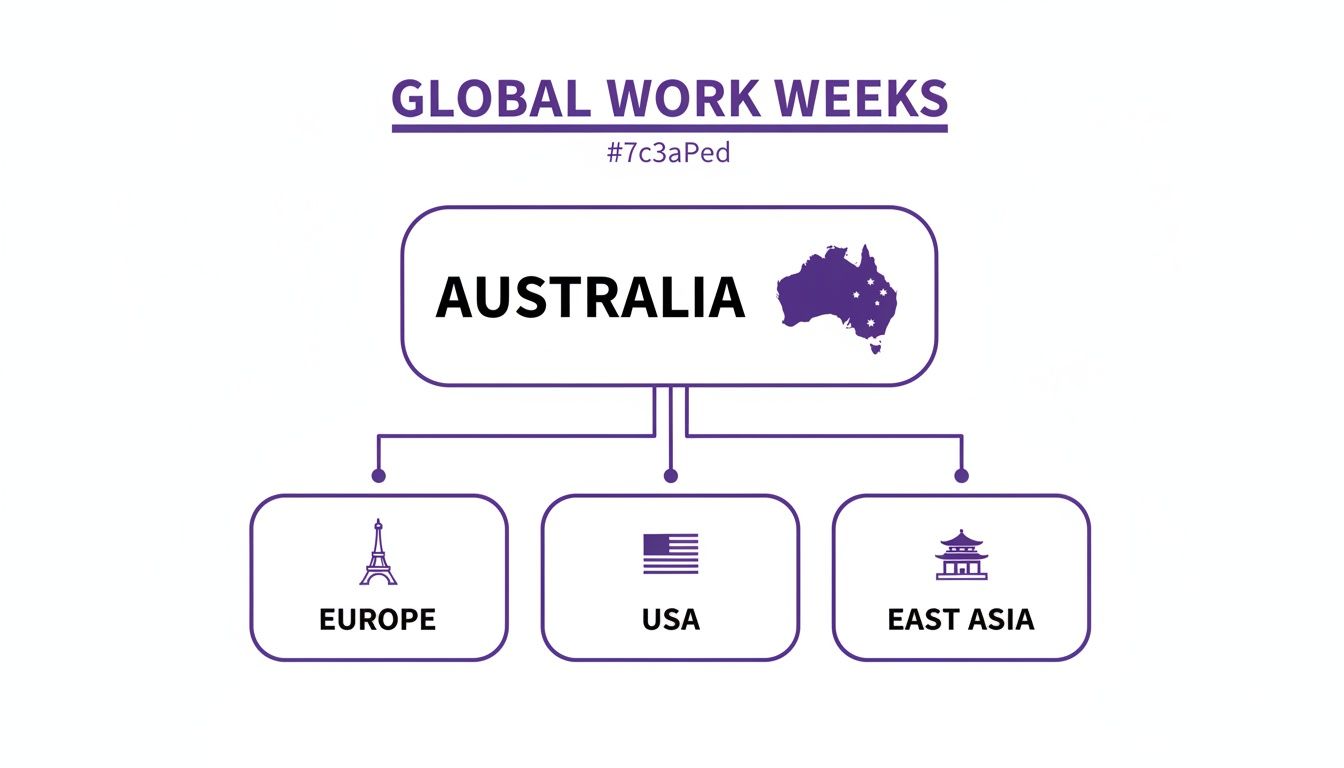
This just goes to show that Australia's 38-hour standard is fairly middle-of-the-road. With norms varying so much between Europe, the US, and Asia, having a transparent billing policy becomes even more critical for a smooth working relationship.
Common Traps That Quietly Drain Your Profits
Even with the best intentions, it's incredibly easy to let billable hours slip through the cracks. These little leaks might seem insignificant on their own, but they add up to a serious amount of lost revenue over a year. Knowing the common traps is the first step to plugging them.
One of the biggest culprits is not billing for the small stuff. That quick five-minute email you fired off, or the ten-minute call to clarify a detail? It’s tempting to just let it slide, but a few of those every day quickly become hours of unpaid work each month.
Another classic profit-killer is scope creep. This is when a project slowly grows bigger than what was originally agreed upon, but the budget doesn't. It always starts with a client asking for "just one more tiny change," and before you know it, you’ve donated an entire day's work for free. Understanding how this chips away at your bottom line becomes even clearer when you consider the total number of working weeks there are in a year.
By getting disciplined about tracking every minute and setting firm boundaries on what’s billable, you make the crucial shift from just being busy to actually being profitable. This mindset ensures you're paid for the full value of your expertise and can build a business that’s financially strong.
Why Accurate Time Tracking Is Your Business Superpower
It’s tempting to write off time tracking as just another admin headache, a necessary evil for getting invoices out the door. But that’s a huge missed opportunity. Think of it less like paperwork and more like a diagnostic dashboard for your entire business. It's the superpower that separates businesses that are just busy from those that are genuinely profitable.
When you track your time accurately, you’re doing far more than just logging the hours in a work week. You’re uncovering the true profitability of each project, shining a light on workflows that are eating up time, and gathering the hard data you need to quote future work with confidence. Without it, you’re essentially flying blind and making critical business decisions based on guesswork.

This kind of detail turns a messy spreadsheet into a clear, integrated system. It fuels smarter decisions and helps you finally regain control over your most valuable asset: your time.
From Busy And Broke To Profitable And In Control
Take the classic story of a freelance graphic designer. Her calendar was always packed, and she was putting in massive hours every week, but her bank account never seemed to reflect the effort. She was perpetually busy but felt broke, completely in the dark about where her time and money were actually going.
Fed up, she finally committed to a proper time-tracking system instead of just relying on memory and rough estimates. The results were immediate and confronting.
She discovered that those "quick five-minute revisions" for one particular client were quietly adding up to five unpaid hours every single month. Another project she thought was profitable was actually a loss-leader because she’d completely underestimated the time spent on back-and-forth client emails and calls.
Armed with this data, she made three powerful changes:
- She adjusted her pricing for new projects based on what the work actually took, not what she felt it should take.
- She set clear boundaries with clients, outlining exactly how many revisions were included in her initial quotes.
- She identified her most profitable clients and focused her energy there, while politely parting ways with the clients who drained her resources.
Within six months, she was working fewer hours but earning significantly more. Time tracking wasn't a burden; it was the tool that gave her the clarity she needed to build a sustainable business and take back control of her work-life balance.
Building Client Trust Through Transparency
Good time tracking isn't just an internal tool; it's a fantastic way to build trust and strengthen your client relationships. When you send an invoice with a detailed timesheet attached, you’re not just asking for money. You're demonstrating professionalism and giving them complete transparency into the value you’ve delivered.
This clarity often nips invoice disputes in the bud. Instead of a vague line item for "Design Services," a client can see a clear breakdown:
- 3.5 hours: Initial concept development and wireframing
- 2 hours: Client feedback and strategy call
- 6 hours: First-round design mockups
- 1.5 hours: Implementing client revisions
This level of detail doesn't just justify your fees; it reinforces the client's confidence that they made the right choice in hiring you. To translate your team's effort into fair billing, you need solid methods for quantifying their contributions. It's worth exploring resources that help you quickly calculate the hours your team worked to make sure every minute is accounted for.
Modern tools have made this process incredibly simple, freeing us from the clunky spreadsheets of the past.
Ultimately, this isn't just about logging the standard hours in a work week; it’s about understanding the real value of that time and communicating it with confidence.
Turning Your Time Into Sustainable Revenue
So, we’ve covered a lot of ground. We've broken down the standard 38-hour work week, tackled the tricky subject of overtime, and highlighted the critical split between worked hours and billable hours. Now, let’s tie it all together and connect these concepts directly to your bottom line.
After all, understanding the theory is one thing, but using it to build a profitable business is the real goal. This isn't just about logging time; it's about taking control of your most valuable asset, your time, and turning it into a reliable, predictable source of revenue.
From Trading Hours to Building Value
When you get a firm grip on your time, you start to make a crucial shift. You move away from simply swapping hours for dollars and begin building a business with genuine, long-term value. This means you can send out an invoice with total confidence, knowing that every minute of your work is tracked, justified, and accounted for.
A business that commands its time commands its future. By mastering your schedule and billing processes, you ensure you are compensated for the incredible value you provide, not just the hours you spend.
This level of professionalism does more than just secure your finances. It builds trust with your clients through complete transparency and sets a solid foundation for future growth.
Key Actions for Sustainable Growth
Ready to put this into practice? Let's move from theory to action. Focusing on a few core habits can make all the difference in creating a more resilient business.
- Establish a Clear Billing Policy: This is non-negotiable. Define exactly what’s billable and what isn’t, and get it in writing in your client agreements from day one. It’s the best defence against scope creep and ensures you’re paid for every bit of client-related work.
- Analyse Your Time Data: Your time tracking reports are a goldmine of information. Dive into them regularly. Figure out which clients and projects are actually making you money, and pinpoint the time-sinks that are draining your energy without adding to your income.
- Optimise Your Invoicing Process: Ditch the messy spreadsheets. Use professional invoicing tools to create clean, itemised invoices that clients can understand at a glance. Even better, set up automated reminders to chase late payments so you don't have to.
By putting these simple strategies into play, you’ll do more than just manage your hours more effectively. You’ll get paid faster, build stronger client relationships, and create a business that’s organised, profitable, and ready for whatever comes next.
Frequently Asked Questions
Figuring out the rules around work weeks can be tricky, so let's tackle some of the most common questions we hear from Australian freelancers, agency owners, and small businesses.
What Is the Maximum Number of Hours I Can Legally Work in a Week in Australia?
Officially, the National Employment Standards (NES) cap the standard work week at 38 hours, plus any 'reasonable additional hours'. This means there isn't a hard, fixed number for the absolute maximum you can work.
But that word 'reasonable' carries a lot of legal weight. What's considered reasonable depends on a few things: your health and safety, the business's needs, your personal situation (like family responsibilities), and whether you're being paid properly for the extra time. The key takeaway is that an employer can't just demand endless hours if it compromises your wellbeing.
As a Freelancer, Should I Track My Non-Billable Hours?
Yes, you absolutely should. I know it feels like time you can't invoice for, but tracking your admin, marketing, and proposal-writing hours is one of the smartest things you can do for your business. Think of it as gathering crucial business intelligence, not just logging time.
Here’s why it’s so important:
- Find Your True Hourly Rate: It reveals how much you're actually earning per hour once you factor in all the unpaid work that keeps the lights on.
- Spot Time Sinks: You might discover that certain admin tasks are eating up way more time than you thought, giving you a chance to find a more efficient way to get them done.
- Set Profitable Rates: Armed with this data, you can confidently set your billable rates to cover all your time and ensure you're running a profitable business.
Without tracking this time, you're essentially guessing when it comes to making major financial decisions for your business. Knowing your total time investment is fundamental to building something that lasts.
How Can I Handle a Client Who Disputes My Tracked Hours?
The best defence here is a good offence. Prevention is far better than cure, and the key is total transparency from day one. Ditch the manual spreadsheets and use a professional time-tracking tool that creates clean, detailed reports showing exactly where the time went.
When it's time to invoice, don't just send a bill. Attach the detailed timesheet that breaks down your hours by specific tasks. This simple step builds trust and shows the client exactly what they're paying for, leaving almost no room for confusion.
If a client still questions the invoice, you’re no longer in a "he said, she said" situation. You have a professional, data-backed report to walk them through, shifting the conversation from a subjective disagreement to a factual review of the work.
An even better step is to bake this into your initial contract. Include a clause that explains how you track time, what’s considered billable, and how your invoices will be presented. It sets clear expectations right from the start and heads off most of these awkward conversations before they even begin.
Ready to take control of your time and turn every billable minute into revenue? Payly combines time tracking, invoicing, e-signatures, and document management into one simple platform for Australian businesses. Stop juggling multiple apps and start streamlining your operations. Start your free 14-day trial today at Payly.
Payly Team
Sharing insights and strategies to help service businesses thrive. Follow Payly for more tips on time tracking, invoicing, and business operations.
Related Articles


Ready to streamline your business?
Join thousands of freelancers and agencies who use Payly to track time, send invoices, and get paid faster.