
Tracking Employee Time in Australia Your How To Guide
A practical guide to tracking employee time in Australia. Learn about policies, tools, and compliance to boost profitability and ensure fair work standards.
Payly Team
December 5, 2025
At its core, tracking employee time is simply the process of recording the hours your team works. But for any Australian business, it's a lot more than just a number on a timesheet. It’s about accurately documenting start times, end times, and breaks to meet your Fair Work obligations and make sure your staff are paid correctly for every hour they put in, especially overtime.
Why Tracking Employee Time Matters for Your Business
For many Australian service businesses, tracking employee time can feel like just another admin task on an already long to-do list. But moving beyond messy spreadsheets or 'she'll be right' verbal agreements isn't just a nice-to-have anymore, it's absolutely essential for your legal compliance, financial health, and team morale. Without a clear system, you're not just guessing about project costs; you're leaving your business wide open to serious risks.
Think about a small creative agency where the team often stays back late to hit a tight client deadline. If those extra hours aren't logged properly, the agency not only misses out on billing the client for all the work done, but it also risks underpaying its staff. That's a direct path to a potential Fair Work dispute. This is where precise time tracking stops being a chore and starts being a powerful business tool.
Legal and Financial Protection
The legal landscape in Australia makes meticulous record-keeping non-negotiable. Fair Work regulations are very clear: employers must keep accurate records of all hours worked, particularly any overtime beyond the standard 38-hour week. This isn't just about casual or hourly workers, either. It applies to salaried employees too, ensuring they're properly compensated or given time off in lieu (TOIL) for extra hours.
Accurate time tracking is your first line of defence against compliance headaches. It gives you undeniable proof that you're meeting your obligations under Australian employment law, protecting your business from hefty penalties and legal battles.
The Evolution of Time Tracking in Australia
The idea of structured timekeeping isn't new; the first time clocks appeared way back in 1888. But it was modern legislation that really turned it from a simple management tool into a legal requirement. A key amendment forced Australian employers to keep detailed records to ensure proper pay for overtime, which was a huge shift for businesses that had always relied on informal systems. This change cemented time tracking's role in protecting both employers and employees.
More recently, conversations around the 'right to disconnect' show how time tracking has even expanded to support employee wellbeing and work-life balance. You can get a deeper understanding of how time tracking in Australia has become a key part of fair employment standards and see the legislative shifts for yourself.
This whole journey highlights a crucial point: effective time tracking isn't about watching over your team's shoulder. It’s about building a transparent, fair, and profitable business. By accurately capturing how time is spent, you can:
- Ensure Fair Compensation: Guarantee every team member is paid correctly for every hour they work. This builds incredible trust and boosts morale.
- Improve Project Profitability: Finally understand the true cost of your projects by seeing exactly how much time they take, which leads to much more accurate quotes in the future.
- Boost Operational Efficiency: Spot bottlenecks and time-wasting tasks you didn't even know existed, helping you fine-tune your workflows and allocate people more effectively.
Choosing the Right Time Tracking Method
Deciding how you're going to track your team's time is one of those foundational decisions that can make or break your profitability down the line. It really boils down to two main camps: sticking with manual methods like spreadsheets, or investing in dedicated time tracking software. There’s no single right answer, but the best fit for your Australian service business depends entirely on its size, complexity, and where you're headed.
For a sole trader, say an electrician just starting out, a simple spreadsheet or even a paper timesheet might do the job just fine. It's straightforward and costs nothing. But the moment you start adding staff, the cracks in that manual system begin to show.
Imagine a growing IT support company trying to manually log hours against dozens of client support tickets each day. It’s not just a hassle; it’s a direct hit to your bottom line. Time gets lost, mistakes are made, and suddenly you're leaking revenue without even realising it. All those hours your team spends fixing timesheet errors or your admin spends chasing them up? That's non-billable time that eats directly into your profit.
Manual vs Automated Systems
This isn't just a question of convenience. It’s about accuracy, the ability to grow, and the insights you get from your data. Manual methods feel cheap at first, but the hidden costs of human error and administrative drag are significant. Research has shown that manual data entry can have error rates as high as 4%, a number that can seriously sting when you apply it across your entire payroll and client invoicing.
Automated software, while it comes with an upfront cost, quickly pays for itself by capturing every billable second. These platforms often plug directly into your project management and accounting software, creating a smooth, accurate flow of information that saves a massive amount of admin time. For any business with ambitions to scale, automation isn't a 'nice-to-have'; it's essential. For a deeper dive, check out our guide on time tracking best practices.
This progression from simple compliance to real business intelligence is key.
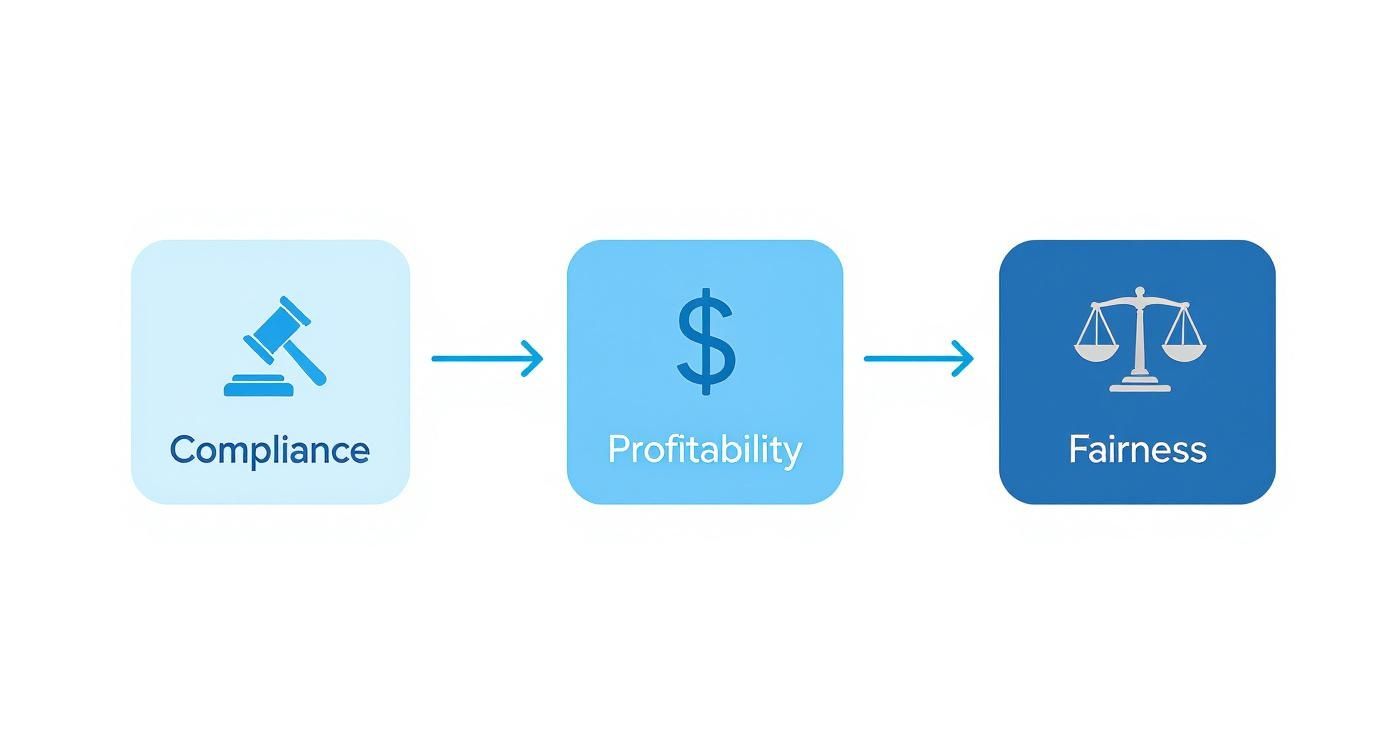
When you nail compliance, you create the foundation for profitability. Get that right, and you build a culture of fairness and transparency for your whole team.
To help you weigh the options, here's a direct comparison of what you can expect from each approach.
Comparing Manual vs Automated Time Tracking Systems
| Feature | Manual Tracking (e.g. Spreadsheets) | Automated Software |
|---|---|---|
| Accuracy | Prone to human error (typos, forgotten entries). Can lead to under-billing clients or payroll mistakes. | High accuracy with real-time tracking, timers, and GPS stamping. Minimises errors significantly. |
| Admin Time | Very time-consuming. Requires manual data entry, chasing staff for timesheets, and manual calculations. | Drastically reduces admin overhead. Timesheets are often auto-generated and approved with a click. |
| Cost | Low initial cost (free templates) but high hidden costs in lost billable hours and admin wages. | Monthly subscription fee, but delivers a high ROI through improved accuracy and efficiency. |
| Integration | None. Data must be manually transferred to payroll and invoicing systems, creating more room for error. | Seamlessly integrates with payroll (e.g., Xero, MYOB) and project management tools (e.g., Jira, Asana). |
| Reporting & Insights | Basic, if any. Getting insights on project profitability or team utilisation requires complex manual analysis. | Powerful, real-time dashboards showing billable hours, project budgets, team capacity, and profitability. |
| Compliance | Difficult to ensure compliance with Modern Awards, overtime, and break requirements without meticulous oversight. | Often has built-in award interpretation and compliance rules, simplifying adherence to Australian regulations. |
| Accessibility | Limited. Can be clumsy for remote or mobile workers to update spreadsheets accurately on the go. | Excellent for remote and field teams via mobile apps with features like geo-fencing and offline tracking. |
Ultimately, while a spreadsheet might seem like the easy choice to start, automated software is built to help you grow. It's designed to give you back time and provide the data you need to run a more profitable business.
Adapting to the Modern Australian Workforce
The push towards better systems is also being driven by huge shifts in how we work here in Australia. We’ve seen a massive move toward flexible and part-time arrangements. Forty years ago, only one in ten employees worked part-time. Today, that figure has jumped to 30.8% of the workforce.
Between 2006 and 2021 alone, part-time employment in Australia grew by a staggering 63.4%. This surge in part-time, remote, and hybrid roles makes manual time tracking a logistical nightmare.
Trying to manage varied schedules, track remote work accurately, and ensure everyone is paid correctly becomes incredibly complex with a simple spreadsheet. Automated systems are built for this reality.
So, the choice comes down to a fundamental question: do you want a system that just records time, or one that helps you manage it? For any service business serious about growth, the answer is pretty clear. The right software provides the accuracy and data needed to make smarter decisions, price your services properly, and build a far more efficient, profitable operation.
Creating a Fair and Compliant Time Tracking Policy
Putting a new time tracking system in place is a great start, but it's only half the job. To make it stick, you need a clear, fair, and legally sound time tracking policy that everyone in your team actually understands and respects. Think of this policy as your company's rulebook: it gets rid of any guesswork and sets expectations right from the beginning.
Without a formal policy, you’re basically inviting inconsistency. One manager might give a verbal thumbs-up for overtime, while another demands it in writing. This kind of confusion quickly leads to frustration, arguments, and potentially serious breaches of Australian employment laws. A solid policy ensures everyone plays by the same rules, which builds a much more transparent and fair workplace.
This document doesn't need to be a massive, complicated legal text, but it absolutely must be thorough. It should clearly explain the A-to-Z of tracking time, from how to clock in each morning to fixing a mistake on a timesheet.
What to Include in Your Policy
A strong time tracking policy is there to protect both your business and your employees. It's the official record you need to meet your obligations under Fair Work and the Australian Taxation Office (ATO). Essentially, it’s your proof that you’re paying everyone correctly for every hour they work.
To be truly effective, your policy should cover a few key areas:
- What are 'Work Hours'? Be crystal clear on your standard business hours, what officially marks the start and end of the workday, and what your expectations are around punctuality.
- How to Log Time: Spell out exactly how your team should record their hours. Do they need to use a desktop timer, a mobile app, or fill in a digital timesheet at the end of the day? The more specific, the better.
- Breaks and Meals: Outline the rules for paid and unpaid breaks. How long are they, and how should they be recorded in the system?
- Overtime Rules: This one is critical. Detail the process for getting overtime approved before the extra hours are worked. This is vital for keeping project budgets in check and staying compliant with Modern Awards.
- Fixing Mistakes: People make mistakes; it happens. Create a simple, clear process for employees to submit corrections to their timesheets and state who has the authority to approve those changes.
If you’re still using manual records, standardising your process is a brilliant first move. You can find a range of professional time sheet templates online that will help ensure you're capturing all the legally required details.
Addressing Modern Work Scenarios
Work isn't just 9-to-5 in the office anymore, and your policy needs to catch up. Fuzzy rules for remote or hybrid staff are a surefire way to cause problems down the line. It's far better to tackle these situations head-on.
For your remote team, for instance, your policy should clarify expectations around their availability during core business hours. If you offer flexible schedules, define exactly how employees should log their varied start and finish times so your records stay accurate.
A great policy is a living document. I always recommend my clients review and update it at least once a year, or whenever their business changes, to make sure it stays relevant, fair, and fully compliant with Australian law.
When all is said and done, a policy that’s been clearly communicated turns time tracking from a chore everyone dreads into a simple, professional habit. It builds a culture of accountability and trust by showing your team that the system is there to ensure fairness for everyone involved.
Introducing a Time Tracking System to Your Team
Rolling out new software is never just about the technology; it's about people. And when that software involves tracking time, things can get personal. It's easy for your team to see a new timesheet system and think it’s a sign of mistrust. That's why the secret to a smooth rollout isn't the software itself, but how you frame it.
Your job is to get ahead of the narrative. Be open, be clear, and focus on the wins for everyone involved. This isn't about surveillance. It’s about fairness and clarity. You're bringing in a tool that ensures everyone gets paid accurately for every hour they work, simplifies the whole payroll headache, and gives you the insights to plan projects better. When your team sees it as a way to improve fairness and stop workloads from spiralling out of control, they're much more likely to get on board.

Communicating the Change Effectively
A single, surprise email announcing a new system just won't cut it. You need a proper communication plan. The best approach is to kick things off in a team meeting, a place where you can explain the 'why' face-to-face (or screen-to-screen) and tackle questions on the spot.
After that initial chat, follow up with clear, written guides and resources. Make sure your communications cover these key points:
- The 'Why' Behind It All: Be straight up about the business reasons. Maybe you need to improve project quoting, ensure you're ticking all the Fair Work compliance boxes, or just make invoicing less of a guessing game.
- What's In It for Them: This is huge. Highlight the direct benefits, like getting paid with pinpoint accuracy, making leave requests simpler, or having a transparent view of project timelines.
- A Quick Rundown of How It Works: Give them a simple overview of the new daily routine without overwhelming them with technical jargon.
- Where to Get Help: Let everyone know exactly when and how they'll be trained and who their go-to person is for any questions or troubleshooting.
Addressing Team Concerns and Building Trust
This is a big deal, especially with so many teams now working in hybrid or fully remote setups. When you can't see your team in the office, time tracking can feel like a digital stand-in for a manager looking over their shoulder. The shift to remote work has completely changed the game for Australian businesses. Before 2020, working from home was a slow-growing trend, but it shot up to a peak of 40% during the pandemic. Even now, in 2024, 36.3% of Australians are still working from home, making these digital tools essential. You can learn more about the evolution of remote work in Australia and how it's shaping business.
You’re almost guaranteed to hear this: “This feels like micromanagement.” Don’t dodge it. Address it directly by explaining that the goal is insight, not oversight. The data isn't about watching them; it's about protecting them from burnout by showing you which projects are under-resourced or who's consistently overworked.
Practical, hands-on training sessions are an absolute must. Forget boring slideshows. Get everyone logged in, clicking around, and actually using the tool in a real-world scenario. You also need to foster a 'no-blame' culture from day one. Let your team know that it's okay if they forget to start a timer now and then. Show them how easy it is to fix it with a manual entry. This small gesture goes a long way in building trust and encouraging people to log their time honestly.
Bridging the Gap: Connecting Time Tracking with Payroll and Invoicing
Once you've got a reliable flow of time data coming in, this is where the real value kicks in. Time tracking stops being just a chore for keeping records and starts acting as the engine room for your business finances. The key is to directly connect your time tracking software with your payroll and invoicing platforms.
This single step can completely change the game for an Australian service business. Think about it: manually punching hours from timesheets into Xero or MYOB isn't just a drag; it’s a minefield of potential errors. One tiny slip-up can mean an employee gets underpaid or a client gets the wrong bill. Both scenarios are a fast way to erode trust and create a mountain of admin work to fix.
From Timesheets to Payments, Without the Headaches
When you automate this link, you eliminate manual data entry completely. Approved timesheets get pushed straight into your payroll system with just a few clicks. Every hour, every bit of overtime, and every leave day is calculated exactly as it should be. This isn't just about saving a few hours a week; it dramatically cuts down on payroll errors, helping you stay on the right side of Fair Work and the ATO.
The impact on your cash flow is just as significant. When it’s time to send out client invoices, the system pulls all the billable hours for a project directly into a new draft. You capture every last minute of work without having to dig through spreadsheets or chase your team for their hours. For a closer look at getting this right, you can find some great tips on streamlining your business invoicing.
A Real-World Example: A Melbourne Digital Agency
I once worked with a digital marketing agency in Melbourne that was constantly scrambling. Their project managers spent the first few days of every month piecing together hours from different spreadsheets to build client invoices. It was chaotic, and they knew they were missing billable time and delaying payments.
After we got their time tracking tool talking directly to Xero, their whole process changed overnight:
- Instant Invoicing: As soon as a project milestone was hit, the account manager could generate a detailed, accurate invoice in minutes. Every task and every logged hour was neatly itemised.
- Healthier Cash Flow: Invoices went out faster and were far more precise. Unsurprisingly, clients paid them quicker, and there were fewer questions about the charges.
- A Direct Hit to the Bottom Line: The agency found they had been under-billing by an average of 8-10%. That wasn't from big mistakes, but from all the little bits of lost time and admin errors that added up. The new system captured that lost revenue, directly boosting their profitability.
Tying time tracking directly to your financial software does more than just cut down on admin. It gives you a crystal-clear, real-time picture of your financial health, project by project.
Using Time Data to Drive Business Growth
Okay, so you've got your time tracking system running. The initial setup and administrative slog are behind you. Now comes the interesting part, turning all that raw data into smarter business decisions. This is where you move beyond simply logging hours and start analysing where that time actually goes. It’s the key to unlocking some powerful insights that can completely reshape how you quote, manage projects, and ultimately, grow your business.
Think of this data as your business's 'ground truth'. It gives you an honest, unfiltered look at where your team's most valuable resource, their time, is being invested. With this knowledge, you can finally ditch the guesswork and start managing by the numbers, making sure every project is genuinely contributing to your bottom line.

Key Metrics to Monitor
You don't need a degree in data science or a library of complex spreadsheets to get started. Honestly, you can gain a huge amount of clarity by focusing on just two critical metrics. These will give you a fantastic high-level view of your business’s health.
-
Billable Utilisation Rate: At its core, this is just the percentage of an employee's time spent on billable client work versus their total hours. The calculation is simple: divide their total billable hours by their total hours worked, then multiply by 100. For example, if one of your designers works a 38-hour week and logs 28.5 billable hours, their utilisation rate is 75%. Keeping an eye on this number is crucial for understanding team capacity and true productivity.
-
Project Profitability: This one is a game-changer. It tells you, in black and white, which jobs are making you money and which ones are secretly draining your resources. To work it out, just subtract your total project costs (and don't forget to include the cost of your team's time!) from the total revenue for that project. A job that consistently blows its time budget is a massive red flag that your quoting process might need a serious rethink.
Turning Insights into Action
Spotting trends in your time data is one thing; doing something about them is what really drives growth. When you see the same issues popping up project after project, you’ve got a clear signal that something needs to change.
The real power of tracking employee time isn't just about looking back at what happened last week. It’s about using that history to make more profitable decisions tomorrow. You're essentially turning past performance into a roadmap for future success.
Let's take a real-world example. Imagine a web development agency that, after a few months of tracking, notices a clear pattern: the "client feedback and revisions" phase consistently takes 20% more time than they've quoted. This isn't a one-off bad project; it's a systemic issue. Instead of just writing off that extra time as a cost of doing business, they can take direct action.
What could they do?
- Refine Future Quotes: They could build a larger buffer for revisions directly into their standard pricing or, even better, specify a hard limit on the number of revision rounds included in their contracts.
- Adjust Resource Allocation: On bigger projects, maybe they assign a dedicated project manager to streamline client communication, keeping feedback focused and on schedule.
- Improve Internal Processes: They might realise their initial project briefs are too vague. Creating a more detailed client onboarding process could minimise misunderstandings and slash the need for extensive changes down the line.
By making these data-informed changes, the agency isn't just plugging a financial leak. They're actively building a more sustainable, scalable, and profitable business model based on the reality of how they actually work.
Got Questions About Time Tracking in Australia? We’ve Got Answers.
Even with the best system in place, you’re bound to run into some tricky questions when you start tracking your team's time. For any Aussie service business, getting your head around the practical and legal side of things is non-negotiable. Nailing these details from the get-go means your setup will be fair, compliant, and actually useful.
Let's dive into some of the most common questions we hear from business owners just like you.
Is It Actually Legal to Track Employee Hours in Australia?
Yes, not only is it legal, but it's often a legal requirement. The Fair Work Act 2009 is crystal clear: employers must keep accurate and up-to-date records of the hours their employees work. This is the only way to prove you're correctly calculating pay, overtime, and leave.
The real key here is transparency. Your time tracking policy shouldn't feel like "big brother" is watching. It needs to clearly explain how and why you're recording hours, framing it as a tool for ensuring everyone gets paid fairly for their work.
Do We Really Need to Track Breaks?
Absolutely. You can’t skip this. Australian workplace laws are very specific about rest and meal breaks, and you need records to prove you're providing them.
For instance, most Modern Awards mandate a 30-minute unpaid meal break for anyone working more than five hours straight. If you can't show that your team took those breaks, you could find yourself in hot water with Fair Work. It’s a small detail that can become a big problem, so make sure your system logs them properly.
What About Staff on a Salary?
This is a massive point of confusion, and getting it wrong can be costly. Many business owners think salaried employees are "set and forget," but that's a dangerous assumption. Under Aussie law, all employees, including those on a fixed salary, must be paid correctly for all hours they work.
Think about it: if a salaried employee is consistently pulling 50-hour weeks, their effective hourly rate could easily dip below the minimum wage outlined in their Modern Award. Tracking their hours is the only surefire way to protect your business and prove you're meeting your obligations.
Can We Use GPS to Track Our Team in the Field?
Using GPS to track time and location is generally fine in Australia, but you have to tread very carefully around privacy. It's most acceptable when it’s directly tied to the job, like logging a technician’s travel time between client sites.
The non-negotiable part is having a rock-solid policy that tells employees exactly what's being tracked and why. You absolutely cannot track them outside of work hours. Be upfront and honest; it’s the only way to maintain trust while staying on the right side of privacy laws.
Ready to stop juggling spreadsheets and start making smarter decisions? Payly combines time tracking, invoicing, e-signatures, and document management into one simple platform designed for Australian businesses. Streamline your operations and get paid faster by visiting our website to start your free trial.
Payly Team
Sharing insights and strategies to help service businesses thrive. Follow Payly for more tips on time tracking, invoicing, and business operations.
Related Articles


Ready to streamline your business?
Join thousands of freelancers and agencies who use Payly to track time, send invoices, and get paid faster.