
A Guide to Non Disclosure Agreement Australia Template
Download our free Non Disclosure Agreement Australia template. Learn to craft a legally sound NDA with essential clauses to protect your business.
Payly Team
February 22, 2026
Got a business secret you need to keep under wraps? Your first line of defence is a solid non-disclosure agreement. This guide gives you just that: a free, ready-to-use non disclosure agreement Australia template built for local businesses, freelancers, and agencies.
Your Free Non Disclosure Agreement Template
Kicking off a new project, bringing on a contractor, or talking a potential partnership through almost always means sharing sensitive information. Before you hand over your client lists, financial projections, or that secret sauce that makes your business tick, you need a legal safeguard in place. That's exactly where a Non-Disclosure Agreement (NDA) - sometimes called a confidentiality agreement - comes in.
Think of it as a formal, legally binding pact. One side agrees to keep the other's private information locked down, no ifs or buts. This simple document is one of the most crucial tools for protecting your intellectual property and keeping your competitive advantage sharp. It creates a legal "cone of silence" around the information that matters most.

Download Your Template Now
We’ve put together a straightforward and effective non disclosure agreement Australia template so you can get protected right away. It's designed to be clear, compliant, and easy to tweak for whatever your business needs.
[Download Your Free Australian NDA Template Here]
A Quick Guide to the Template
To get you started, the table below gives you a bird's-eye view of the key sections in the template. It breaks down what each part does and why it’s so important for keeping your business information safe.
Quick Guide to Your Australian NDA Template
| Clause | What It Does | Why It Matters for Your Business |
|---|---|---|
| Parties to the Agreement | This clearly names everyone involved - individuals or companies - and labels them either the "Disclosing Party" (the one sharing info) or the "Receiving Party" (the one getting it). | Getting this right removes any doubt about who is legally on the hook. It’s the bedrock of an enforceable agreement. |
| Definition of Confidential Information | It spells out exactly what kind of information is covered. This could be anything from financial data and customer lists to trade secrets and unreleased marketing plans. | A vague definition is a classic weak spot that can make an NDA useless in court. Being specific means the other party knows precisely what they can and can’t share, which makes your position much stronger. |
| Obligations of the Receiving Party | This section details the legal duties of the person or company getting the information. It usually covers things like keeping the info secure, only using it for the agreed-upon purpose, and not passing it on. | This is the heart of the NDA. It sets the ground rules, preventing accidental leaks and giving you a clear path for legal action if someone deliberately shares your secrets. |
This non disclosure agreement Australia template is your starting point. The rest of this guide will walk you through how to customise it, understand all the key clauses, and make sure it’s a powerful shield for your valuable business secrets.
What Is an NDA and When Should You Use One?
At its heart, a non-disclosure agreement (or NDA) is a legally binding contract that establishes a confidential relationship. Think of it as putting a formal, legally enforceable ‘cone of silence’ over your business conversations. Its main purpose is to make sure sensitive information you share for a specific reason stays private and isn't passed on to anyone else without your permission.
This document legally forces the person receiving the information to keep it secret. By signing on the dotted line, they’re formally acknowledging that what you're sharing is proprietary. More importantly, they’re agreeing to face legal consequences if they break that trust. It turns a simple handshake and a promise to keep quiet into something you can actually enforce.
Unilateral vs Mutual NDAs
When you look for a non-disclosure agreement Australia template, you’ll generally find two main types. The right one for you comes down to a simple question: which way is the confidential information flowing? Getting this right is crucial.
-
Unilateral NDA (One-Way): This is the most common kind you'll come across. It’s used when only one party is sharing sensitive information. The other party (the recipient) is the one who agrees to keep it under wraps. It's a one-way street of obligation.
-
Mutual NDA (Two-Way): This is your go-to when both parties are sharing secrets with each other. It creates a two-way street of confidentiality, where both sides are equally bound to protect the information they receive.
A unilateral NDA is the perfect fit when the flow of information is lopsided. For example, if you bring on a marketing agency, you'll be handing over your sales figures, customer lists, and strategic plans. The agency isn't really sharing anything sensitive back. A unilateral NDA makes sure they are legally bound to protect your data.
On the other hand, a mutual NDA is built for collaboration. Picture two companies exploring a potential merger or joint venture. To see if the partnership makes sense, they'll both need to open their books and share financial data, trade secrets, and future plans. A mutual NDA ensures everyone's cards are protected while they're on the table.
Common Scenarios Demanding an NDA
Knowing when to pull out an NDA is just as important as knowing what it is. It's a proactive tool, not a reactive one. Using it at the right moment protects your most valuable assets before they're ever at risk.
You should definitely be thinking about an NDA in situations like these:
- Pitching to Investors: When you're trying to secure funding, you have to reveal your secret sauce, including detailed business plans, financial projections, and maybe even proprietary tech. An NDA is your safety net to stop a potential investor from walking away with your idea.
- Hiring Employees or Contractors: New team members, particularly those in senior, technical, or strategic roles, will need access to trade secrets, client databases, or internal systems. An NDA should be a standard part of their onboarding paperwork.
- Engaging Service Providers: When you work with accountants, consultants, or software developers, they get a backstage pass to your business operations. An NDA ensures they don't leak what they see.
- Discussing a Potential Business Sale or Merger: During the due diligence phase, an enormous amount of sensitive information gets passed back and forth. An NDA is absolutely non-negotiable here to protect both the buyer and the seller.
A well-timed NDA fosters trust. It creates a secure environment where everyone can have an open and honest discussion, confident that a legal framework is in place to prevent the misuse of shared information.
Ultimately, the rule of thumb is simple: if you’re about to share information that gives your business a competitive advantage, get an NDA signed first. It clearly defines the rules of the conversation and gives you legal recourse if someone breaks them, making it an essential tool for any savvy Australian business.
The Anatomy of a Strong Australian NDA: Understanding the Key Clauses
A non-disclosure agreement is only as good as what’s written inside it. While a solid non disclosure agreement Australia template gives you a great starting point, understanding the core clauses is what turns it from a standard document into a powerful shield for your business.
Think of these clauses as the specific rules of your cone of silence. Each one plays a vital role in defining what’s protected, who’s responsible, and what happens if that trust is broken.

Let's pull apart the most important clauses you'll encounter, translating the legalese into practical terms so you can adapt your template with real confidence.
Defining "Confidential Information"
This is the heart of the entire agreement. It needs to be incredibly clear about exactly what information you're protecting. If this definition is vague or way too broad, an Australian court might just throw the whole thing out.
Imagine you’re building a new software app. Simply defining your 'Confidential Information' as "all business information" is a recipe for disaster. It's too loose.
Instead, a strong definition gets specific. It would explicitly list things like:
- The software’s source code, object code, and its underlying architecture.
- All user interface designs, wireframes, and prototypes, whether they're finished or still in development.
- Your marketing strategies, customer acquisition data, and any financial projections tied to the app.
- Lists of potential or existing clients, partners, and investors.
By being this precise, you leave zero room for interpretation. The other party knows exactly which lines they can't cross.
Obligations of the Receiving Party
Okay, so you’ve defined what’s confidential. Now, what does the other person have to do with it? This clause lays down the ground rules for handling your sensitive data. It’s the "how-to" guide for maintaining secrecy.
Typically, this section will require the recipient to:
- Use the information only for the agreed purpose. For instance, a contractor can look at your client list to do their job, but they can't poach it to start their own competing business.
- Restrict access internally. They have to ensure only authorised people within their own team see the data, and only on a strict need-to-know basis.
- Protect the information with reasonable care. This just means they need to take the same common-sense steps to prevent leaks as they would with their own secret information.
This clause turns a simple promise into a set of clear, actionable duties. Everyone knows what’s expected.
Exclusions from Confidentiality
Not every piece of information can be locked down forever. A truly enforceable NDA has to include reasonable exceptions. It’s an acknowledgement that some information simply falls outside the scope of confidentiality, and this fairness is something Australian courts look for.
An NDA isn't meant to lock down public knowledge. Including standard exclusions shows that your agreement is reasonable and fair, which paradoxically makes it legally stronger and more likely to be upheld if challenged.
Common-sense exclusions you’ll find in any good non disclosure agreement Australia template include information that:
- Was already public knowledge before it was shared with them.
- The recipient already knew before you even came along.
- The recipient developed on their own, without using any of your confidential data.
- Becomes public through no fault of their own (e.g., it’s published in a major news article by someone else).
These carve-outs prevent the agreement from being seen as overly restrictive, which is absolutely crucial for it to hold up in court.
Term and Duration
So, how long does the cone of silence last? That’s what the 'Term' clause is for. The duration you set has to be reasonable and directly tied to how long the information remains valuable. An indefinite term for something that will be outdated next year is a massive red flag for the courts.
A standard duration for project-based information is usually somewhere between two to five years. But for genuine trade secrets, like the secret formula for Coca-Cola or a unique manufacturing process, an indefinite term can be perfectly appropriate. The trick is to match the duration to the nature of what you're protecting.
Consequences of a Breach
Finally, the agreement must have teeth. This clause spells out what happens if someone breaks the rules. It outlines the remedies available to you and serves as a powerful deterrent, making the risks of a leak crystal clear from the get-go.
Typical remedies include:
- Injunctive Relief: A court order forcing the other party to immediately stop disclosing the information.
- Damages: Financial compensation you can claim for any losses your business suffered because of the breach.
- Account of Profits: A requirement for the breaching party to hand over any money they made from misusing your information.
By getting these key clauses right, you turn a generic template into a customised legal tool that provides specific, robust, and truly enforceable protection for your business's most valuable assets.
How to Make Sure Your NDA Is Legally Enforceable in Australia
A signed NDA that won't hold up in court is worse than useless; it’s a false sense of security. To turn your non-disclosure agreement Australia template into an ironclad legal tool, you need to know what Australian courts actually look for. It really all boils down to a single, powerful concept: reasonableness.
Think of it this way: an NDA is a type of contract. And for any contract to be valid, it has to be fair. If its terms are overly aggressive or lopsided, a court can strike it down as an unreasonable "restraint of trade." Your mission is to draft an agreement that robustly protects your secrets without unfairly kneecapping the other person's ability to earn a living.
Why Reasonableness Is the Name of the Game
When an NDA comes before a judge in Australia, they’ll examine it to make sure it doesn’t go further than what’s genuinely needed to protect legitimate business interests. They look at it from a real-world perspective, asking whether the terms make sense in the context of the relationship and the type of information involved.
The whole idea of 'reasonableness' is a vital check and balance. It stops bigger players from using NDAs to crush competition or unfairly lock down former employees and contractors. It ensures the agreement sticks to its true purpose: protecting actual secrets.
It’s a bit like putting up a fence. A small fence to keep rabbits out of your veggie patch is perfectly reasonable. A three-metre-high electric fence with barbed wire around the same patch? Not so much. The same logic applies to your NDA; the protection has to fit the sensitivity of the information.
Defining a Sensible Time Limit
One of the first things a court will look at is the duration. How long does the obligation to keep quiet last? An NDA that tries to keep information under wraps forever, especially when that info loses its value over time, will likely be thrown out. The time limit has to be directly linked to how long the information is actually commercially valuable.
Here are a couple of examples:
- Project-Specific Data: If you're sharing insights for a one-off marketing campaign, a confidentiality period of two to three years is generally seen as fair. After that, the information is probably stale.
- Core Trade Secrets: For the real crown jewels, like a unique software algorithm or a secret manufacturing process, a much longer or even indefinite period can be justified because its value doesn't fade.
The trick is to match the timeframe to the information. A generic, one-size-fits-all five-year term is much harder to defend than a carefully considered one.
Keeping the Scope of Your NDA Reasonable
It's not just about time; it's also about what you're protecting. The scope of your "Confidential Information" clause has to be realistic. An agreement that tries to claim ownership over information that's already public knowledge, or stuff the other party already knew or developed themselves, won’t fly.
Your NDA must be crystal clear about what, specifically, is covered. Vague, sweeping definitions like "all business information" are a massive red flag for courts. You need to zero in on the specific categories of information that give your business its competitive edge and aren't out there for everyone to see.
To get a better handle on what makes any agreement legally sound, it’s worth reading our guide on the essential elements of a contract.
Don't Forget "Consideration"
Finally, for any Australian contract to be legally binding, there must be "consideration." It's a legal term, but it simply means that each party has to give something of value to get something of value. Luckily, with NDAs, this is usually pretty straightforward.
The disclosing party provides access to valuable, private information. In return, the receiving party gets the opportunity that comes with that access, be it a potential job, a business partnership, or a role in a new project. This exchange is the legal glue that turns a simple promise into an enforceable agreement.
Using NDAs in Employment and Workplace Relations
In the Australian workplace, non-disclosure agreements are a common and often necessary tool. They usually pop up during employee onboarding, acting as the first line of defence for a business’s most sensitive information. Think of it as setting the ground rules from day one.
When a new team member joins, they get an all-access pass to your inner workings. This can include everything from priceless customer lists and proprietary software to internal financials and secret marketing plans. A well-drafted NDA, often built right into the employment contract, makes sure the new hire understands their legal duty to keep this information under wraps, both during their time with you and long after they've left.
This initial agreement is all about protecting the very things that give your business its competitive edge. It draws a clear line in the sand: the knowledge they gain is for doing their job, not for personal use or to be carried away to their next gig.
Employee Onboarding and Protecting Trade Secrets
The main job of an NDA in an employment setting is to guard your intellectual property and trade secrets. For many businesses, especially in tech or service industries, this information isn't just important; it's everything.
An NDA used for onboarding needs to be crystal clear about what counts as confidential. This usually includes things like:
- Client and Supplier Lists: The details of who you work with are incredibly valuable.
- Business Processes: Your unique way of doing things, whether it's making a product or delivering a service.
- Financial Information: Think pricing models, profit margins, and revenue figures.
- Technical Data: This could be source code, product blueprints, or R&D notes.
This creates a legally binding responsibility for the employee to protect what they learn on the job. For a better sense of how NDAs fit into the bigger picture of legal paperwork, you might find our guide on examples of employee contracts helpful.
The Controversial Side of NDAs: Workplace Disputes
Beyond onboarding, NDAs play a more complex and often contentious role in settling workplace disputes, like claims of bullying, discrimination, or harassment. Here, an NDA is frequently part of a settlement deal. The employee gets a financial payout, and in return, they agree not to talk publicly about what happened or the settlement itself.
This practice has kicked off a major public debate. On one hand, supporters say it allows for a quick, private resolution, saving both sides from a long and expensive court battle. It gives the employee closure and compensation while protecting the employer's reputation from public fallout.
On the other hand, critics raise serious ethical red flags. They argue these "hush money" agreements can foster a culture of silence, allowing toxic behaviour and even serial offenders to stay hidden. This keeps other employees, and the public, in the dark about systemic problems within an organisation.
The use of NDAs to resolve workplace grievances walks a fine line between protecting privacy and enabling silence. Modern employers need to be incredibly careful to use these agreements ethically, ensuring they don't contribute to a culture where misconduct can thrive unchecked.
The use of NDAs in Australian workplace sexual harassment cases has become a particularly sharp point of concern. A huge percentage of lawyers report they have rarely, if ever, settled a sexual harassment case without strict NDA clauses. This reveals a deeply rooted practice where confidentiality has become the default, not the exception. It's a critical area where legal and ethical standards are shifting, pushing businesses to rethink their entire approach.
How to Customise, Sign, and Manage Your NDA
Getting a non-disclosure agreement Australia template from a document on your screen to a legally sound shield for your business is all about the workflow. This is where the legal theory hits the road, turning a template into a tailored, signed, and managed agreement that actually protects you. It’s less about filling in blanks and more about building a clear, defensible record of trust.
The path from a blank slate to a locked-down contract is pretty straightforward. You’ll need to define who’s involved, nail down exactly what’s secret, and then make it all official with a signature.
Customising Your NDA Step-by-Step
Before you even think about sending that NDA off for a signature, you have to get your hands dirty with a bit of customisation. This is what makes the agreement fit your specific situation like a glove, and it’s crucial for making sure it holds up if you ever need it to.
-
Identify the Parties Accurately: Get this wrong, and you’ve got a problem before you even start. Use the full legal names for everyone. For an individual, that’s "Jane Marie Smith," not "Jane Smith." For a company, it’s the complete registered name, like "Acme Innovations Pty Ltd," not just "Acme Innovations." Any sloppiness here can create a loophole.
-
Tailor the Confidential Information Clause: This is where you need to be sharp. Don't settle for generic terms. Be specific about the types of information you're protecting. For instance, if you're bringing on a developer, your clause should mention things like "software source code," "user interface designs," and "database architecture." The more specific you are, the stronger your protection.
-
Set a Reasonable Timeframe: Think carefully about how long the information needs to stay secret. As we've covered, a period of two to five years is pretty standard for most commercial projects. If you’re dealing with a genuine trade secret that has a much longer shelf life, you can justify a longer term, but be prepared to explain why it’s necessary.
The Signing Process and E-Signatures
Once your NDA is tailored, it’s time to get it signed. Here in Australia, the old routine of printing, signing, posting, and scanning is fading fast. Electronic signatures are the way to go.
The great news is that e-signatures are completely valid and legally binding for commercial contracts like NDAs under Australian law. And modern e-signature platforms aren’t just about convenience; they offer a layer of security and verification that paper just can’t compete with. If you want to dive deeper into the nuts and bolts, check out our guide on how to electronically sign a PDF document.
Using a dedicated e-signature platform is about creating a defensible audit trail. It’s not just a digital signature; it’s a time-stamped, verifiable record that proves who signed, when they signed, and that the document hasn’t been tampered with since.
That digital paper trail is gold if you ever find yourself in a dispute. It provides concrete proof that the other party saw and agreed to the terms, wiping out any "he said, she said" arguments.
Managing Your Signed Agreements
Getting the signature isn't the finish line. How you manage your NDAs afterwards is just as important. A messy, disorganised system can leave you just as exposed as a poorly written agreement.
Here are a few best practices to keep things tight:
- Create a Centralised Repository: Keep all your signed NDAs in one secure, digital spot. This stops them from getting lost in a sea of different email inboxes or forgotten on someone's old laptop.
- Track Key Dates: Make a note of the important dates, especially when the confidentiality period expires. This tells you when obligations lift or if you need to think about renewing the agreement.
- Control Access: Not everyone in your company needs to see these agreements. Lock down access to only those who absolutely need it. Good platforms have permission controls built-in, so you can keep sensitive documents confidential even within your own organisation.
This flowchart maps out the typical journey of an NDA in a business, from the moment someone is onboarded right through to handling potential disputes.
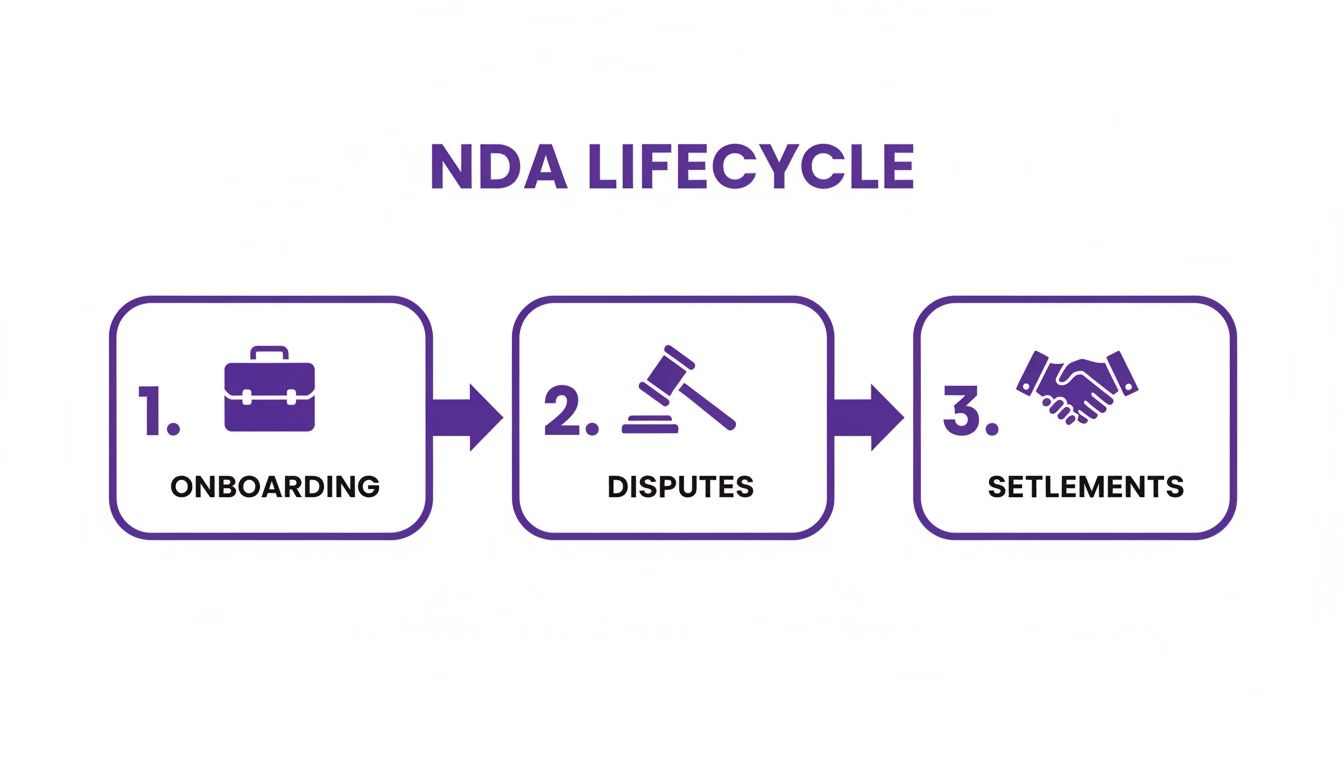
It really shows that an NDA isn’t a "set and forget" document. It’s a living tool that needs to be managed throughout a professional relationship. By taking a structured approach to customisation, signing, and management, your non disclosure agreement Australia template will become a genuinely effective asset for your business.
Common Questions About Australian NDAs
Getting your head around non-disclosure agreements can feel a bit daunting. Here are some straightforward answers to the questions we hear most often from business owners.
Are these templates actually legally binding in Australia?
Absolutely. A well-constructed NDA template is a legitimate legal contract in Australia. For it to stand up, it just needs to tick the essential boxes of any valid contract: there's a clear offer and acceptance, something of value is exchanged (that's the 'consideration'), and both sides intend for it to be a serious legal arrangement. The key, though, is that its terms must be reasonable, otherwise, a court might not enforce it.
How long should an NDA last?
This is a classic "it depends" scenario. The timeframe needs to make sense for the information you're protecting. For most projects or business discussions, a period of 2 to 5 years is a pretty standard and sensible range. However, if you're dealing with genuine, high-value trade secrets, an indefinite period can sometimes be justified. Just be careful not to overreach; an unreasonably long duration could void the entire agreement.
What happens if someone breaks an NDA here?
If one party violates the agreement, the other party has legal options. It’s not just a piece of paper; it has real teeth.
A breach can lead to serious consequences, including a court injunction to prevent any more information from getting out, a demand for financial damages to cover your losses, or even an order for the breaching party to hand over any profits they made from the misuse of your information.
This is precisely why taking the time to get your NDA right from the start is so important.
Streamline your business operations with Payly, the all-in-one platform for Australian service businesses. From time tracking and invoicing to legally binding e-signatures for your NDAs, manage it all in one place and save up to 95% on software subscriptions. Find out more at the official Payly website.
Payly Team
Sharing insights and strategies to help service businesses thrive. Follow Payly for more tips on time tracking, invoicing, and business operations.
Related Articles
Ready to streamline your business?
Join thousands of freelancers and agencies who use Payly to track time, send invoices, and get paid faster.