
Elements of a Contract: elements of a contract in Australia
Discover the elements of a contract in Australia and learn offer, acceptance, and consideration to draft valid agreements.
Payly Team
December 9, 2025

For any agreement to stand up in court, it needs a few essential ingredients. Think of it like a recipe: miss one key component, and the whole thing falls flat. The core elements of a contract are offer, acceptance, consideration, an intention to create a legal relationship, capacity, and legality. If even one is missing, what you thought was a solid deal might not be enforceable at all.
What Makes an Agreement a Real Contract
It's easy to think of a contract as just a formal document, but it's really a recipe for a legally binding promise. It’s far more than a casual handshake or a vague understanding; it’s a structured agreement with specific parts that a court can recognise and, more importantly, enforce.
For Australian freelancers, agencies, and anyone running a service business, getting your head around these foundational pillars isn't just "good to know" it's critical for protecting your work, your time, and your bank account.
Knowing what makes a contract legitimate takes the guesswork out of your business dealings. It helps you understand the exact moment a quote or proposal transforms into a rock-solid commitment.
The Foundational Pillars of a Contract
Every single enforceable agreement is built on the same core principles. We'll dive into each one properly, but it helps to first see how they all slot together. These elements are what ensure an agreement is clear, mutual, and taken seriously by everyone involved.
The diagram below breaks down the primary elements needed to form a valid contract.
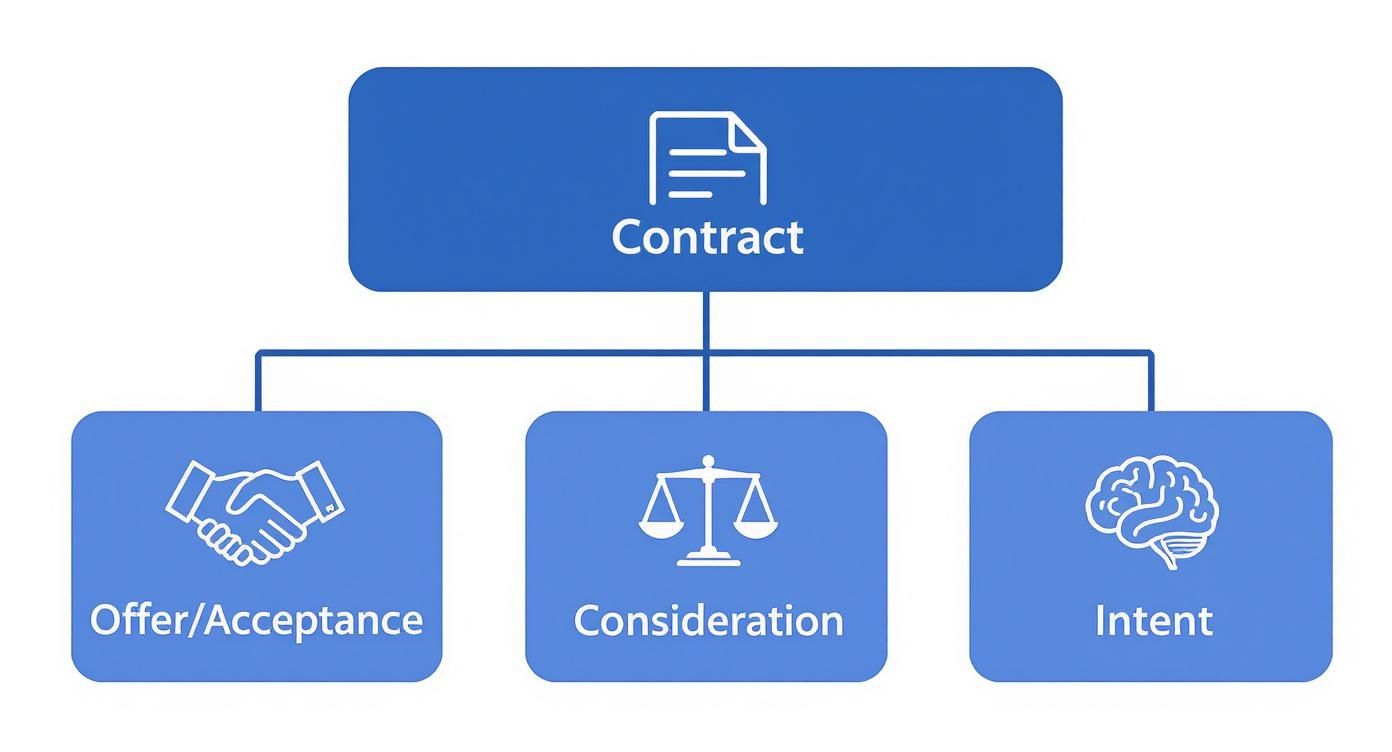
This gives you a simple visual: a real contract starts with a mutual agreement (the offer and acceptance), is backed by a fair exchange (consideration), and is made with a genuine desire to be legally bound (intention).
These core components are like a checklist for any business arrangement. They make sure everyone is on the same page and truly committed to holding up their end of the bargain. If you want to build secure agreements, you need to be able to spot and include each of these in your client dealings.
At its heart, a contract is just a promise the law will enforce. The presence of these key elements is what separates a legally binding commitment from a simple, unenforceable promise. Without them, you’re just running on trust.
The main elements we’ll cover are:
- Offer and Acceptance: One party makes a clear proposal, and the other agrees to it without changing the terms.
- Consideration: The value (like money, goods, or services) that each person gives and gets.
- Intention to Create Legal Relations: Everyone involved understands the agreement is serious and legally enforceable, not just a casual chat.
- Capacity: All parties must have the legal ability to enter into a contract (e.g., they're of sound mind and legal age).
- Legality: The contract’s purpose must be lawful; you can't have a valid contract for an illegal act.
The Foundation of Agreement: Offer and Acceptance
At the very core of any contract is a simple idea: two parties agreeing on the same thing. Lawyers often call this a "meeting of the minds," but really, it just means everyone is on the same page. This mutual understanding isn't just a handshake; in the eyes of the law, it’s built on two specific actions: a clear offer and an unqualified acceptance.

Think of an offer as putting a concrete proposal on the table. For a service business, this is your quote or that detailed project proposal you spent hours on. It’s you saying, "I will design your new logo for $5,000," with enough detail that there's no room for misinterpretation.
The Offer: A Clear Proposal
An offer has to be more than just a vague chat about a potential project. It must be a definite promise, communicated to the specific person you want to work with. This is where many people get tripped up between a genuine offer and what's called an "invitation to treat".
An invitation to treat is essentially an invitation for someone else to make you an offer. It’s not something that can be "accepted" to lock in a deal.
- Example of an Offer: A copywriter sends a client a formal document outlining three blog posts of 1,000 words each, including two rounds of revisions and SEO keywords, for a fixed fee of $1,200. This is a clear-cut offer.
- Example of an Invitation to Treat: That same copywriter advertises "Content packages starting from $500" on their website. This isn’t an offer; it’s marketing. It invites potential clients to get in touch and request a custom quote, which then becomes the offer.
A valid offer is the starting pistol for a legally binding agreement. It must be so clear that the only response needed is a simple "yes" or "no". Any fuzziness here can prevent a contract from ever forming.
Acceptance: The Unconditional "Yes"
Once a solid offer is on the table, the ball is in the other person's court. For a contract to be formed, they must provide acceptance, a direct and unconditional "yes" to the exact terms you proposed.
If they try to tweak the deal, it’s not an acceptance. Saying, "I'll agree to the $1,200 price if you throw in social media captions for free," isn’t an acceptance at all. It’s a rejection of your original offer and the creation of a brand new counter-offer.
At that point, your first offer is dead and gone. Now it's up to you to accept or decline their new proposal. This back-and-forth continues until one person gives an unconditional acceptance to a live offer.
This acceptance needs to be communicated clearly, whether it’s said out loud, written in an email, or formalised with a signature. Using a proper e-signature for your business is a great way to make sure this final, crucial step is both secure and legally enforceable.
This fundamental 'offer and acceptance' dance is a cornerstone of Australian contract law, inherited from English common law and upheld by our courts since the 19th century. You can see how these principles play out on a massive scale by looking into Australian government procurement contracts.
Understanding Consideration: The Value Exchange
What's the magic ingredient that turns a casual promise into a contract a court will enforce? It’s a legal concept called consideration.
Think of it as the core bargain, the "this for that" of any deal. It's the price one party pays for the other party's promise. Without this two-way exchange of value, all you have is a one-sided, unenforceable pledge.

For instance, when a client pays your invoice, that money is their consideration. In return, the web design services you provided are your consideration. Something of value has flowed in both directions, making the agreement stick.
What Counts as Valid Consideration?
It’s a common mistake to think consideration has to be money. The law is actually much more flexible. Just about anything of value that the parties agree on can count.
Valid forms of consideration often include:
- A Promise to Do Something: This is the most common form in business. You agree to build an app, write copy, or deliver a marketing strategy.
- A Promise Not to Do Something: Known as forbearance, this could be an agreement not to work for a direct competitor for six months after a project ends.
- Goods or Property: A photographer providing finished prints or a designer handing over digital files in exchange for payment.
Getting this part right is non-negotiable. This is why a detailed Statement of Work (SOW) is crucial for service businesses. It meticulously outlines the exact services (your consideration) being provided for the agreed payment (the client's consideration), wiping out any ambiguity.
A quick but important note: Consideration must be for a present or future promise, not something you’ve already done. If a client promises you a bonus for a project you finished last year, that's generally just a nice gesture, not a binding contract. The value (your work) was given in the past, not as part of the new deal.
Adequacy vs. Sufficiency of Consideration
Here’s a concept that often surprises people: the courts don’t care if you made a good deal. They only care that you made a deal. This is the legal principle of sufficiency versus adequacy.
For a contract to be valid, consideration must be sufficient, which simply means it has to have some real, recognisable value in the eyes of the law.
However, it doesn't need to be adequate, meaning its commercial value doesn't have to be a fair match for what you're getting. If you agree to design a complex logo for $50, a court won't invalidate the contract simply because the work was clearly worth $500. As long as some value was exchanged, the consideration is sufficient. This principle is all about contractual freedom; it lets people strike their own bargains, for better or for worse.
The Intention to Be Legally Bound
Not every promise you make is destined for the courtroom. This might sound obvious, but it points to a crucial, and often overlooked, element of a valid contract: the intention to create legal relations. Think of it as a filter that separates serious, commercial commitments from casual, social arrangements.
Imagine promising a neighbour you'll help them move some furniture over the weekend. If you forget, they can’t sue you for breach of contract. Why? Because neither of you ever intended for that friendly promise to carry the weight of the law. It was a social agreement, pure and simple.
This distinction is what keeps our everyday interactions from turning into legal minefields.
Commercial vs. Social Agreements
When it comes to figuring out intention, Australian courts have a practical starting point. They presume that agreements made in a commercial or business setting are meant to be legally binding. On the flip side, they assume that arrangements between family or friends are not.
Of course, these are just presumptions, not unbreakable rules. You can always present evidence to show that the opposite was true.
- Commercial Scenario: A marketing agency drafts and signs a client agreement. The law automatically assumes both sides intend for that document to be enforceable.
- Social Scenario: A parent promises their child $100 for getting good grades. This is almost always seen as a domestic arrangement, not a contract a court would enforce.
The real test is this: would a reasonable person, looking at the situation, believe the parties intended for their agreement to be legally enforceable? Context is everything. If the stakes are purely personal or social, the law tends to stay out of it.
This principle has been a cornerstone of Australian contract law for over a century. Issues around intention pop up all the time in commercial disputes and consumer protection cases. For a deeper dive into current legal trends, the Australian litigation insights on Chambers.com are a great resource.
Upholding Fair Business Practices
This isn't just some abstract legal theory; it has a direct impact on fair and accountable business in Australia. It’s what ensures that when a business makes a promise to a customer, that promise actually means something.
Our consumer laws, especially the Competition and Consumer Act 2010, are built on this foundation. The Act demands that contracts, particularly those between businesses and consumers, reflect a genuine intention to be legally binding. This is a key part of protecting people from empty promises and ensuring businesses operate with integrity.
So, when you present a client with your service agreement, you’re doing more than just outlining a project plan. You’re sending a clear signal that you intend to enter a formal, legally recognised relationship. It’s this commitment to being legally bound that gives your contracts and your business promises their teeth. It’s what separates a professional from someone just making a casual offer to help out.
Ensuring a Contract Is Valid and Lawful
So, you've ticked all the boxes: there's a clear offer, a definite acceptance, solid consideration, and a genuine intention to create a legal relationship. But hold on, we're not quite there yet. Even a perfectly structured agreement can fall over if it fails two final, crucial tests: capacity and legality.
Think of these as the final integrity checks. They act as gatekeepers, making sure the people signing the dotted line are actually able to make a binding promise, and that the purpose of the agreement is above board.
Capacity to Enter a Contract
Not just anyone can legally bind themselves to a contract. Capacity is all about whether a person has the legal competence to understand the agreement and its consequences. It’s a protection built into the law, designed to shield vulnerable people from being locked into deals they don’t comprehend.
So, who lacks this legal capacity? Generally, a few groups are protected:
- Minors: In Australia, anyone under 18 generally can't be held to a contract. There are some exceptions, though, usually for essentials like a reasonable employment contract, food, or a place to live.
- Individuals with mental impairments: If a person's mental condition prevents them from understanding the very nature of what they're signing, the contract is likely voidable.
- People under the influence: This is a tricky one, but a contract can be challenged if one person was so intoxicated by alcohol or drugs that they had no idea what they were doing.
For freelancers and agencies, this idea of capacity also extends to who you're dealing with at a company. You absolutely must make sure the person signing your service agreement is actually authorised to do so. A signature from a junior employee who doesn't have the authority to commit company funds could make your contract completely worthless.
A contract is only as strong as the parties who make it. Ensuring everyone has the legal capacity to agree is a fundamental step in risk management, preventing deals from being undone on a technicality.
The Requirement of a Lawful Purpose
This last element is perhaps the most obvious, but it’s non-negotiable: the contract's purpose must be legal. An agreement to do something illegal is void from the moment it's made. It has zero standing in the eyes of the law. This is the principle of lawful purpose.
A court will never enforce a contract for something criminal, like an agreement to buy stolen equipment or to commit fraud. It’s a no-brainer. But this principle also covers agreements that, while not strictly criminal, go against public policy. For instance, a contract that unfairly stops someone from earning a living in their chosen profession might be thrown out for being an unreasonable restraint of trade.
These rules form the bedrock of business integrity in Australia's legal services market, a sector projected to be worth around AUD 35.8 billion by 2025. You can discover more about the Australian legal market on imarcgroup.com. Ultimately, the law won’t help you enforce a deal that is unethical or illegal. To see how these principles are applied in a standard digital agreement, you can look at our own Payly terms and conditions.
A Practical Contract Checklist for Your Business
Knowing the theory is one thing, but actually putting it into practice to build a rock-solid agreement is what really protects your business. This is where a simple checklist comes in handy. It’s your secret weapon to make sure you don’t miss a critical piece when you're pulling together a new client agreement.
Think of it like a pilot's pre-flight check. Before the project gets off the ground, you run through each item to confirm every essential part is in place and properly documented. This isn't just about ticking boxes; it's about giving yourself the confidence that your agreement is built to withstand turbulence like misunderstandings, scope creep, or payment hassles.
Core Components to Document
Before you even think about hitting 'send' on that agreement, walk through these fundamental points. Each one lines up with the legal elements we've talked about, turning your project plan into a proper, legally enforceable contract.
- Who’s Who (The Parties): Nail down exactly who you’re working with. Use their full legal names and ABNs, and clearly define who is the "Client" and who is the "Service Provider." No ambiguity here.
- What You’re Doing (The Offer): This is your Scope of Work. Get super specific about the exact services, deliverables, and milestones. Crucially, you should also spell out what’s not included to shut the door on scope creep from day one.
- When It’s Happening (Timelines): Map out the project timeline clearly. Include the start date, key deadlines for milestones, and the final handover date.
- How You’re Getting Paid (The Consideration): State the total fee, the payment schedule (e.g., 50% up-front, 50% on completion), how they can pay you, and what happens if a payment is late.
- Making it Official (Acceptance): How will the client agree to the terms? For most service businesses today, the best way is to specify that acceptance is made via a secure electronic signature. It's fast, clear, and easy to prove.
Clauses for Managing Expectations
Once you have the basics down, a few extra clauses can save you a world of pain later. These aren't just legal fluff; they are practical tools for managing the relationship and setting firm boundaries from the start.
A well-drafted clause is a conversation you have in advance to prevent an argument later. It sets clear rules of engagement so everyone knows what to expect when things inevitably change.
A classic example? The dreaded revision cycle. A simple, upfront clause can keep this from spiralling out of control.
Sample Revisions Clause:
"This project fee includes up to two (2) rounds of reasonable revisions to the submitted deliverables. Additional revision requests will be billed separately at the rate of [Your Hourly Rate] per hour."
Language this clear is your best friend. It helps you keep control over the project's scope and protects your profitability, ensuring the value exchange stays fair. By systemically documenting these key elements of a contract, you’re not just writing a document, you're building a strong foundation for a great client relationship.
To bring this all together, here’s a simple checklist you can use to review your own service agreements.
Contract Essentials Checklist for Australian Service Businesses
This table breaks down the core contract elements into actionable questions and provides a real-world example for a web designer. Use it to audit your own templates and ensure you’ve covered all your bases.
| Contract Element | Key Action or Question | Example for a Web Designer |
|---|---|---|
| Parties | Have I listed the full legal names and ABNs for both my business and the client? | "This agreement is between Web Creations Pty Ltd (ABN: 12 345 678 901) and Client Cafe Pty Ltd (ABN: 98 765 432 109)." |
| Offer (Scope) | Is the scope of work crystal clear? Does it state what isn't included? | "Design and build a 5-page WordPress website. Does not include copywriting, SEO services, or ongoing maintenance." |
| Acceptance | Is it obvious how the client accepts the offer? | "The Client can accept this proposal by providing a digital signature via the link provided." |
| Consideration | Are the fees, payment schedule, and late payment penalties clearly defined? | "Total project fee: $5,000 + GST. Payment schedule: 50% deposit ($2,500) to begin, 50% ($2,500) upon project completion." |
| Intention | Does the agreement's language show it's a serious business arrangement? | "This Services Agreement outlines the terms and conditions of our professional engagement." |
| Certainty | Are all terms specific and unambiguous? Is anything vague or left open to interpretation? | Instead of "provide revisions," use "provide up to two rounds of minor revisions within 5 business days of delivery." |
| Capacity | Am I sure the person signing has the authority to do so and is over 18? | "The signatory confirms they are an authorised representative of the Client and have the full authority to enter into this agreement." |
Running your agreement through this checklist is a final, critical step. It helps ensure that what you’ve written is not only clear and professional but also legally sound, protecting both you and your client.
Common Questions About Business Contracts
Getting your head around the legal side of your business can feel like a huge task, but the fundamentals are actually pretty straightforward. Let’s tackle some of the most common questions freelancers and agencies ask about what makes a contract stick in Australia.

A bit of practical knowledge here will give you a lot more confidence when you’re drawing up your next agreement.
Does a Contract Have to Be in Writing to Be Legal in Australia?
Not necessarily. A verbal agreement can be legally binding, provided it ticks all the essential boxes of a contract. The big problem? They’re incredibly hard to prove if things go south.
For any kind of professional service, a written contract is your best friend. It's solid proof of what everyone agreed to: the scope, the deadlines, the payment terms. And it goes a long way in stopping small misunderstandings from becoming big problems.
Plus, some specific types of agreements, like those involving real estate, are legally required to be in writing anyway. So it's a great habit to get into.
Are Electronic Signatures Legally Binding in Australia?
Yes, they definitely are. Thanks to the Electronic Transactions Act 1999 (and similar state laws), electronic signatures are treated with the same legal respect as an old-fashioned pen-and-ink signature.
For a digital signature to hold up, it just needs to meet a few conditions:
- You have to be able to reliably identify the person signing.
- The person has to clearly indicate they intend to sign the document.
- Everyone involved has to agree to do things electronically.
Using a reputable digital signature platform is the easiest way to make sure you're covering these bases, giving you a secure and quick way to get your agreements finalised.
An enforceable agreement hinges on having all its core components. If a fundamental element is missing, what you have is likely not a valid contract in the eyes of the law. This can leave your business unprotected.
What Happens if a Key Element Is Missing from My Contract?
If one of those core pillars is missing, the whole agreement can come tumbling down. It would likely be considered unenforceable by a court.
For example, if there’s no consideration (that exchange of value), a judge would probably rule that no contract ever existed. The same goes for intention; if it looks like just a casual promise between mates rather than a serious business arrangement, it won't be treated as a binding contract.
This is precisely why you need to be so careful about making sure every element is present and clearly spelled out. It's the best way to protect your business and ensure you get paid for the work you do.
Ready to manage your contracts, track your time, and get paid faster all in one place? Payly combines smart invoicing, legally binding e-signatures, and timesheets into a single platform for Australian service businesses. Start your free 14-day trial today.
Payly Team
Sharing insights and strategies to help service businesses thrive. Follow Payly for more tips on time tracking, invoicing, and business operations.
Related Articles
Ready to streamline your business?
Join thousands of freelancers and agencies who use Payly to track time, send invoices, and get paid faster.