
Agreement of Understanding Template for Australian Service Projects
Get a free agreement of understanding template for Australian service businesses. Tailor easily, add e-signatures, and start projects fast.
Payly Team
February 10, 2026
Think of an agreement of understanding template as a structured handshake. It's a preliminary document that lays out what you and your client intend to do together, long before you get into the nitty-gritty of a formal contract. For Australian service businesses, it’s the perfect way to align on the scope of a project, its goals, and who's responsible for what, all without the immediate legal pressure.
What Is an Agreement of Understanding and Why You Need One

Before any project gets underway, clarity is everything. An Agreement of Understanding (AoU) is a vital first step for Aussie freelancers and service businesses because it sets clear expectations right from the start, helping you sidestep those costly misunderstandings that can pop up later.
This document really serves as a foundational roadmap. It maps out the project’s direction before you sink significant time and money into drafting a legally binding contract, fostering a sense of collaboration and making sure everyone is on the same page from day one.
The Purpose of a Preliminary Agreement
Let's be clear: an AoU isn't meant to be legally enforceable. Its main job is to confirm that everyone involved shares the same vision for the project. It’s a low-pressure way to discuss and jot down key details, which is incredibly helpful in the early days of a new client relationship.
This is your chance to clearly define the project's scope, outline the deliverables, and pencil in some preliminary timelines. A marketing agency, for instance, might use an AoU to list a new client's campaign goals and key performance indicators before drawing up a full-service agreement.
The real power of an Agreement of Understanding lies in its ability to build trust and alignment. It signals professionalism and a commitment to clear communication, setting a positive tone for the entire project.
Differentiating from Contracts and MoUs
It’s crucial to know that an AoU is not a formal contract. A contract creates legal obligations you must adhere to, while an AoU simply documents everyone's intentions. Still, this preliminary step is incredibly valuable. Solid partnerships in Australia are often built on the practice of formalising intentions early.
You might have also heard of a Memorandum of Understanding (MoU). While they're similar, an AoU is typically less formal and more suited to smaller projects. An MoU is often used between larger organisations for bigger collaborations. For a deeper dive into the differences, you can explore our detailed guide on creating a Memorandum of Understanding template.
For a freelancer or small agency, an AoU is the ideal tool to kick off conversations and get that initial buy-in without getting bogged down in legal complexities.
Download Your Free Australian Agreement of Understanding Template
Here's the tool you need to get client relationships started on the right foot. I’ve put together this agreement of understanding template specifically for Australian freelancers, consultants, and service-based businesses like yours.
It’s designed to cover all the essential preliminary details: the stuff you need to agree on before you dive into a hefty formal contract. Think of it as the perfect way to get on the same page with your clients without scaring them off with pages of legalese.
This template helps you quickly nail down the mutual intentions for a project. You can clarify the scope, what you'll deliver, timelines, and even payment expectations, making it incredibly versatile for anything from a short-term consulting gig to a complex digital marketing campaign.
Getting to Grips With the Template
To help you hit the ground running, I've laid out the template to be as clear and logical as possible. The goal is a straightforward document that you and your client can complete together without any confusion. It tells the story of your project from start to finish.
Understanding what each section does is the key to customising it properly for your own business needs.
My biggest tip? A solid agreement of understanding isn't just a piece of paper; it's the bedrock of a transparent and successful client partnership. Getting these early details right is your best defence against scope creep and the fastest way to build trust.
This structured approach makes sure nothing gets missed, giving you a reliable reference point as you progress towards a more detailed service agreement or contract.
Let's break down the core components you'll find inside the downloadable template. I’ve summarised the key sections and their purpose in this table so you know exactly what you’re working with.
Key Sections in Your Agreement of Understanding Template
| Section Name | Purpose and Key Details to Include |
|---|---|
| Parties Involved | Clearly identifies everyone entering the agreement. Be sure to include full names, business names, ABNs, and primary contact details. |
| Project Overview | A "big picture" summary. This is where you describe the project's main purpose and what you're both hoping to achieve. It ensures you share the same vision from day one. |
| Scope & Deliverables | Gets into the specifics of what's included (and what's not). List the concrete tasks you’ll perform and the tangible outcomes the client will receive. |
| Timelines & Milestones | Manages expectations around timing. Include an estimated start date, key project milestones, and an anticipated completion date. |
| Responsibilities | Defines who does what. Briefly outline what you need from the client (e.g., feedback, content, access) and what they can expect from you to keep things moving smoothly. |
Each part plays a critical role in building a comprehensive, yet easy-to-understand, preliminary agreement that protects both you and your client.
Making the Template Your Own: A Practical Guide
A template is just the starting point. The real magic happens when you take that general framework and mould it to fit the specific project you're about to start. Think of it less like filling in a form and more like creating a precise, shared roadmap for you and your client. This is where you iron out the details before they become problems.
First things first, get the basics right. Clearly identify everyone involved. Don't just jot down names; include the full business names, their ABNs (Australian Business Numbers), physical addresses, and the best contact person on each side. It might seem small, but getting this down on paper adds a layer of professionalism and makes it crystal clear who is responsible for what.
From there, it’s all about the project scope. This is the single most important part of the agreement, and where most misunderstandings begin. Vague descriptions like "new website" or "marketing help" are a recipe for scope creep and painful conversations down the track. You need to be brutally specific.
Nail Down the Specific Deliverables
This is where you stop talking in generalities and start listing the exact, tangible things the client will receive. The goal is to define the outcome of your work in a way that anyone can measure and tick off a list.
Let’s look at a few real-world examples:
- You're a Graphic Designer? Don't just say "Logo design." Instead, write: "Three initial logo concepts delivered as JPEGs, with two rounds of client revisions included."
- A Marketing Consultant? "Social media management" is too broad. Try this: "A monthly content calendar for Instagram and Facebook, featuring 12 static posts and 4 Reels, scheduled and posted by us."
- Working as a Web Developer? "Website build" means nothing. Get specific: "Development of a 5-page WordPress website (Home, About, Services, Blog, Contact) with a functioning contact form and basic on-page SEO setup."
See the difference? This level of detail sets clear expectations and gives both of you a shared definition of what "done" actually looks like. It turns your agreement into a practical project checklist.
Set Timelines You Can Actually Meet
Once you’ve defined what you're delivering, you need to establish when. A solid Agreement of Understanding should map out the project timeline. Include an estimated start date, a few key milestones along the way, and a target completion date.
Breaking a big project into smaller phases with their own deadlines is a great way to build client confidence. It shows you have a structured plan and helps keep everything moving forward.
An effective agreement doesn't just outline what will be done, but also when. Clear timelines prevent frustration and show you're in control of the process.
This is also the perfect place to state what you need from the client to hit those deadlines. Be upfront about requiring things like timely feedback, access to their accounts, or specific content they need to provide.
Add Some Key Australian Details
Working in Australia means there are a couple of extra things you should always include. It’s smart to mention GST right from the start. A simple sentence like, "All formal invoices will be subject to 10% Goods and Services Tax (GST)" avoids any awkward surprises when the first bill is due.
It’s also a good idea to pop in a basic confidentiality clause. Even in a preliminary document, stating that any sensitive information shared during your talks will be kept private protects both you and your client.
Think of it this way: even massive international trade deals rely on clear, detailed agreements. The recent UAE-Australia Comprehensive Economic Partnership Agreement (CEPA) has entire sections dedicated to helping small and medium businesses trade more easily. In the same way, a well-customised Agreement of Understanding helps you onboard clients smoothly and sidestep costly disagreements.
Navigating The Legal Side for Australian Businesses
While our agreement of understanding template is a fantastic tool for getting everyone on the same page, it's vital to understand its place in the legal landscape here in Australia. Think of it as a formal, written handshake. It shows intent and clarifies expectations, but it isn't the final, legally binding promise.
Getting this distinction wrong from the start can create some serious headaches and unintentionally lock you into commitments you weren't ready for.
The simplest way to avoid this is by including a crystal-clear 'non-binding' clause. You don't need a lot of legal jargon. Something straightforward like, "This Agreement of Understanding is non-binding and serves only to outline the mutual intentions of the parties" usually does the trick. This one sentence is your safety net, making it plain that this document is a stepping stone to a proper contract, not the contract itself.
When To Upgrade to a Formal Service Agreement
An Agreement of Understanding is your best friend during those early-stage chats and planning sessions. But as soon as things get serious, it’s time to bring in the big guns: a legally binding Service Agreement.
You absolutely must have a formal contract signed, sealed, and delivered before any of these things happen:
- Money changes hands. This could be a client paying a deposit or you buying project-specific materials.
- Real work kicks off. Once you start sinking significant, billable hours into the project, the AoU is no longer enough.
- Confidential information is shared. If you're being given access to sensitive client data, internal processes, or customer lists, you need the protection of a formal contract.
Making this switch isn't just a box-ticking exercise; it’s a crucial move to protect your business and ensure everyone is legally accountable. If you want to dive deeper into what makes a contract legally sound, have a read of our guide on the essential elements of a contract in our guide.
The whole point of an AoU is to smooth the way to a formal contract, not to avoid one. Use it to hash out all the details so there are no nasty surprises when the time comes to sign on the dotted line.
Aligning With Australian Consumer Law
Even though an AoU isn't typically binding, your business always needs to operate in line with Australian Consumer Law (ACL). This means total transparency and honesty in all your dealings, and that includes what you put in your agreement.
Overstating your capabilities or making misleading claims about what the project can achieve could land you in hot water, regardless of the document's legal status.
For bigger projects, the kind involving significant investment or risk, I'd always recommend getting a legal professional to cast an eye over things. They can help you draft a rock-solid Service Agreement that covers all your bases. And when you're sending these finalised documents out, it's also smart to know how to secure PDF documents to keep both your and your client's information safe. It's these foundational practices that build a trusted, well-protected business.
Getting Your Agreement Signed with E-Signature Tools
Once you’ve tailored your Agreement of Understanding, the final piece of the puzzle is getting it signed. This is where you formalise everyone's intentions and get the project moving. Thankfully, in Australia, electronic signatures are legally recognised, which means you can finalise your AoU quickly and securely without touching a single piece of paper. Using a good e-signature tool not only saves a heap of time but also shows your clients you're professional and organised, setting a great tone right from the start.
This isn't just about ticking a box. The act of signing transforms your document from a collection of ideas into a verified record of mutual understanding. It's the moment alignment is confirmed and the foundation for the project is officially laid.
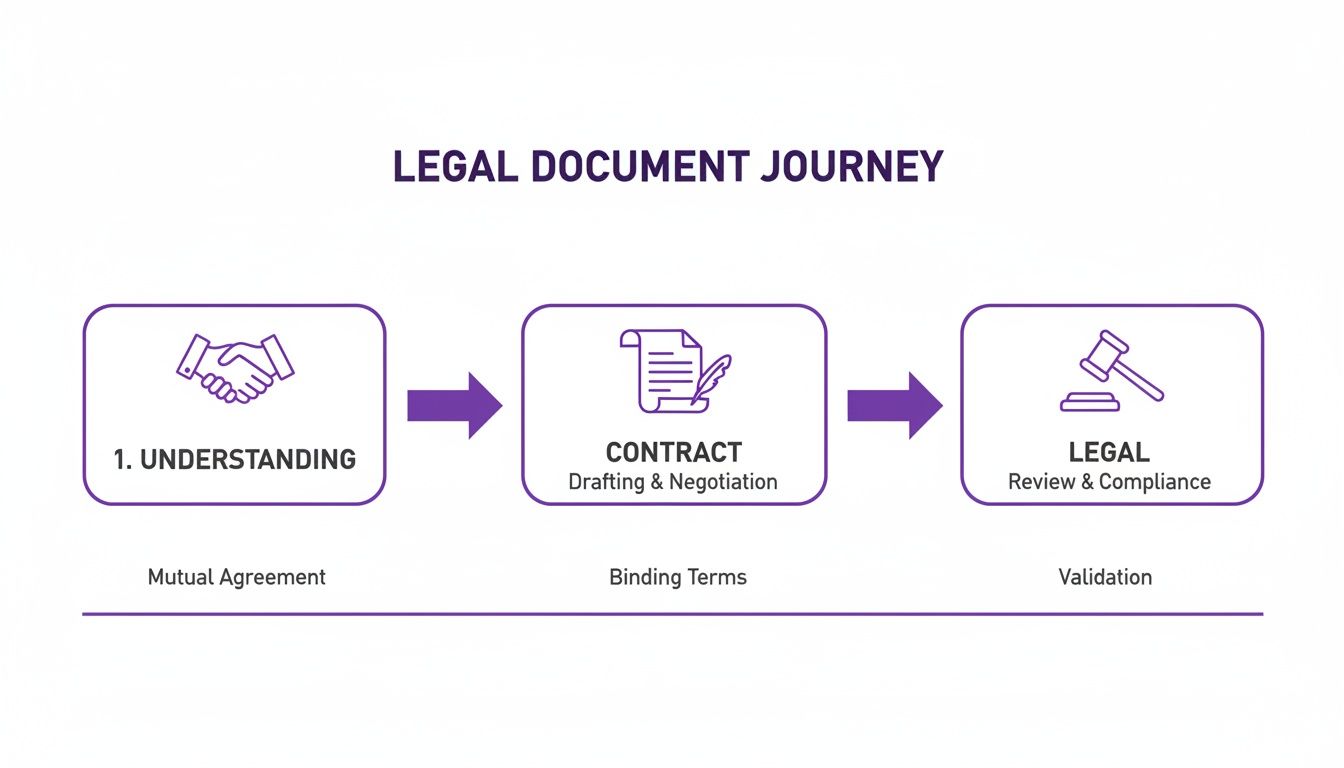
As you can see, there's a natural journey from a handshake agreement to a formal contract, and secure e-signatures are what bridge that gap efficiently. This digital step ensures a clear, documented transition from establishing intent to creating a real commitment.
Why Use an Integrated E-Signature Tool?
Platforms like Payly that have e-signatures built-in are a game-changer. They let you handle the entire process from one place, so you’re not juggling different apps and logins. This is more than just convenient; it helps you maintain momentum with your client and offers a seamless, professional experience from the get-go.
The process is usually dead simple.
- Upload Your Document: First, you’ll upload your finalised AoU, which is typically a PDF.
- Place Signature Fields: Next, you just drag and drop the fields for signatures, initials, and dates where they need to go. It’s incredibly intuitive.
- Send it Off: Pop in your client’s contact details and hit send, all from within the platform.
Your client gets a secure link to review and sign the document on their phone, tablet, or computer. It’s incredibly easy for them, which they’ll appreciate. If you want a deeper dive into how these tools work, this Pandadoc E-signature guide is a fantastic resource.
The Real Wins: Security and Speed
Using a proper e-signature tool gives you much more than just a digital version of a pen-and-paper signature. It adds a robust layer of security and verification that gives your agreements real legal weight. The two biggest benefits here are the cryptographic audit trail and bank-level document encryption.
The audit trail is a detailed log that tracks every single action taken on the document: when it was sent, opened, viewed, and signed. This creates rock-solid proof of the signing process that’s hard to dispute. On top of that, bank-level encryption keeps the document itself safe from prying eyes, ensuring any sensitive project details stay completely confidential. We cover the tech behind this in more detail in our article on what is a digital signature.
An electronic signature does more than just replace ink; it provides a secure, verifiable, and professional way to finalise agreements, building client trust from the very beginning.
This level of security is quickly becoming the standard for doing business properly. It's the same principle major organisations rely on; for example, the Australian Bureau of Statistics’ latest corporate plan hinges on secure data partnerships to modernise its operations. Your business agreements are no different.
We’ve seen over 10,000 documents signed through Payly, and the impact is clear. Businesses using integrated e-signatures often see deals close 30% faster, which is a massive advantage when you’re trying to stay ahead. That speed translates directly into faster project kick-offs and a much smoother workflow for you and your team.
Beyond the Agreement: How to Streamline Your Workflow
Getting that signature on your agreement of understanding is a great feeling, isn't it? It’s the official start of a new client relationship. But it’s not the finish line, it’s the launchpad. This is your moment to shift from planning into a smarter, more efficient workflow for the entire project.
It’s really all about connecting the dots. Once you've established clarity with the AoU, the next logical step is to manage the entire client journey in one place. This simple shift can completely change how you operate, getting you away from the headache of juggling separate documents and multiple software subscriptions.
From Agreement to Action
Think about what happens right after the client signs. You immediately need to start tracking your billable hours, creating professional invoices, and, most importantly, making sure you get paid on time. An all-in-one system helps you do all this without dropping the ball.
When your agreement, time tracking, and invoicing all live in the same ecosystem, the whole process just clicks into place:
- Track Time Against the Project: You can link every minute you work directly back to the scope you both agreed on. No more guesswork.
- Generate Accurate Invoices: Turn your approved timesheets into detailed, professional invoices with a couple of clicks, ensuring you bill correctly for every bit of work.
- Get Paid Faster: Send out invoices with built-in payment options and automated reminders. This drastically cuts down on the time you waste chasing up late payments.
Bringing everything into one cohesive system isn't just about making your life easier; it's a strategic move. It declutters your admin and frees you up to focus on what you actually do best: delivering fantastic work for your clients.
This approach also creates a much cleaner, more professional journey for your clients. They experience a consistent process from the first agreement right through to the final payment, which does wonders for building trust and reinforcing the value you bring to the table. You end up saving money, cutting down on administrative stress, and giving your clients an experience they'll appreciate.
Frequently Asked Questions
Got a few lingering questions? You're not alone. Let's tackle some of the most common queries we hear from Australian service businesses about using an Agreement of Understanding.
Is This Thing Actually Legally Binding?
Straight to the point: No, an Agreement of Understanding (AoU) is designed to be non-binding. Its whole purpose is to get everyone on the same page about intentions before you get into the legal weeds.
But here’s a crucial tip: to avoid any messy misunderstandings, your AoU absolutely must include a clause that clearly states it is 'non-binding'. If you leave that out, and the document happens to tick all the boxes of a contract (like offer, acceptance, and an intention to create a legal relationship), it could be argued in court that it is a binding contract. A simple sentence can save a world of headaches.
When Should I Switch to a Proper Contract?
Think of the AoU as the handshake before the deal. It’s perfect for those early conversations where you’re hashing out the scope, goals, and who’s doing what.
But you absolutely need to switch to a formal, legally binding contract before any of the following happens:
- The first real bit of work kicks off.
- Money is exchanged, even a deposit.
- You start sharing sensitive or confidential business information.
A proper contract is your safety net. It provides real legal protection and spells out what happens if things go wrong, which an AoU just isn't built to do.
Can I Get This Signed Electronically?
Yes, you certainly can. E-signatures are completely valid and legally recognised in Australia thanks to the Electronic Transactions Acts.
In fact, getting your AoU e-signed through a secure platform is a smart move. It’s quick, professional, and creates a clear, time-stamped record of when both parties agreed. Even for a non-binding document, that audit trail adds a welcome layer of accountability.
Doing it this way doesn't just speed things up; it shows your clients you're organised and serious about clear communication right from the get-go.
Ready to streamline how you handle everything from agreements to getting paid? See how Payly brings it all together in one place, saving you time and helping you get paid faster. Explore plans at https://www.payly.com.au.
Payly Team
Sharing insights and strategies to help service businesses thrive. Follow Payly for more tips on time tracking, invoicing, and business operations.
Related Articles
Ready to streamline your business?
Join thousands of freelancers and agencies who use Payly to track time, send invoices, and get paid faster.