
Your Free Memorandum of Understanding Template for Australian Businesses
Download our free, editable memorandum of understanding template. Get a practical, jargon-free guide for Australian businesses to draft clear MOUs.
Payly Team
December 10, 2025
Think of a Memorandum of Understanding (MOU) as a formal handshake on paper. It’s a document that outlines the broad strokes of an agreement between two or more parties, laying the groundwork before you dive into a formal, legally binding contract.
It’s all about setting clear expectations from the get-go and heading off potential misunderstandings before they even start.
What Is a Memorandum of Understanding?
A Memorandum of Understanding, or MOU for short, is really a foundational document. It’s there to clarify the intentions of everyone who plans to work together on a project or partnership. I like to think of it as a preliminary agreement that maps out the most important terms. It's less intimidating than a contract but far more concrete than a simple verbal agreement.
The main reason you'd use an MOU is to make sure everyone is on the same page. It defines the scope of what you're trying to achieve, outlines who is responsible for what, and sets a rough timeline for moving things forward. Honestly, this process alone can save you a world of pain later by forcing you to hash out any potential disagreements early on.
Why Use an MOU?
An MOU brings much-needed clarity and creates a paper trail of your negotiations and what you’ve all agreed to so far. It becomes a really useful reference point as you work your way towards a more detailed, formal contract. Essentially, it helps dial down the uncertainty without locking anyone into a legally enforceable commitment just yet.
This makes it perfect for those early-stage collaborations where you’re still ironing out the finer details. By creating an MOU, you're building a solid framework for cooperation that can guide the relationship as it develops.
Key Takeaway: An MOU isn't usually a legally binding contract. Its real power lies in outlining the mutual understanding and intentions of all parties, creating a solid foundation for a proper agreement down the track.
To help you get a better feel for when an MOU might be the right tool for the job, here’s a quick guide to some common situations where a well-drafted one can protect your interests and clarify what everyone expects.
Common Scenarios for Using an MOU
A quick guide to situations where an MOU can protect your interests.
| Business Scenario | Why an MOU Is Recommended |
|---|---|
| New Business Partnership | To outline partner contributions, responsibilities, and the venture's goals before drafting a formal partnership agreement. |
| Joint Venture Project | To define the scope, objectives, and roles of each organisation in a collaborative project without immediate legal obligations. |
| Freelancer and Agency Collaboration | To agree on the scope of services, project timelines, and payment structures before signing a detailed service contract. |
| Sub-Contracting Agreement | To clarify the relationship and responsibilities between a prime contractor and a sub-contractor on a specific project. |
Ready to get started? You can download your free, editable memorandum of understanding template now to begin structuring your next partnership with confidence and clarity.
How to Draft an Effective MOU
Looking at a blank MOU template can feel a little daunting. The trick is to see it not as one big task, but as a series of smaller, logical steps. Every clause you add is there for a reason: to protect everyone involved and to lay down a clear roadmap for how you'll work together. You're basically just translating your handshake agreement into a structured document that leaves no room for guessing games later.
Don't get bogged down in trying to sound like a lawyer. An effective MOU is all about clarity and mutual understanding, not complex jargon. You're building the foundation for a potential formal contract, and this is your best chance to get everyone on the same page about expectations from the get-go.
The whole process is about turning a general idea into a solid plan.
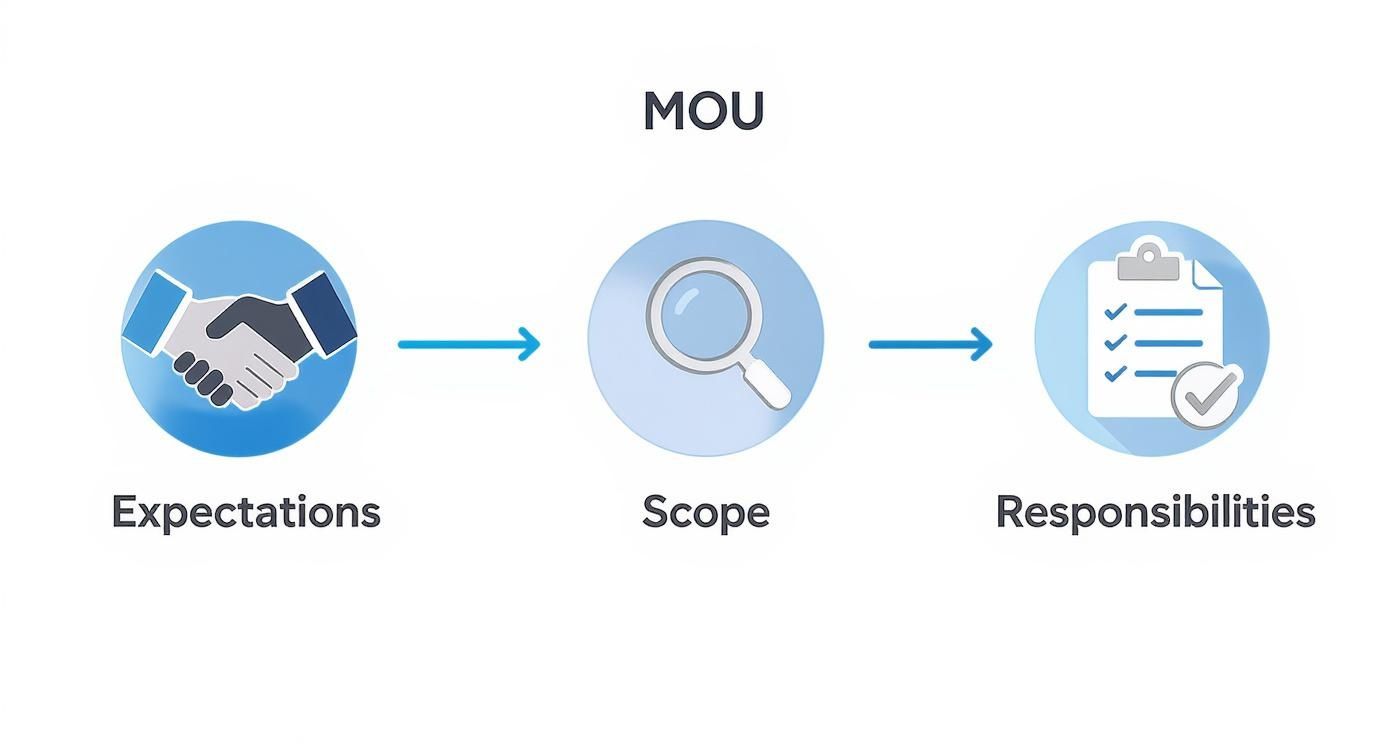
As you can see, a solid MOU starts with aligning what everyone expects, moves on to defining the actual work, and finishes by locking in who's responsible for what.
Identify the Parties Involved
First things first: you have to clearly state who is involved in the agreement. This sounds incredibly basic, but getting it wrong can cause real headaches.
Make sure you use the full legal names for any individuals or companies, along with their main business addresses. For instance, a freelancer partnering with an agency should list their full name and ABN, while the agency side would list its registered business name, ABN, and office address. This simple step removes any doubt about who the agreement is between.
Define the Scope and Objectives
Once you know who is involved, you need to lock down what you're all going to do. This is the scope of your collaboration, and it's where you detail the project's goals. Being specific here is your best defence against "scope creep", that slow, painful process where a project gets bigger and bigger without any formal agreement.
Think of a well-defined scope as the project's north star. It should answer a few key questions:
- What are we trying to achieve? Write down exactly what a successful outcome looks like.
- What work is included? List the key tasks and activities covered by the agreement.
- What's definitely not included? Sometimes, stating what's out of bounds is just as important.
For example, an MOU between a marketing agency and a videographer might state the scope includes producing three specific promotional videos but explicitly excludes managing the social media distribution. For projects with a lot of technical detail, you might find a Statement of Work is a better fit for hammering out the nitty-gritty.
Outline Roles and Responsibilities
With the scope locked in, it’s time to get clear on who does what. This section assigns specific roles and responsibilities to each party. Vague duties are a recipe for conflict, so this is where you need to be precise.
Treat it like a high-level action plan. Everyone should see their name next to specific tasks, contributions, and deliverables. It’s the best way to avoid work being duplicated or, even worse, important tasks falling through the cracks entirely.
A well-drafted MOU clearly defines who does what, by when. This simple allocation of duties is often the most valuable part of the document, turning a vague intention into a practical plan of action.
Include Essential (But Often Overlooked) Clauses
Most MOU templates will cover the basics, but a few other clauses are absolutely essential for protecting yourself. Forgetting them can leave you exposed if things don't go to plan.
Key Clauses You Shouldn't Skip:
- Confidentiality: This protects any sensitive information you share. It should define what's considered "confidential" and legally oblige everyone to keep it under wraps.
- Intellectual Property (IP) Rights: Be crystal clear about who owns any new IP created during the project. This is a must-have for any creative or tech-based collaboration.
- Dispute Resolution: Outline a simple process for what happens if you disagree. This could be agreeing to mediation first, which can save a lot of time, money, and stress.
- Termination: Spell out the conditions for ending the MOU. This could be a set date, a project milestone, or simply giving a certain amount of written notice.
Adding these clauses is like having a safety net. You’re putting a plan in place for common issues before they happen, which shows a professional and forward-thinking approach that gives everyone peace of mind.
Real-World MOU Examples and Wording
Theory is one thing, but seeing a memorandum of understanding in action is where it all clicks. To close that gap between the template and the real world, let's walk through three common business scenarios you’re likely to encounter in Australia. These examples will give you the specific wording and, just as importantly, the confidence to shape your MOU for whatever you’re planning.
We’ll look at how to adapt your template for a freelancer-agency gig, a prime and sub-contractor arrangement, and a new business partnership. You’ll see exactly how to tweak the key clauses for each situation, turning a generic document into a genuinely useful tool that gets everyone on the same page.

These aren't just abstract ideas; they show how a single, flexible template can be your starting point for very different kinds of collaborations.
Freelancer and Agency Collaboration
Picture this: a busy creative agency needs to bring in a freelance graphic designer for a big client project. An MOU is perfect here. It sketches out the relationship before everyone gets bogged down in a multi-page service agreement, focusing on creative ownership and the project's boundaries.
The Intellectual Property (IP) Rights clause is where you really need to be precise. You have to nail down who owns what, and when.
- Sample Wording: "The Agency agrees that the Freelancer shall retain ownership of all preliminary concepts and draft materials created during the project. Upon full and final payment for the relevant project milestones, the Freelancer grants the Agency an exclusive, perpetual, worldwide licence to use, reproduce, and display the final delivered artwork for the client's specified campaign purposes. The Freelancer retains the right to display the final work in their professional portfolio after the campaign has been publicly launched."
This is a win-win. The freelancer protects their creative process and early ideas, while the agency secures all the rights it needs for the client once the invoice is paid.
Prime Contractor and Sub-Contractor Relationship
Now, think about a construction firm (the prime contractor) hiring a specialist electrical company (the sub-contractor) for a new commercial build. An MOU is absolutely vital here to define who does what and ensure everything runs smoothly on a busy, and potentially dangerous, site.
The Roles and Responsibilities clause needs to be crystal clear to avoid overlaps or, even worse, gaps in the work.
- Sample Wording: "The Sub-contractor shall be solely responsible for the supply, installation, and certification of all electrical wiring and fixtures as outlined in the project blueprint (Appendix A). The Prime Contractor will be responsible for ensuring the work site is accessible and safe for the Sub-contractor’s team during the agreed schedule, including providing all necessary scaffolding and site-wide safety measures. The Sub-contractor is not responsible for any data cabling or security system installation."
Key Insight: Getting this specific is non-negotiable in sub-contracting. It draws a clear line between duties, which is critical for managing risk, meeting safety standards, and keeping the project on track.
This simple bit of clarity can prevent massive arguments down the line, a common headache on multi-trade projects.
New Business Partnership Venture
Let’s imagine two entrepreneurs teaming up to launch an e-commerce brand. One is a product whiz with great supplier contacts, and the other is a digital marketing gun. An MOU is their first step to mapping out their shared vision and contributions before they legally tie the knot with a formal partnership agreement.
For any new venture, the Contributions and Decision-Making clause is the heart of the MOU. It lays the groundwork for how the business will run day-to-day and, crucially, how you’ll handle disagreements.
A simple table can make contributions easy to understand at a glance.
Contributions Table Example
| Partner Name | Primary Contributions | Initial Capital Investment |
|---|---|---|
| Partner A | Product sourcing, supplier relationships, inventory management, and logistics. | $10,000 for initial stock purchase. |
| Partner B | Website development, digital marketing strategy, social media management, and customer acquisition. | $10,000 for marketing budget and platform fees. |
Just as important as what you put in is how you’ll make calls together.
- Sample Wording: "Both parties agree that major business decisions, defined as any financial commitment exceeding $2,000, hiring of staff, or changes to the business's core product offering, shall require unanimous written consent from both partners. Day-to-day operational decisions related to each partner's area of primary contribution may be made independently."
Walking through these different situations, you can see how an MOU template is so much more than a form to fill out. It’s a dynamic starting point that you can shape to build strong, clear, and professional foundations for any new venture.
Understanding the Legal Side of MOUs in Australia
Navigating the world of business agreements can sometimes feel like walking a tightrope, especially when it comes to a Memorandum of Understanding in Australia. The legal status can seem a bit grey, so let's clear it up.
The most important thing to grasp is that an MOU is typically not a legally binding document. Its real job is to outline intentions and get everyone on the same page, not to create hard and fast rules you can be sued over.
Think of it as a roadmap, not the final destination. It shows the path you and your partners plan to follow, but it doesn't legally force anyone to take the journey. This non-binding nature is exactly what makes MOUs so useful in the early stages; it fosters open discussion without the pressure of a locked-in contract.
But this is where you need to tread carefully. The line between a preliminary chat and a binding agreement can get blurry, and Australian courts have, on occasion, enforced parts of an MOU if they look and act like a contract.
The Fine Line Between Intention and Obligation
So what tips an MOU over into binding territory? It all comes down to the intention of the parties. If the language you use or the way you act suggests you intended to create a legal relationship, a court might just agree.
For instance, if your MOU happens to contain all the key ingredients of a formal contract, like a clear offer, acceptance, and an exchange of value (what lawyers call 'consideration'), it could be seen as much more than a simple handshake agreement. To get a better handle on this, it's worth understanding the essential elements of a contract.
This is precisely why you can't afford to be vague when drafting your MOU.
The Power of an Explicit Non-Binding Clause
To slam the door on any unintended legal trouble, your MOU absolutely must include a clause that clearly states it is not legally binding. This one sentence is your best defence against the document being misinterpreted later on.
You don't need anything fancy; simple and direct works best.
Sample Non-Binding Clause: "This Memorandum of Understanding is not intended to be legally binding and does not create any legal rights, duties, or obligations for any party. The parties intend to enter into a separate, formal agreement at a later date, which will be legally binding."
Putting this in writing removes all doubt. It signals to everyone involved, and importantly, to any court, that this is purely a framework for future talks. Without it, you’re leaving things open to interpretation and potential disputes down the track.
E-Signatures and Their Validity in Australia
These days, no one has time for printing, signing, and posting documents. Thankfully, Australian law is well and truly on board with electronic signatures, so you can finalise your MOU digitally with full confidence.
The Electronic Transactions Act 1999 (Cth), backed by similar state and territory laws, gives e-signatures the green light. They are a perfectly valid and legal way to execute documents, as long as a few common-sense conditions are met:
- Identity: You have to be able to reliably identify the person signing.
- Consent: Everyone involved must agree to sign things electronically.
- Reliability: The method you use has to be trustworthy and appropriate for the document.
This legal backing means you can use a secure digital signature tool to get your MOU signed off quickly and efficiently. It’s a faster process that also creates a clear, time-stamped audit trail of when everyone agreed to the terms.
Finalising and Signing Your MOU
Before you send that MOU on its way, it’s worth taking a moment for one last, thorough review. This isn’t just about catching a stray typo; it's your final opportunity to make sure the document truly reflects the handshake agreement you’ve made. A careful final check prevents any misunderstandings down the track and really sets a professional tone for the work ahead.
This last pass confirms that everything is clear, accurate, and agreed upon. Getting this right solidifies the groundwork you've laid, making the eventual move to a formal contract a much smoother process for everyone.
Your Pre-Flight Checklist
Think of this as the pre-flight check before your collaboration takes off. Grab your draft and run through these key points with a fine-tooth comb. A few minutes spent here can save you a world of headaches later.
- Parties Correctly Identified: Are the full legal names and ABNs for everyone involved listed correctly? Don't forget to double-check spelling and addresses.
- Scope is Well-Defined: Is it crystal clear what this collaboration covers and, just as importantly, what it doesn't? Vague scope is a classic recipe for future conflict.
- Responsibilities are Clear: Does everyone know exactly what’s expected of them? Duties should be spelled out explicitly, leaving no room for guesswork.
- Non-Binding Clause is Explicit: This is the big one. Have you included a clear, unambiguous statement that the MOU is not legally binding? This is your most critical safeguard.
The Professional Sharing and Signing Workflow
Once you're happy that the draft is rock-solid, it’s time to share and sign. The aim here is to keep the process smooth and professional. The way you handle this final step says a lot about your intent and your respect for the other party's time.
When you email the MOU, attach a simple, professional note. Something like, "Here’s the draft Memorandum of Understanding we discussed. Please take a look and let me know if it captures our conversation correctly," works perfectly. It's a collaborative approach, not a demand, which reinforces the spirit of the agreement.
A professional signing process isn't just admin. It's a continuation of the trust-building exercise you started. A clean, transparent workflow shows you're organised, reliable, and ready to get to work.
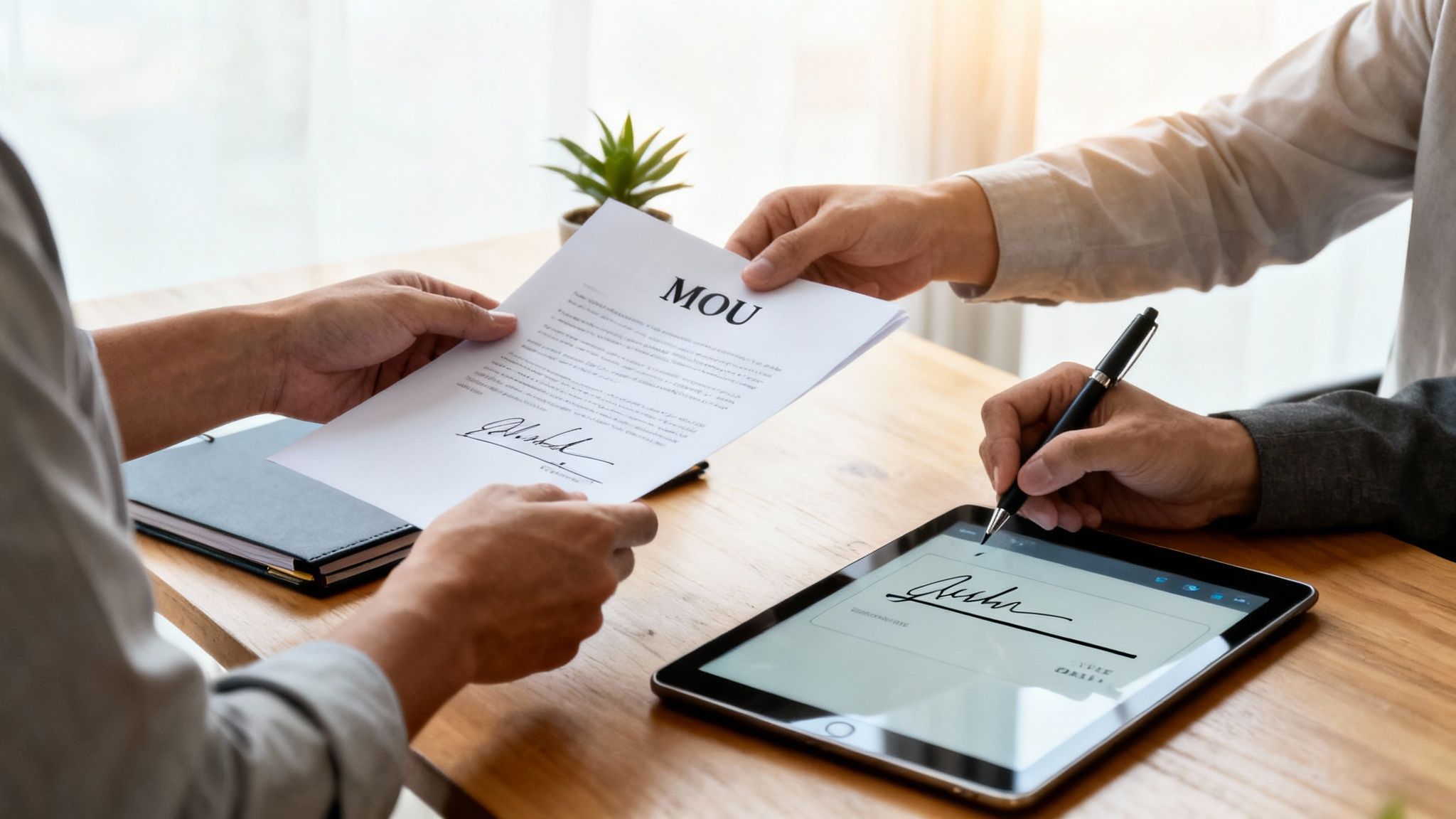
After everyone has had a chance to review it and you've made any final tweaks, you can move on to the official signing. This is where digital tools really come into their own.
Using Digital Tools for Secure Execution
The old days of printing, scanning, and posting documents are well and truly behind us. In Australia, using a dedicated platform for electronic signatures is now the standard. It’s a secure, efficient, and legally recognised way to formalise agreements.
A good digital process creates a cryptographic audit trail, a secure, time-stamped record of who signed and when. This actually provides a stronger level of verification than a traditional 'wet ink' signature. Platforms like Payly offer a really straightforward way to handle this whole workflow. If you're interested in the tech, you can find out more about our secure e-signature solutions.
This approach also keeps your important documents in one central place. Instead of digging through old emails or files, your signed MOU is stored securely, ready to be referenced whenever you need it. This organised method ensures nothing gets lost in the shuffle and helps keep your business operations tidy from day one.
Got Questions About MOUs? We’ve Got Answers.
Jumping into a Memorandum of Understanding can bring up a few tricky questions, even when you’re starting with a solid template. It’s completely normal. Most people I’ve worked with have the same queries, especially when it comes to the legal nitty-gritty.
Let’s tackle some of the most common questions head-on so you can get your MOU sorted with confidence.
Is an MOU Actually Legally Binding in Australia?
This is the big one, and the short answer is usually no. In Australia, a properly written MOU isn't meant to be a legally binding contract. Think of it more as a formal handshake. It maps out everyone's intentions and sets the stage for future discussions, but it doesn't create legal duties you can be sued over.
Here’s the catch, though. The language you use is critical. If your MOU accidentally ticks all the boxes of a legal contract (like a clear offer, acceptance, and something of value being exchanged) and you don't explicitly say it's non-binding, a court could see it differently. This is exactly why a crystal-clear non-binding clause is an absolute must-have.
What's the Real Difference Between an MOU and a Contract?
It all boils down to intention versus obligation.
An MOU is the "let's get on the same page" document. It’s where you and your potential partner outline your shared understanding and sketch out a plan before making any hard-and-fast legal commitments.
A contract, on the other hand, is a legally enforceable deal. It creates solid rights and responsibilities. If someone drops the ball on their contractual duties, the other party has legal options. An MOU doesn't give you that kind of leverage; its job is to be the stepping stone to a formal contract later on.
Key Takeaway: An MOU is a non-binding roadmap of a shared vision. A contract creates legally binding promises that can be enforced in court.
Can I Just Draft an MOU Myself Without a Lawyer?
For many straightforward scenarios, absolutely. Using a well-crafted memorandum of understanding template is often all you need, especially if the stakes are relatively low and you just want to align on goals and who’s doing what. A good template gives you the guardrails you need.
However, it’s smart to get a lawyer involved if your situation gets more complicated. I’d always recommend seeking professional advice when:
- There’s a significant amount of money on the line.
- You’re dealing with complex intellectual property rights.
- The partnership is particularly high-stakes or involves parties from other countries.
When things move beyond a simple arrangement, a lawyer can make sure you're properly protected.
How Long is an MOU Supposed to Last?
An MOU isn't a "forever" document. It should have a clearly defined expiry date built right into it.
Typically, an MOU comes to an end in one of two ways. It might have a fixed timeline (for example, "This MOU is valid for six months from the date of signing"), or it can be set to automatically dissolve once a formal, binding contract is put in place.
Having a clear termination clause is essential. It ensures the MOU serves its purpose as a temporary guide and is then neatly replaced by the final agreement, leaving zero confusion about which document is in charge.
Ready to manage your agreements with confidence? With Payly, you can handle everything from tracking time and sending invoices to securing legally binding e-signatures on your documents. Stop switching between apps and bring your business operations into one smart platform. Start your free 14-day trial today.
Payly Team
Sharing insights and strategies to help service businesses thrive. Follow Payly for more tips on time tracking, invoicing, and business operations.
Related Articles
Ready to streamline your business?
Join thousands of freelancers and agencies who use Payly to track time, send invoices, and get paid faster.