
Wet Signature Meaning: What It Is and Why It Matters
Discover the wet signature meaning and how it compares to ink and electronic signatures, so your contracts stay compliant.
Payly Team
January 21, 2026
Before digital was the default, there was only one way to sign on the dotted line: with a pen. This classic, ink-on-paper signature is what we now call a wet signature.
It's a term that comes from the literal wet ink left on the page as you sign your name. Think of it as the original, time-tested method for showing you agree to something - a physical mark that has sealed deals and finalised agreements for centuries.
What Exactly Is a Wet Signature?
A wet signature is the physical, handwritten mark you make on a document. It’s the kind of signature you’d use to sign a birthday card, a cheque, or the contract for your first car.
The act itself is simple, but it carries a lot of weight. When you physically sign a document, you’re performing a deliberate action that signals your clear consent to the terms written on the page. It's a personal, tangible act of commitment.
The Key Ingredients
What makes a wet signature legally and historically significant? It really comes down to three core ideas:
- A Physical Act: Someone has to physically hold a pen and apply it to the paper.
- Clear Intent: The action of signing is universally understood as an intention to be bound by the document’s contents.
- Personal Touch: Everyone's handwriting is slightly different, making the signature a unique identifier, much like a fingerprint.
Here's a quick summary of what defines a traditional wet signature.
Wet Signature at a Glance
| Attribute | Description |
|---|---|
| Method | Applying ink from a pen directly onto a physical document. |
| Medium | Paper or another tangible surface. |
| Verification | Visual comparison of the signature against a known sample. |
| Record | A physical, hard-copy document that can be stored. |
This combination of a physical mark and clear intent has made the wet signature a reliable way to verify agreements for a very long time.
A wet signature creates a tangible, hard-copy record of an agreement. Historically, this has been the gold standard for proving consent and identifying forgeries in legal disputes.
In Australia, the wet signature remains a legally powerful tool, especially for high-stakes documents like wills, deeds, and statutory declarations. While digital options have surged in popularity - a trend you can read more about on this report on the Australian digital signature market - the traditional pen-and-paper method still holds a crucial place.
Ultimately, this time-honoured method provides an undeniable record of who signed a document, forming the bedrock of trust in business for generations. Now, let's see how it stacks up against its modern digital counterparts.
Wet Signatures vs. Electronic Signatures in Australia
While a wet signature involves physically putting pen to paper, an electronic signature (or e-signature) is its modern, digital equivalent. The easiest way to think about it is like the difference between a handwritten letter and an email. Both get the message across, but how they’re created, sent, and verified are worlds apart. A wet signature relies on the unique characteristics of your handwriting, whereas an e-signature uses digital means to verify your identity and show your intent.
For Australian businesses, this isn't just a matter of preference; it's about efficiency. E-signatures let you send a service agreement to a client on the other side of the country and have it signed and returned in a matter of minutes. Better yet, they automatically create a digital audit trail, capturing information like the signer’s IP address and the precise time the document was viewed and signed. It's a level of verification that paper trails struggle to match.
Understanding the Legal Landscape
So, are e-signatures actually legitimate in Australia? Absolutely. Their legal standing is cemented by the federal Electronic Transactions Act 1999 and similar laws in each state and territory. In short, these laws state that an electronic signature is just as valid as a traditional wet signature, as long as a few key conditions are met.
Generally, for an e-signature to hold up, it needs to satisfy these points:
- Identity Verification: You must use a reliable method to confirm who the signer is.
- Consent: The signer must clearly show they agree to the terms within the document.
- Agreement to Use Electronic Method: Everyone involved must be on board with using an electronic method for the transaction.
It's a common misconception that an e-signature is just a scanned image of your name. The reality is more nuanced. An e-signature is a broad legal term for any electronic process that signals acceptance. A digital signature, on the other hand, is a specific, highly secure type of e-signature that uses cryptography. You can dive deeper into this in our guide on the differences between digital and electronic signatures.
This legal backing makes e-signatures a safe and reliable choice for the vast majority of business documents you handle every day, from client contracts and proposals to invoices and new staff paperwork.
To help you choose the right path, this table breaks down the core differences.
Comparing Wet and Electronic Signatures
| Feature | Wet Signature | Electronic Signature |
|---|---|---|
| Method | Physically signing a paper document with a pen. | Applying a signature electronically via a computer, tablet, or phone. |
| Verification | Relies on handwriting analysis and witness testimony. | Authenticated through digital audit trails, IP addresses, and time-stamps. |
| Speed & Efficiency | Can be slow; requires printing, signing, scanning, or posting. | Nearly instant; documents can be signed and returned in minutes. |
| Security | Susceptible to forgery, loss, or physical damage. | Often more secure, with encryption and detailed tracking logs. |
| Legal Standing (AU) | The traditional standard, legally binding for almost all documents. | Legally binding for most commercial agreements under the ETA 1999. |
| Common Use Cases | Wills, deeds, statutory declarations, certain government forms. | Service agreements, sales contracts, invoices, NDAs, onboarding forms. |
This side-by-side view shows that while both have their place, electronic signatures offer clear advantages for speed and security in most business contexts.
This flowchart can help visualise the first step in your decision-making process.
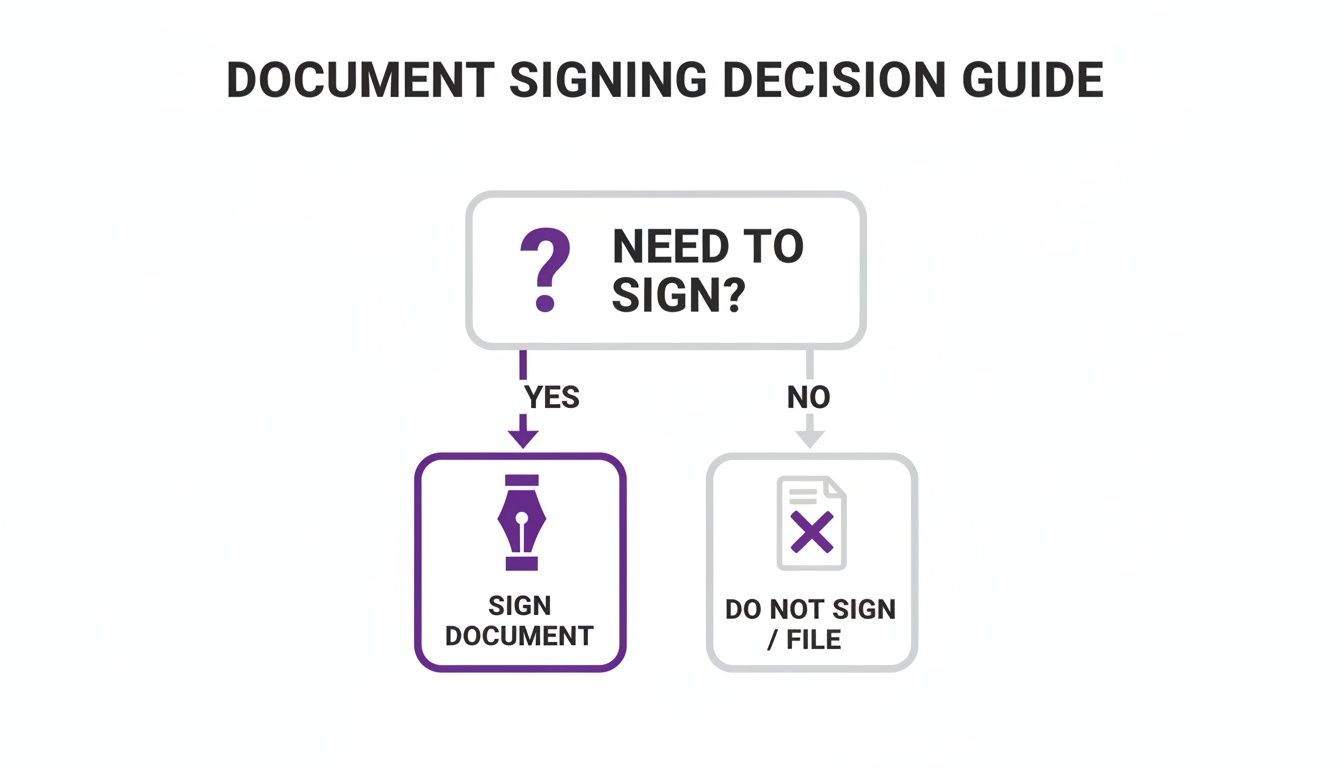
This simple guide helps you quickly determine whether an action is needed on a document you've received.
When Ink Is Non-Negotiable
Even with all the benefits of going digital, there are still times when only a pen will do. In Australia, a wet signature remains the gold standard for certain documents where the absolute highest proof of identity and consent is required.
The Electronic Transactions Act 1999 specifically carves out exceptions for documents like citizenship applications, adoption papers, passports, and some migration forms. For these high-stakes situations, the law insists on the physical act of signing. Knowing when to use ink versus a click is crucial for staying compliant and ensuring your most important agreements are always ironclad.
When Australian Law Still Demands a Wet Signature
Even though electronic signatures are the go-to for most business deals these days, Australian law puts its foot down for a handful of really important documents. These are the high-stakes situations where there’s no room for doubt, and the law insists on the clear, physical proof that only a traditional signature can offer.
Getting this right isn't just about good habits - it's about making sure your most critical agreements are legally sound and can stand up to scrutiny. For life-altering decisions, the physical act of putting pen to paper is a powerful and long-standing way of showing you understand and mean what you’re signing.

The Documents That Demand Ink
Some documents are specifically carved out of laws like the Electronic Transactions Act 1999, meaning an e-signature just won’t cut it. Using the wrong type of signature here could make the whole agreement invalid.
You'll find a wet signature is mandatory in Australia for documents like these:
- Wills and Codicils: To make sure a person's final wishes are carried out without any question, a physical signature is essential.
- Powers of Attorney: When you give someone the legal power to make decisions for you, it’s a big deal that demands the certainty of an ink signature.
- Certain Real Estate Transactions: Many documents tied to land titles and property deeds across different states and territories still need to be physically signed.
- Specific Corporate Documents: Some official papers filed under the Corporations Act 2001 must be signed in person by company directors.
- Statutory Declarations: If you're making a sworn statement of truth, it must be physically signed and properly witnessed.
Why the old-school approach? It all comes down to creating a rock-solid, undeniable record for the most serious legal steps someone can take. These are foundational agreements, and understanding the core elements of a contract really shines a light on why the rules are so strict.
At the end of the day, these rules are in place to protect everyone. By sticking with physical signatures for these key documents, the law helps reduce the risk of fraud or pressure, giving you a solid foundation for your most important legal affairs.
Making the Smart Switch to Digital Signatures
Just because some documents still need a traditional signature doesn't mean your business should be chained to a printer and scanner. For most day-to-day agreements, moving to a digital signing process is one of the smartest operational shifts an Australian service business can make.
Going digital is about so much more than just convenience. It’s a complete upgrade to your workflow that gets rid of the frustrating costs and delays that come with paper. Think about it: no more printing, posting, scanning, or chasing up lost mail. Client agreements that used to take days - or even weeks - to come back can now be sorted in a matter of minutes.
This newfound speed has a direct impact on your cash flow. When documents are turned around faster, you can kick off projects sooner and, crucially, invoice and get paid much quicker.
Building a More Secure and Professional Operation
Modern electronic signature platforms offer a kind of security that paper documents could only dream of. A wet signature relies on someone looking at it and deciding if it’s real. A digital signature, on the other hand, is backed by robust cryptographic security and a meticulous audit trail.
This digital log creates a clear, undeniable history of your agreement from start to finish. It captures all the important details, including:
- Who signed: Identity is verified through email addresses or other secure methods.
- When they signed: A precise timestamp is embedded, which is admissible in court.
- Where they signed: The IP address of the signer is recorded, adding another layer of verification.
This comprehensive audit trail gives you far more visibility and control over your agreements. It creates a tamper-evident record that often holds up even better in a legal dispute than a simple squiggle of ink.
By embracing this technology, you instantly look more polished and organised to your clients. It sends a clear message that you value their time and take security seriously, which helps build trust right from the get-go. Exploring tools like E Signature Card services can be a great starting point for streamlining your document workflows.
Ultimately, making this switch frees you up from tedious admin. It lets you redirect your energy back to what you do best: delivering outstanding service and growing your business.
Best Practices for Managing Your Signed Documents
Whether you’ve signed a document with a pen or a click, that agreement is a critical business record. It needs to be protected. Setting up a clear, simple system for managing both your wet and electronic signatures isn’t just about being organised - it's about compliance and giving yourself some peace of mind.
When it comes to paper documents, your main goal is to prevent them from getting lost, damaged, or seen by the wrong people. This means thinking beyond the old filing cabinet in the corner. You'll want to store your paper records somewhere secure and climate-controlled, keeping them safe from things like dampness, pests, and even fading ink.

Organising Your Physical Records
Having a solid system for your ink-signed documents means you can find what you need, when you need it - especially if you’re facing an audit or a legal query. Here are a few practical steps to get it right:
- Create a Logical System: It doesn't have to be complicated. Just decide if you'll file by client name, date, or project, and then stick to it. Consistency is everything.
- Use High-Quality Storage: It's worth spending a little on good-quality, acid-free folders and archive boxes. They’ll do a much better job of preserving the paper and ink over the long haul.
- Digitise for Backup: Get into the habit of scanning your most important wet-signed documents. Storing a digital copy securely is a lifesaver if the original ever gets lost or damaged.
While you'll always have some paper to store, shifting to a digital-first mindset for everything else is a game-changer for security and efficiency.
Think of a centralised digital repository as the new standard for managing your documents. It gives you secure, instant access to all your agreements and gets rid of the risks that come with stacks of physical paperwork.
Leveraging a Centralised Digital System
For your electronic signatures, the best approach is to use a platform that acts as a secure, central hub for everything. This completely changes how you manage business-critical information. When you’re looking at different systems, make sure you choose one that gives you a complete, tamper-proof audit trail for every document. That digital log is your ultimate proof of who signed, what they signed, and when and where it all happened.
For companies, this goes beyond client agreements. You also need to properly manage official records, so understanding your corporate minute book requirements is key to staying compliant.
In the end, bringing all your signed agreements into one unified system - partly physical, mostly digital - is the smart move. It tightens up security and just makes your whole operation run smoother. If you’re curious about finding the right tools, check out our guide to document management software for small business.
Got Questions About Signatures? We've Got Answers
Figuring out the rules for signatures can feel like navigating a minefield, especially when you're trying to run a business efficiently and stay on the right side of the law. To clear things up, we've tackled some of the most common questions Australian business owners have about wet ink versus electronic signatures.
Getting these details right is crucial for making sure your agreements are solid and you're not left exposed by a simple, avoidable mistake.
Are Scanned Signatures Legally Binding in Australia?
This is a classic "yes, but..." situation. A scanned copy of a document signed in ink can be treated as a valid electronic signature under Australian law, but only if everyone involved agrees to this method upfront.
The real issue is that a simple scan doesn't have the same legal muscle as a signature created on a proper e-signature platform. Those platforms create a secure, cryptographic audit trail that a scanned image just can't match. And for certain documents that legally must have a wet signature - think wills or property deeds - a scanned copy is not a valid substitute. Ever.
Think of it this way: a scanned signature is just a photo of an old-school process. A true electronic signature is a secure digital process from start to finish, giving you a much stronger, verifiable trail that will stand up far better if ever questioned legally.
Can I Use an Electronic Signature for Employment Contracts?
You certainly can. Electronic signatures are not just legally valid for employment contracts in Australia; they've become the standard for most HR paperwork. The Electronic Transactions Acts across the country give this a firm legal thumbs-up.
Using a secure e-signature service is a fantastic way to handle the entire employee onboarding process. It creates a tamper-proof record showing exactly who signed what and when, making your HR workflow smoother from the get-go.
What Happens If a Document Is Signed Electronically When It Needed a Wet Signature?
This is a mistake you really don't want to make. Using an electronic signature on a document that legally requires a wet signature can make the whole thing invalid or completely unenforceable in court.
The fallout can be serious, from a property deal falling through to a critical legal agreement being voided. It really drives home why you need to understand the legal weight behind a wet signature. For any high-stakes document, it’s absolutely vital to check the specific legal requirements to ensure your agreements are always ironclad.
Ready to streamline your client agreements and get paid without the hassle? Payly is your all-in-one solution. We combine smart invoicing, time tracking, and legally binding PDF e-signatures, built specifically for Australian service businesses. Stop juggling different tools and see how Payly makes running your business simpler at https://www.payly.com.au.
Payly Team
Sharing insights and strategies to help service businesses thrive. Follow Payly for more tips on time tracking, invoicing, and business operations.
Related Articles

Ready to streamline your business?
Join thousands of freelancers and agencies who use Payly to track time, send invoices, and get paid faster.