
Employee Time Clock: Boost Efficiency and Compliance (employee time clock)
Discover how an employee time clock can streamline your Australian business. Guide explains types, benefits, Fair Work compliance, and how to pick software.
Payly Team
January 14, 2026
Think of an employee time clock, and you might picture an old, clunky machine that stamps a card. But that's a world away from today's digital tools. Modern time clocks are the bedrock of any successful Australian service business, accurately tracking work hours for payroll, project costing, and legal compliance, all through a web browser, mobile app, or dedicated device.
What Is an Employee Time Clock and Why Does It Matter Now?
Let's get one thing straight: a modern employee time clock is so much more than a digital punch card. It's the central hub for tracking the most valuable resource your service business has: your team's time. At its simplest, it's a way for staff to log their start and finish times, along with any breaks. This creates a perfect digital record of their day.
But its real power goes far deeper than just clocking in and out. This digital log becomes the single source of truth for your most critical operations. For Australian agencies, consultancies, and professional services firms still relying on spreadsheets or notebooks, manual time tracking isn't just inefficient; it's a liability. It creates administrative headaches, is riddled with errors, and directly eats into your profits.
The Problem with Doing It by Hand
The biggest issue with any manual system is simple: inaccuracy. People forget to log their hours, or they guesstimate their timesheets at the end of the week. Those small "fudges" and forgotten minutes seem harmless, but they snowball into massive problems.
- Inaccurate Invoicing: If you under-report your hours, you're literally giving away your services for free. That's revenue straight out the door.
- Payroll Errors: Over-reporting leads to overpaying staff, while getting overtime wrong can land you in serious trouble with regulators.
- Zero Real Insight: How can you know if a project is actually profitable? Or which client is taking up all your team's time? Without precise data, you're just guessing.
A digital employee time clock solves all of this. It creates an automated, undeniable record of every single billable minute, turning time tracking from a chore into a powerful business tool.
The Foundation of Profitability and Compliance in Australia
For businesses in Australia, meticulous timekeeping isn’t just good business sense; it’s the law. The standard full-time workweek is locked in at 38 hours under the National Employment Standards of the Fair Work Act. This means employers have a legal duty to record every hour worked, including overtime and leave, to ensure everyone is paid correctly and avoid hefty fines. You can explore this guide on Australian working hours to get a better handle on these obligations.
A digital system helps you nail compliance almost effortlessly. The screenshot below shows how a platform like Payly weaves time tracking right into your project workflows.
As you can see, employees don't just clock on; they log time against specific projects and tasks. This gives managers a crystal-clear, live view of where resources are going and how budgets are tracking. When you connect time directly to projects, you suddenly have the intelligence to make smarter, more profitable decisions.
Comparing Different Types of Employee Time Clocks
Choosing the right employee time clock isn’t as simple as sticking a machine on the wall anymore. The options have exploded, moving well beyond physical hardware to flexible software that works for today’s dynamic workforce. For any Australian business, getting your head around the key differences is the first step to finding the perfect fit.
The whole idea started with traditional hardware, where your team had to be physically present to clock in. While those systems have evolved, they've been largely overtaken by nimbler, software-based tools that offer far more freedom, especially for service-based businesses.
Traditional Hardware Time Clocks
Hardware time clocks are exactly what they sound like: physical devices you install at a specific spot, like an office, workshop, or job site. For decades, they were the only game in town and came in a few main flavours.
- Punch Card Machines: The old-school mechanical clock that stamped a paper card. They’re mostly relics now, but they were the original form of automated time tracking.
- Card Swipe Systems: A step up from punch cards, these use magnetic stripe or proximity cards (think key fobs) for clocking in and out. They're quicker but still tie your staff to a physical terminal.
- Biometric Scanners: The most advanced hardware option, these devices use unique biological markers like fingerprints or facial scans to confirm an employee’s identity. This approach is fantastic for eliminating “buddy punching,” where one employee clocks in for a mate.
Even though biometric systems offer great security, all hardware solutions have the same fundamental drawbacks. They hit you with a big upfront cost for the device and installation, they offer zero flexibility for remote or field staff, and they can be a real headache to scale up as you hire more people.
Modern Software Time Clocks
Software has completely rewritten the rules, offering an agility that hardware just can't compete with. Instead of a physical box, your team logs their hours through an app on a computer, tablet, or phone. This approach is built for the way modern businesses actually operate.
Generally, software-based time clocks fall into a few camps:
- Desktop Applications: These apps are installed on an employee’s computer, often running quietly in the background to track activity and sync data without getting in the way.
- Web-Based Platforms: The most common solution today, these are accessed through any internet browser. There’s nothing to install, and both employees and managers can get to the data from anywhere.
- Mobile Apps: An absolute must-have for teams on the move. Mobile time clock apps let staff clock in from a client’s site, track their travel time, and even snap photos of receipts for expenses, all from their phone. Many even use GPS for location verification.
As this chart shows, the benefits of a modern digital time clock ripple out from simple time entry to touch every part of the business.

It’s clear that a digital system isn't just a tracking tool. It's a strategic asset that directly boosts your bottom line, keeps you compliant, and makes day-to-day operations run a whole lot smoother.
Hardware vs Software A Direct Comparison
When you put these two options head-to-head, the benefits of software really stand out, particularly for agile Australian service businesses. Hardware is rigid and expensive upfront, while software is flexible, easy to scale, and designed for operational efficiency.
For a modern business, especially one with remote or hybrid teams, software provides the essential agility to track time accurately without being tied to a physical location. It simply aligns with how work gets done today.
To make the choice even clearer, let's break down how hardware and software stack up against each other across the things that really matter to a business owner.
Hardware vs Software Employee Time Clock Comparison
Here’s a feature-by-feature comparison showing the practical differences between a traditional hardware clock and a modern software solution.
| Feature | Hardware Time Clocks (e.g., Biometric, Card Swipe) | Software Time Clocks (e.g., Payly) |
|---|---|---|
| Upfront Cost | High (purchase of physical units and installation) | Low to none (typically a monthly subscription) |
| Flexibility | Low (fixed to a physical location) | High (accessible from any web browser or mobile device) |
| Scalability | Difficult (requires purchasing new hardware) | Easy (add or remove users with a few clicks) |
| Integrations | Limited (often requires custom development) | Extensive (seamlessly connects to payroll and accounting software) |
| Maintenance | Ongoing (physical repairs and software updates) | None (handled by the software provider) |
In the end, while hardware clocks solved yesterday's problems, software solutions like Payly are built for the challenges of today and tomorrow. They give you the data, flexibility, and integrations you need to not just track time, but to actively grow your business.
The Real-World Benefits of a Digital Time Clock
Switching to a digital employee time clock is about so much more than just recording when people start and finish. It becomes the engine room for smarter business decisions, giving you clear insights into payroll, project costs, and how your team operates. The advantages aren't just about convenience; they fundamentally improve how your business runs.
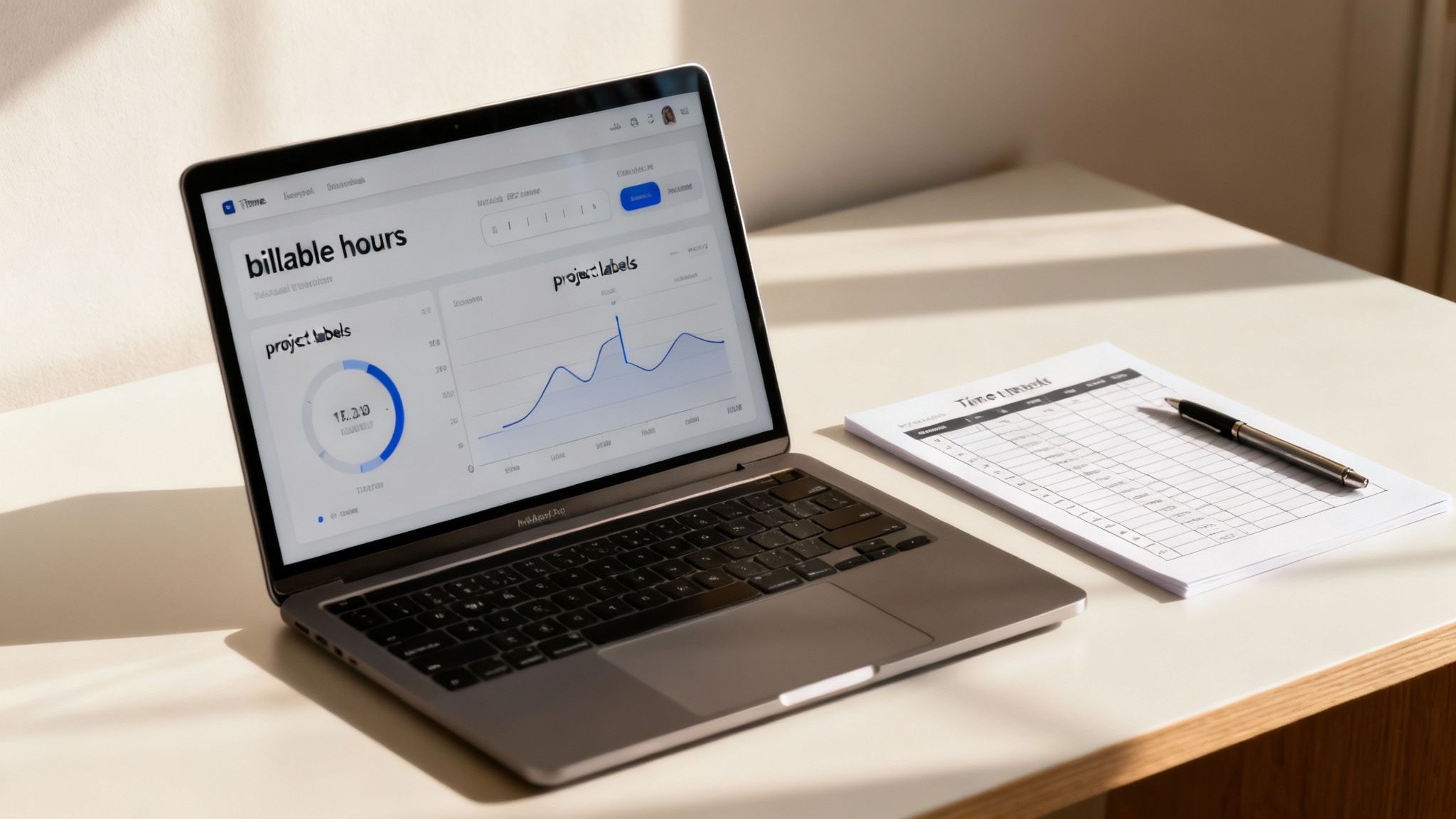
The first place you’ll notice the impact is your bottom line. When you ditch manual timesheets, payroll accuracy skyrockets, and those costly human errors disappear. Every minute of work, including overtime, is captured and calculated perfectly. This ensures you're paying your team fairly for their effort without accidentally overpaying due to rounding errors or guesswork.
Drive Smarter Project Management
A digital time clock isn't just a payroll tool; it’s a massive asset for managing projects effectively. When your staff can log their time against specific clients, projects, or even individual tasks, you suddenly get a crystal-clear view of your operations.
This data shows you exactly where your team’s time and energy are being spent. You can finally get solid answers to crucial questions. Are certain clients eating up more hours than you budgeted for? Are some types of projects far more profitable than others? Accurate time allocation gives you the confidence to make informed decisions.
For any service-based business, like a creative agency or a consultancy, this is a complete game-changer. It turns time tracking from a tedious admin task into a strategic tool for analysing profitability and controlling budgets.
Think about a marketing agency running a big campaign. By tracking every hour spent on design, copywriting, and account management, they can see in real-time if the project is on track with its budget. If the hours start to climb, they can step in and fix it immediately, instead of finding out they've made a loss weeks after the project is done.
Foster Transparency and Trust
Putting a clear and accurate time tracking system in place helps build a stronger, more transparent relationship with your team. Employees have a clear record of their hours, and you have the data to back up every single payslip.
This clarity eliminates any confusion or potential disputes over hours worked. It helps build a culture of accountability where everyone understands the value of their time and sees how it directly contributes to the business's goals. An employee clock in app is one modern way to simplify this whole process.
Improve Resource Planning and Wellbeing
For Australian businesses, the data from a digital time clock is crucial for more than just compliance. With employees often working long hours, understanding individual workloads is key to preventing staff burnout and holding onto your best people.
Recent analysis shows that Australian workers logged an average of 1,694 hours per employee each year. This is a critical trend to watch, especially when over a third of workers have reportedly left jobs due to long hours and burnout from unrecorded overtime. An accurate time clock makes sure every hour is counted, which helps prevent overwork and guarantees people are paid for their time.
This information helps you spot team members who are consistently overloaded, allowing you to proactively shift resources or adjust project timelines. Your time tracking system becomes a tool for supporting your team’s wellbeing, which is absolutely vital for building a productive and sustainable workforce.
Navigating Fair Work and Australian Compliance
For any Aussie business owner, getting your head around time and wage records isn’t just good practice; it's the law. The Fair Work Act 2009 lays down some pretty strict rules, and having an accurate employee time clock has shifted from a "nice-to-have" to an essential tool for keeping your business safe.
Let's be clear: failing to keep proper records can land you in serious hot water. We're not talking about a slap on the wrist. Breaches of federal law can lead to hefty fines, orders to back-pay staff, and a real hit to your reputation. At the end of the day, the onus is on you, the employer, to prove you're paying your team correctly for every single hour they work.
Your Core Obligations Under the Fair Work Act
The Fair Work Ombudsman doesn't mince words: employers are required to keep accurate, up-to-date records for everyone on their payroll. This isn't just a vague suggestion; there are specific details you absolutely have to track.
Here’s a quick rundown of what you must record:
- Ordinary Hours Worked: A simple, clear log of when each employee starts and finishes their shift.
- Overtime Hours: Any time worked outside of ordinary hours needs to be recorded separately. This is crucial for making sure you’re paying the correct penalty rates under their modern award or agreement.
- Leave Entitlements: You need a running tally of all leave taken (annual, personal, or long service) and a clear record of the remaining balance.
- Breaks: Even unpaid meal breaks need to be logged to show your team is getting their proper rest periods.
And here’s the kicker: you need to keep these records in a legible, easily accessible format for a minimum of seven years. Trying to manage this with paper timesheets or a tangle of spreadsheets is a massive headache just waiting to happen.
The Complexity of Modern Awards and Pay Rates
Australia's workforce is a mix of different roles, work patterns, and pay structures. A May 2023 ABS survey revealed that managers work an average of 36.8 hours at $67.20 an hour, while part-timers now make up a huge 41.2% of all employees. With such a diverse team, getting time tracking right is the only way to meet Fair Work standards and avoid underpayment claims. You can discover more insights about these workforce statistics on abs.gov.au.
A reliable employee time clock removes the guesswork from compliance. It creates an automated, tamper-proof digital record that directly helps you meet these strict legal standards, protecting your business from costly disputes.
Juggling different modern awards only adds to the challenge. Each award comes with its own set of rules for minimum wages, how overtime is calculated, penalty rates for weekends and public holidays, and various allowances. A manual system is just asking for human error, which can easily spiral into a major underpayment issue.
New Developments and Creating Clear Boundaries
The ongoing conversation about work-life balance is also changing the legal goalposts. The recent 'right to disconnect' legislation in Australia really drives home the need for clear lines between work and personal life, and a time clock is a perfect tool for this.
It provides an official record of when the workday begins and ends, making sure that any work done outside these hours is properly accounted for and paid. For a deeper look at this, you can learn more by checking out our guide on tracking employee time. This level of transparency protects your staff from working for free and protects you from claims about unpaid overtime. A digital time clock is simply the smartest way to keep your business fair, compliant, and protected.
What to Look for in a Modern Employee Time Clock
Picking the right employee time clock isn’t just about finding a fancy stopwatch. A truly modern system should work as a powerful partner in your business, automating the boring stuff, giving you real-time insights, and keeping everything above board with compliance. This checklist will walk you through the features that actually make a difference.
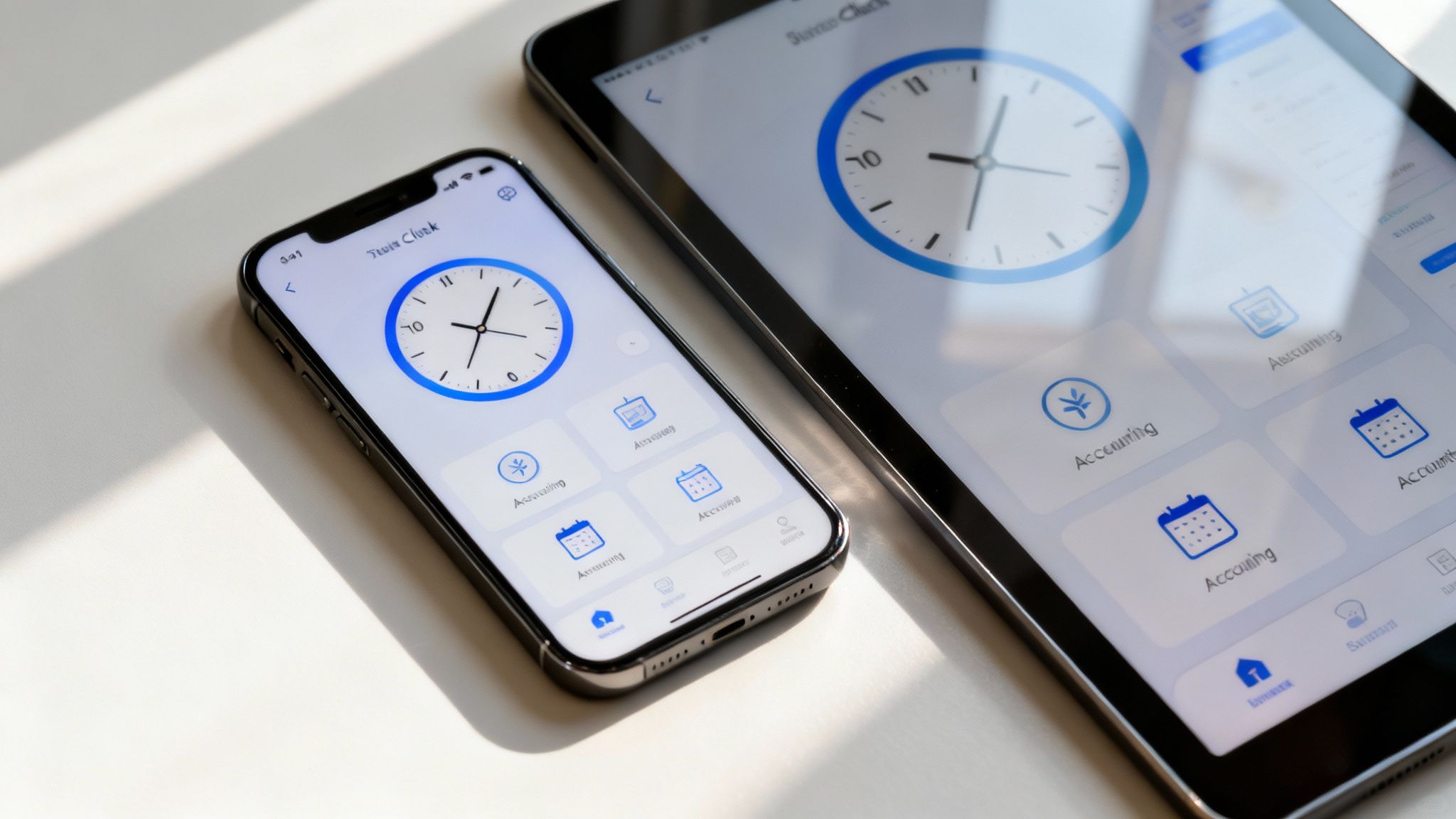
First things first: you need a system that meets your team where they are. A clunky, office-only clock just doesn’t cut it anymore with today’s flexible work styles. For a modern business, true mobility is a must-have.
Core Functionality and Accessibility
At its heart, any time clock worth considering has to be flexible. Your team needs to be able to track their hours accurately, whether they’re at a desk, on a client site, or working from the kitchen table.
Here are the non-negotiables to look for:
- Mobile and Web Access: Your team should have the freedom to log time from any device, anywhere. A proper mobile app for both iOS and Android, backed by a solid web platform, means no one has an excuse for not tracking their hours.
- Automatic Timesheets: The whole point of a system is to cut down on admin. It should take every minute tracked and automatically turn it into a clean, professional timesheet. This simple feature saves countless hours and prevents those little errors that can lead to big payroll headaches.
- Detailed Project and Task Tracking: It's not enough to know when someone is working; you need to know what they're working on. The ability for employees to assign their time to specific clients, projects, or tasks gives you the detailed data needed to see what’s actually profitable.
Nailing these fundamentals ensures the system is not only easy for your team to adopt but also gives you data you can trust. You can dive deeper into how these elements fit together in our guide to modern time tracking solutions.
Integrations and Australian-Specific Tools
A great employee time clock shouldn’t be an island. Its real value is unlocked when it talks to the other software you rely on every day, creating a smooth, connected workflow across your business.
When it comes to compliance and audits, a good time clock is also essential for maintaining efficient record-keeping practices. The right software makes this effortless by plugging directly into your financial systems.
For Aussie businesses, these integrations and local features are crucial:
- Accounting Software Integration: Look for a system that plays nicely with platforms like Xero, MYOB, or QuickBooks. This lets you sync timesheet data straight across for payroll and invoicing, completely eliminating the need to enter data twice.
- Built-in GST Calculation: Any tool built for Australia should handle Goods and Services Tax without a fuss. The ability to automatically add GST to invoices is a massive time-saver and keeps you on the right side of the ATO.
- State-Specific Public Holiday Calendars: Public holidays are all over the place in Australia, varying from state to state. A system with these calendars built-in ensures overtime and penalty rates are calculated correctly every single time, with no manual checking needed.
When you choose a platform with these features baked in, your time clock stops being a simple tracking tool and becomes the engine room of your operations. It automates your workflows, guarantees accuracy, and gives you more time to focus on what matters: growing your business.
Making Your Business Flow with Payly
Picking the right time clock system is a big decision, but tracking hours is only half the battle. The real win is finding a tool that connects those hours to everything else, from payroll right through to invoicing. This is where an all-in-one platform like Payly really shines for Australian service businesses.
Payly isn’t just another time clock. Think of it as the central hub for your operations, linking the time your team puts in directly to the money you earn. It cuts out the admin headaches and manual errors that eat up your day, replacing the need to juggle separate tools for timesheets, invoicing, and document storage.
From Time Tracked to Invoice Paid
Picture this: your team tracks their hours on a project using a simple app on their phone or computer. As soon as they do, that time populates a clean, accurate timesheet. Then, with a couple of clicks, you turn those timesheet entries into a professional, branded invoice and send it straight to your client.
That’s the magic of Payly. It creates a smooth, unbroken line from work done to money in the bank. You can finally say goodbye to the tedious task of copying numbers from a spreadsheet into your accounting software. Every billable minute is captured, so your invoices are spot on, every single time.
The interface is designed to be clean and straightforward, making it easy to manage everything in one place.
This integrated workflow means less time spent on paperwork and more time focused on what you do best: delivering great work for your clients.
Built from the Ground Up for Aussie Businesses
Payly also comes packed with features specifically for the unique demands of operating in Australia. These aren't just nice-to-haves; they're essential for staying compliant and running your business efficiently.
- Integrated GST Tools: No more pulling out a calculator or double-checking your maths. Payly automatically calculates and adds Goods and Services Tax to your invoices.
- Public Holiday Calendars: State-specific public holidays are already loaded into the system, which helps ensure you’re handling pay rates and leave correctly.
- Simple, Account-Based Pricing: A lot of tools charge you per user, which gets expensive fast. Payly’s model is built for small teams and agencies. You pay one flat fee for your account, which saves you a bundle compared to stacking multiple software subscriptions as your team expands.
Payly brings together a powerful employee time clock, invoicing, and business management tools into a single, cohesive platform. It’s one subscription to manage the entire cycle, from an employee clocking in to you getting paid, all while keeping you aligned with Australian compliance.
For any business wanting to improve its processes from start to finish, a unified system is a game-changer. It simplifies everything. If you're also focused on making your hiring process just as smooth, you can learn more about effective employee onboarding. With Payly, you get the tools to not only track time perfectly but to build a more efficient, profitable, and compliant business from day one.
Frequently Asked Questions
It's only natural to have a few questions when you're thinking about bringing a new system into your business. You might be wondering how it works for different types of staff, what it means for your finances, or how it will fit into your daily routine. Let's tackle some of the most common queries we hear from Australian business owners.
Getting these details clear will help you understand the practical benefits and the legal must-haves, so you can make a decision with confidence.
Do I Need an Employee Time Clock for Salaried Staff in Australia?
Yes, absolutely. It's a common misconception that time tracking is only for hourly workers, but for salaried staff in Australia, it's often a legal requirement. The Fair Work Act is very clear: employers need to keep accurate records of all hours worked by employees covered by modern awards, and that includes many salaried roles.
The main reason is to keep a close eye on any overtime hours worked beyond their standard 38-hour week. If your salaried team regularly puts in extra time and you don't have a precise record, you could be facing serious underpayment claims. A digital time clock provides a clear, undeniable log of all hours worked, protecting you and making sure your team is paid fairly.
Think of it this way: accurate time records are your best line of defence in a Fair Work audit. They prove you're on top of workloads and meeting your legal duty to pay for all time worked, not just the contracted hours.
How Does a Time Clock Improve Business Profitability?
A good time clock system can have a surprisingly direct impact on your bottom line. It immediately stops you from losing money by making sure every single billable hour is captured and invoiced. No more guesswork, no more valuable work accidentally given away for free.
But it goes deeper than that. It gives you the hard data you need to figure out which projects are actually profitable. You can see exactly which clients or services bring in the most money for the hours you put in, helping you focus your energy where it counts.
And finally, it takes the pain out of payroll and invoicing. Automating these tasks saves a massive amount of admin time and slashes the risk of costly human errors. That frees you and your team up to focus on the work that actually grows the business.
Is It Difficult to Implement a New Time Clock System?
Not anymore. Modern software-based time clocks, like Payly, are built to be incredibly easy to set up. Forget complicated manuals and lengthy training sessions; the web and mobile apps are so intuitive that your team will pick them up in no time.
Because everything is in the cloud, there's no expensive hardware to buy or maintain. The whole process is managed online, and you can get up and running in minutes.
It’s usually as simple as this:
- Sign up for an account (most offer a free trial).
- Send email invites to your team members.
- Add your first few clients and projects.
- That’s it. You’re ready to start tracking time.
This quick, painless setup means you can start seeing the benefits right away without causing any disruption to your team's work.
Ready to see how an all-in-one platform can make your business operations flow? Payly combines time tracking, invoicing, and e-signatures into one simple system built for Australian businesses. Start your free 14-day trial today and experience the difference at https://www.payly.com.au.
Payly Team
Sharing insights and strategies to help service businesses thrive. Follow Payly for more tips on time tracking, invoicing, and business operations.
Related Articles


Ready to streamline your business?
Join thousands of freelancers and agencies who use Payly to track time, send invoices, and get paid faster.