
Statement of work SOW: A Clear Guide to Prevent Scope Creep
Learn how to craft a statement of work sow that prevents scope creep and clarifies deliverables, roles, and timelines with practical tips.
Payly Team
January 10, 2026
At its core, a Statement of Work (SOW) is a formal, legally binding document that lays out the entire scope of a project. It gets into the nitty-gritty of the work to be done, covering everything from activities and deliverables to the project's timeline. Think of it as the ultimate project blueprint, designed to leave zero room for confusion between you and your client.
Understanding the Statement of Work (SOW)

Can you imagine building a house without a proper architectural plan? You might agree on four walls and a roof, but without the specifics, the result would be a mess. The builder wouldn't know which materials to order, how to lay out the rooms, or when it should all be finished. A Statement of Work serves this exact purpose in any professional service project.
It becomes the single source of truth that maps out every single aspect of the job. This document is the bedrock of your agreement, ensuring everyone involved has the exact same picture of what success looks like. It’s what turns a vague idea into a concrete plan of action.
Why an SOW Is Non-Negotiable
A well-written SOW is your best defence against the project-killing nightmare known as "scope creep." It provides a formal framework that stops misunderstandings and conflicts before they can even start. When expectations aren't clearly documented, projects almost always run into delays, budget blowouts, and arguments that can sour even the best client relationships.
The clarity an SOW brings is critical for:
- Protecting Both Parties: It legally locks in the agreed-upon terms, safeguarding everyone's interests.
- Defining Project Boundaries: It clearly states what’s included in the project and, just as importantly, what’s not included.
- Setting Clear Expectations: Everything from deliverables and deadlines to payment schedules is laid out, so there's no guesswork involved.
A strong SOW forces everyone to think through the project's details before any work begins. This upfront investment in clarity pays for itself many times over by preventing costly assumptions and getting everyone aligned on the goals and responsibilities from day one.
The Legal Standing in Australia
Here in Australia, a signed SOW is a legally enforceable contract. It forms the foundation of the business relationship for the entire project. When disputes pop up over work quality, missed deadlines, or payment issues, it nearly always comes back to what was written and agreed upon in the SOW.
Ambiguous agreements are a massive source of conflict in the professional services industry. In fact, failing to nail down clear terms can lead to formal disputes, which highlights just how important this document is. The Fair Work Ombudsman’s annual report often provides insights into common workplace issues that could have been avoided with clearer agreements. By creating a detailed and unambiguous statement of work sow, you're not just planning a project, you're building a solid foundation for a successful, dispute-free partnership.
The Core Components of an Effective SOW

While no two projects are identical, every truly effective Statement of Work is built on the same handful of non-negotiable foundations. Think of these as the pillars holding up the entire project. They work in tandem to create a crystal-clear picture, wiping out any grey areas or dangerous assumptions before they can cause trouble.
Getting these right isn't just about ticking boxes. It's about understanding why each section matters and how it protects your Australian business. From defining the project’s big-picture goal to spelling out exactly when and how you get paid, these components create a rock-solid framework for success.
Project Purpose and Objectives
Before you get lost in the weeds of what you'll be doing, a great SOW starts with the why. This is your purpose statement, a sharp, clear summary of the project's goals and the value it's meant to deliver. It answers the most important question of all: What problem are we actually trying to solve here?
This section sets the stage for everything else. It makes sure you and your client are on the same page, chasing the same big-picture outcomes, not just ploughing through a to-do list.
For instance, if you're redesigning a website, a strong purpose statement might read: "To redevelop the client's e-commerce website to improve mobile user experience, increase conversion rates by 15%, and slash page load times, with the ultimate goal of driving higher online sales."
A Rock-Solid Scope of Work
This section is the absolute heart of your statement of work sow. It's where you meticulously lay out every single piece of work to be done, breaking the project down into specific tasks, activities, and processes needed to hit those objectives.
You can't afford to be vague here. Ambiguity is the number one cause of scope creep and client disputes. This part needs to be exhaustive, covering every major activity you can think of.
A well-defined scope typically includes:
- Project Tasks: A granular list of the actions you'll take. Think "Conduct keyword research," "Design user interface mockups," or "Develop the backend database."
- Project Deliverables: The tangible things the client will physically (or digitally) receive. This could be a "Brand Style Guide PDF," "A fully functional and tested website," or "A monthly performance report."
- Exclusions: Just as crucial is spelling out what's not included. This draws a firm line in the sand and manages expectations from day one. For example, "This SOW excludes any ongoing SEO management after the website launch."
A well-defined scope is your project's best friend. It's the shared rulebook on what's in and what's out, making it your primary defence against those dreaded "Can you just..." requests down the line.
To help you map this out, here’s a quick breakdown of what each essential SOW section does and why it’s so important.
Essential SOW Sections and Their Purpose
| SOW Section | Key Information to Include | Primary Purpose |
|---|---|---|
| Purpose & Objectives | The "why" behind the project; high-level goals and desired business outcomes. | Aligns both parties on the strategic vision and defines what success looks like. |
| Scope of Work | A detailed breakdown of all tasks, activities, and specific deliverables. | Prevents scope creep by creating clear boundaries for the project work. |
| Exclusions | A clear list of what is not included in the project scope. | Manages client expectations and avoids misunderstandings about out-of-scope work. |
| Acceptance Criteria | Objective, measurable standards that each deliverable must meet to be approved. | Removes subjectivity from the approval process and defines "done." |
| Timeline & Milestones | Key dates, project duration, and significant checkpoints for progress. | Provides a clear roadmap, tracks progress, and helps manage deadlines effectively. |
| Payment Terms | Total project cost, payment schedule, invoice due dates, and payment methods. | Ensures you get paid on time and links financial compensation to project progress. |
By meticulously detailing each of these areas, you transform your SOW from a simple agreement into a powerful project management tool.
Clear Acceptance Criteria
So, how will everyone agree when a deliverable is actually finished and up to standard? That's where acceptance criteria come in. They define the specific, measurable conditions a task or deliverable must meet to be considered complete and officially signed off by the client.
This takes all the guesswork and subjectivity out of the approval process. It replaces a vague "I'll know it's right when I see it" with clear, objective benchmarks that anyone can check.
For a website design deliverable, your acceptance criteria might look like this:
- The design must be fully responsive, rendering perfectly on the latest versions of Chrome, Safari, and Firefox.
- All pages must achieve a Google PageSpeed Insights score of 85 or higher on mobile.
- The final design must strictly adhere to the client's brand style guide.
Timelines and Milestones
Every project needs a realistic schedule to keep it on the rails. This section of your SOW should map out the entire project timeline, including a clear start date, a projected end date, and key milestones along the way. Milestones are simply major checkpoints that mark the completion of a significant phase of work.
Tying these milestones to actual dates creates a roadmap that everyone can follow. It helps you and your client see if the project is on track and gives you an early warning if things start to slip. Having legally binding timelines is a crucial part of any service agreement. To understand this better, check out our guide on the essential elements of a contract.
Payment Terms and Schedule
Finally, let's talk money. This section outlines the complete financial agreement, from the total project cost to the payment schedule. It specifies exactly how and when you’ll be paid for your hard work. A smart and common approach is to link payments directly to the completion of those milestones we just talked about.
For instance, a typical payment schedule might be structured like this:
- 30% non-refundable deposit due upon signing the SOW.
- 30% due upon completion of Milestone 1 (e.g., final design approval).
- 40% due upon final project completion and launch.
This kind of structure is a win-win. It keeps your business cash flow healthy and gives the client peace of mind, as they're paying for tangible progress. It's a critical component that ties your work directly to your income.
How to Draft an SOW That Prevents Scope Creep
Scope creep is the silent killer of projects. It rarely announces its arrival; instead, it sneaks in with small, seemingly harmless requests. "Can we just add one more feature?" or "Could you quickly tweak this design?" Before you know it, these little extras have snowballed, derailing your timeline, draining your budget, and testing everyone's patience.
Your Statement of Work is your single most powerful line of defence. Drafting an SOW that actively prevents scope creep isn’t about being difficult or inflexible. It’s about creating such a clear, shared understanding that there’s simply no room for confusion. Think of it as building a strong fence around the project from day one, so everyone knows exactly where the boundaries lie.
The Power of Precision in Your Scope
Vague language is an open invitation for scope creep. Phrases like "provide ongoing support" or "develop a modern website" are practically begging to be misinterpreted. Precision is your best friend here.
Ditch the generalities and use specific, measurable language that leaves no doubt about what you're delivering.
For instance, instead of saying you'll "assist with social media," get granular. Try this: "Create and schedule 12 unique social media posts for LinkedIn and Instagram per month, including custom graphics and copywriting." See the difference? There's no ambiguity about the volume, platforms, or the nature of the work.
Clearly Define What Is Out of Scope
This might be the most underrated part of a great SOW. Explicitly stating what the project does not include is just as important as defining what it does. This "Exclusions" section is where you can proactively shut down any potential assumptions the client might be making.
Listing exclusions clears up grey areas and manages expectations before a single hour of work has been logged.
- For a web design project: "This SOW excludes logo design, content writing, and ongoing SEO services."
- For a consulting engagement: "This SOW does not include the implementation of our recommendations or software procurement."
- For a marketing campaign: "All advertising spend is excluded from this SOW and will be billed separately."
This level of clarity is vital for keeping projects on track and clients happy, especially when project overruns are so common.
Embed a Formal Change Control Process
Let’s be realistic: change happens. The key is to control it. Your SOW absolutely must outline a formal change control process. This gives you an official, agreed-upon procedure for handling any request that falls outside the original plan.
This process isn’t about saying "no" to every new idea. It’s about having a professional system to evaluate, cost, and approve changes, ensuring you’re fairly compensated for any extra work you take on.
A solid change control clause should lay out these simple steps:
- Formal Request: The client must submit all change requests in writing, usually via a "Change Order Request" form.
- Impact Assessment: You'll then assess how the request affects the project’s timeline, budget, and resources.
- Formal Quote: You provide the client with a detailed quote for the additional work, including any adjustments to deadlines.
- Written Approval: Work on the change only begins after the client gives their written approval, typically by signing the Change Order.
This structured approach transforms "scope creep" into "scope evolution," a managed process where changes are handled transparently and profitably. A well-managed project schedule in project management is crucial for keeping track of these adjustments.
Beyond just a great SOW, it's also worth looking into other effective strategies for project scope creep management. By building these safeguards directly into your SOW, you protect your bottom line, keep your client relationships strong, and maintain control from start to finish.
Common SOW Mistakes and How to Avoid Them
Even the most carefully planned project can go off the rails because of a weak Statement of Work. It’s a classic story: small oversights and seemingly harmless ambiguities snowball into major roadblocks, souring client relationships and eating away at your profits. Knowing the common traps is the best way to steer clear of them.
Where do most SOWs go wrong? They make assumptions. They assume the client has the same definition of "complete" as you do, or that they understand all the technical jargon you live and breathe every day. These unwritten assumptions are the fertile ground where disputes take root, turning a promising partnership into a nightmare for everyone.
Vague Language and Ambiguous Scope
One of the biggest culprits is fuzzy, open-ended language. Phrases like "provide general marketing support" or "develop a user-friendly design" are dangerously subjective. They're an open invitation for misunderstanding and the dreaded scope creep.
The fix? Be relentlessly specific. When it comes to building a rock-solid statement of work sow, precision is your best friend.
Before (Vague):
- "The contractor will provide ongoing technical support for the new software."
After (Specific):
- "The contractor will provide technical support limited to bug fixes for the core software application. This support is available via email between 9 am and 5 pm AEST, Monday to Friday, with a guaranteed response time of four business hours. It explicitly excludes new feature development and user training."
See the difference? A vague promise becomes a clear, measurable commitment. There’s simply no room left for misinterpretation.
Forgetting to Define "Done"
This one is huge. How do you actually know when a task is finished and ready for the client to sign off on? Without clear, objective standards, "done" becomes a frustratingly moving target. If you don't include specific acceptance criteria, you're basically leaving the entire approval process up to someone's mood on a given day.
Acceptance criteria are the pre-agreed conditions a deliverable must meet to be considered complete. They take personal opinion out of the picture and create a shared, unambiguous definition of success.
Here’s how to properly nail down your deliverables:
- Be Measurable: Don't say "a fast website." Specify "a Google PageSpeed Insights score of 90+ on mobile."
- Be Specific: Instead of "adheres to brand guidelines," write "complies with all colour palettes, fonts, and logo usage as defined in the Brand Style Guide V2.1."
- Be Binary: Frame each criterion as a simple yes/no question. Can the software process 1,000 transactions per minute? Yes or no.
Disconnected Payment Schedules
Another classic mistake is setting up a payment schedule that isn't tied to actual progress. A schedule based purely on calendar dates (like "50% due on 1st March") is a risk. What happens if the project is delayed for reasons completely outside your control? You’re left waiting for payment.
The solution is simple: link every single payment to the successful completion and formal acceptance of a specific milestone.
- Weak Schedule: Payment due on a set date.
- Strong Schedule: 40% of the project fee is due within seven days of the client's formal sign-off on Milestone 2 (User Acceptance Testing).
This ties your cash flow directly to the value you deliver. It creates a powerful incentive for both you and the client to keep the project moving forward. It’s worth remembering that many common tender mistakes that lead to rejection can be traced back to these kinds of ambiguities in the SOW.
By getting ahead of these common pitfalls, you can turn your SOW from a potential source of conflict into your project’s most valuable asset.
Integrating Your SOW into a Seamless Workflow
A perfectly written Statement of Work is a great starting point, but its real power is unlocked when it stops being just another file and starts acting as the engine for your entire project. A good SOW shouldn’t just be signed and filed away; it needs to be woven into the very fabric of your daily operations. This is how you turn a simple agreement into an active command centre.
When you plug your SOW into a connected workflow, you create a powerful, self-reinforcing loop. The promises you made in the document directly inform the work getting done, the time being tracked, and the invoices going out the door. This isn't just about making things easier; it's about building a foundation of accountability and efficiency from the very beginning.
From Static Document to Dynamic Project Hub
The first step is getting your SOWs out of scattered folders and into a single, secure, and centralised system. A dedicated platform like Payly gives you a secure home for all your documents, letting you organise active SOWs and even create templates from your best work. This simple move ensures your team can always find what they need and, crucially, that everyone is working from the latest approved version.
From that central hub, the workflow integration gets even better:
- Legally Binding E-Signatures: Getting the SOW signed is the first hurdle. Modern platforms provide legally binding e-signatures, complete with cryptographic audit trails. This doesn't just get projects kicked off faster; it adds a layer of security and legal standing that's fully recognised under Australian law.
- Automated Time Tracking: The scope and tasks you carefully defined in the SOW can be linked directly to your time-tracking tools. This allows team members to log their hours against specific deliverables from the agreement, making sure every minute of billable work is captured with precision.
- Smart Invoicing from Milestones: This is where it all comes together beautifully. The payment schedule and milestones from your SOW can automatically trigger the creation of an invoice. Once a milestone is ticked off as complete, the system can generate and send the corresponding invoice without you lifting a finger, slashing manual data entry and billing mistakes.
This diagram shows how fixing common SOW mistakes is the first step toward a smooth workflow.
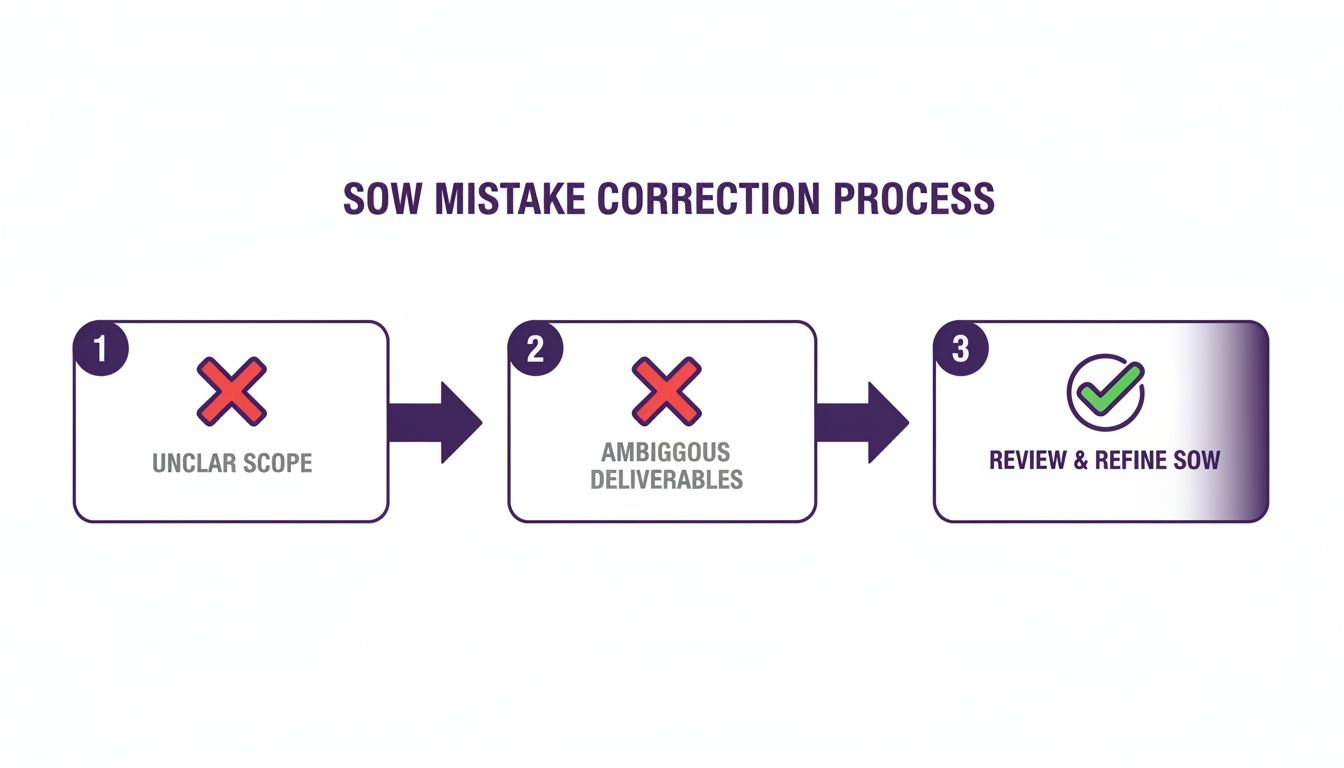
As the visual makes clear, you can't integrate a broken document. Nailing down a clear scope and unambiguous deliverables is the essential groundwork for any successful workflow.
Connecting the Dots for Financial Clarity
The biggest win from an integrated workflow? It forges an unbreakable link between the work you deliver and the money you earn, ensuring you get paid accurately and on time for everything you do. When your SOW, time tracking, and invoicing are all speaking the same language, financial management becomes surprisingly simple.
This kind of cohesive system saves an enormous amount of admin time. While hard data on SOWs specifically is rare, broader research into the Australian labour force from sources like the Australian Bureau of Statistics consistently highlights the need for greater efficiency in the professional services sector.
By turning the terms of your SOW into automated financial actions, you slash the risk of human error, chase fewer late payments, and gain a crystal-clear, real-time view of your project's profitability.
The Power of a Single Source of Truth
Ultimately, bringing your SOW into a wider workflow transforms it from a static file into a living document. It becomes the single source of truth that governs not just the project's scope, but its day-to-day execution and financial health. This level of clarity and control is a cornerstone of great project management.
Platforms that bring all these functions together are often called professional services automation software, and they're built specifically to create this kind of effortless operational flow. Instead of juggling separate tools for signatures, timesheets, and invoicing, everything connects back to the original agreement.
This creates a simple but incredibly powerful feedback loop:
- Agreement: The SOW sets the rules of the game.
- Execution: Your team tracks their work and time against those rules.
- Compensation: Invoices are generated automatically based on the completed work.
This clean, automated cycle is the secret to running more efficient, predictable, and profitable projects. It lets you spend less time bogged down in admin and more time delivering the incredible work your clients signed up for.
Got Questions About SOWs? We've Got Answers.
When you're dealing with project agreements, it's natural for questions to pop up, especially when there's money and legal commitments on the line. A solid Statement of Work is your best mate for keeping everyone on the same page, but let's clear up some of the common queries we hear from Australian service businesses.
Think of this as your quick-fire guide to the stuff that really matters. We’ll get into the nitty-gritty of legal distinctions and practical, real-world situations you'll face when using a statement of work sow.
What’s the Difference Between an SOW and a Contract?
This one trips a lot of people up, but the difference is actually pretty straightforward. Think of it this way: a Master Services Agreement (MSA) is like the overarching rulebook for your entire relationship with a client. It sets out the big, ongoing legal terms like confidentiality, liability, and general payment processes.
The Statement of Work (SOW), on the other hand, is the detailed game plan for a single project that sits under that rulebook. It's a specific type of contract that drills down into the what, when, and how of the work to be done. The MSA is the 'who we are to each other', and the SOW is the 'what we're doing right now'.
Can We Change an SOW After It’s Been Signed?
You bet. But, and this is a big but, it has to be done properly. Projects evolve, and that’s perfectly normal. The key is to have a formal change control process, which should be spelled out in your original SOW. This is your number one defence against scope creep.
Any changes should be handled through a written 'change order' or 'variation request'. This isn't just a quick email; it's a formal document that should cover:
- A clear description of the new or changed work.
- The impact on the project’s cost, no surprises!
- Any knock-on effects for the timeline and milestones.
- Fresh signatures from both sides to make it official.
Following this process turns a potential argument into a managed, and often profitable, adjustment to the project.
Is an SOW Legally Binding in Australia?
Absolutely. Once an SOW is signed by people with the authority to do so at both the client's and your business, it becomes a legally binding agreement in Australia. It has the same legal muscle as any other contract and can be enforced in court if things go south.
This applies to old-school ink signatures and modern digital ones. E-signatures, particularly from platforms that provide a secure audit trail, are fully recognised under Australia’s Electronic Transactions Acts.
This isn't just a formality. It means the terms you've carefully laid out, from your payment schedule to what 'done' looks like, are not just suggestions. They are legally enforceable commitments that ensure you get paid for the incredible work you deliver.
Who Actually Writes the SOW?
Typically, the service provider, that’s you, or your project manager takes the lead on drafting the SOW. It just makes sense. You're the expert on the work being done, so you’re in the best position to define the tasks, deliverables, and timelines with accuracy.
However, it should never be a one-sided affair. Great SOWs are born from collaboration. The client brings their goals and requirements to the table, and you translate that vision into a detailed, practical plan. The final document must be something both parties have read, understood, and agreed to.
How Detailed Should We Make Our SOW?
The short answer: detailed enough that there’s zero room for misunderstandings. The right level of detail really depends on the project itself. A small, simple job might only need a concise SOW, whereas a massive, multi-stage project will demand a document that covers every possible angle.
Here’s a good test: could a complete stranger read the SOW and understand exactly what's being delivered, by when, for how much, and to what standard? If the answer is a clear "yes," you've probably nailed it. When in doubt, always err on the side of being too specific. Vague terms are where disputes begin.
Ready to turn your SOWs from clunky documents into a smart, integrated workflow? Payly pulls together e-signatures, document management, time tracking, and invoicing into one clean platform built for Australian businesses. Ditch the app-juggling and start managing your projects with total clarity. Start your free 14-day trial today.
Payly Team
Sharing insights and strategies to help service businesses thrive. Follow Payly for more tips on time tracking, invoicing, and business operations.
Related Articles



Ready to streamline your business?
Join thousands of freelancers and agencies who use Payly to track time, send invoices, and get paid faster.