
Discover non disclosure statement template: Free guide for Australians
Download a free non disclosure statement template for Australian businesses. Learn how to customise and protect your confidential information.
Payly Team
January 13, 2026
If you’re a freelancer, agency owner, or run a small business in Australia, a non-disclosure statement is your first line of defence. It’s the legal handshake that protects your brilliant ideas and sensitive information, creating a formal, confidential relationship between you and anyone you're sharing with. It's all about making sure your business secrets stay secret.
To get started right away, you can grab this comprehensive and free non disclosure statement template for Australians.
Protecting Your Business Secrets Starts Here

In professional services, your most valuable assets aren't always physical. They're your ideas, your strategies, and your client data. Protecting them isn't just a stuffy legal formality; it's a critical part of staying in business and growing. A non-disclosure statement, often just called an NDA, is your shield against unwanted leaks.
Forget the dense legal jargon for a moment. This guide is about real-world situations where an NDA is absolutely essential. Think of it not as a barrier, but as a smart, strategic tool for protecting your intellectual property and fresh concepts before you share them with the world.
When Is an NDA Absolutely Necessary?
You probably handle confidential information more often than you think. An NDA simply puts a clear framework around these conversations, so everyone knows where they stand right from the start.
Just think about these common scenarios:
- Onboarding Contractors: You’re bringing on a freelance web developer who’ll need access to your backend systems and maybe even some proprietary code.
- Discussing Partnerships: You're exploring a joint venture with another agency, which means you'll need to share your client list and financial projections.
- Pitching New Clients: You’re about to present a killer marketing strategy, complete with unique campaign ideas and your own market research data.
In every one of these situations, having a signed NDA means the other party is legally bound to keep your information under wraps. It builds a foundation of trust, giving you the freedom to collaborate and innovate without worrying about your ideas walking out the door.
An NDA is more than just paper; it’s a clear signal that you take your intellectual property seriously. It professionalises your relationships and gives you legal options if someone breaks that trust.
This guide will not only give you a free, customisable non-disclosure statement template designed for Aussie businesses but will also walk you through tailoring it to fit your exact needs for solid protection. Of course, signing it is only half the battle. Storing these documents properly is just as crucial, and you can learn more about finding the right document management software in Australia to keep your agreements secure and easy to find.
What Makes an NDA Actually Enforceable?
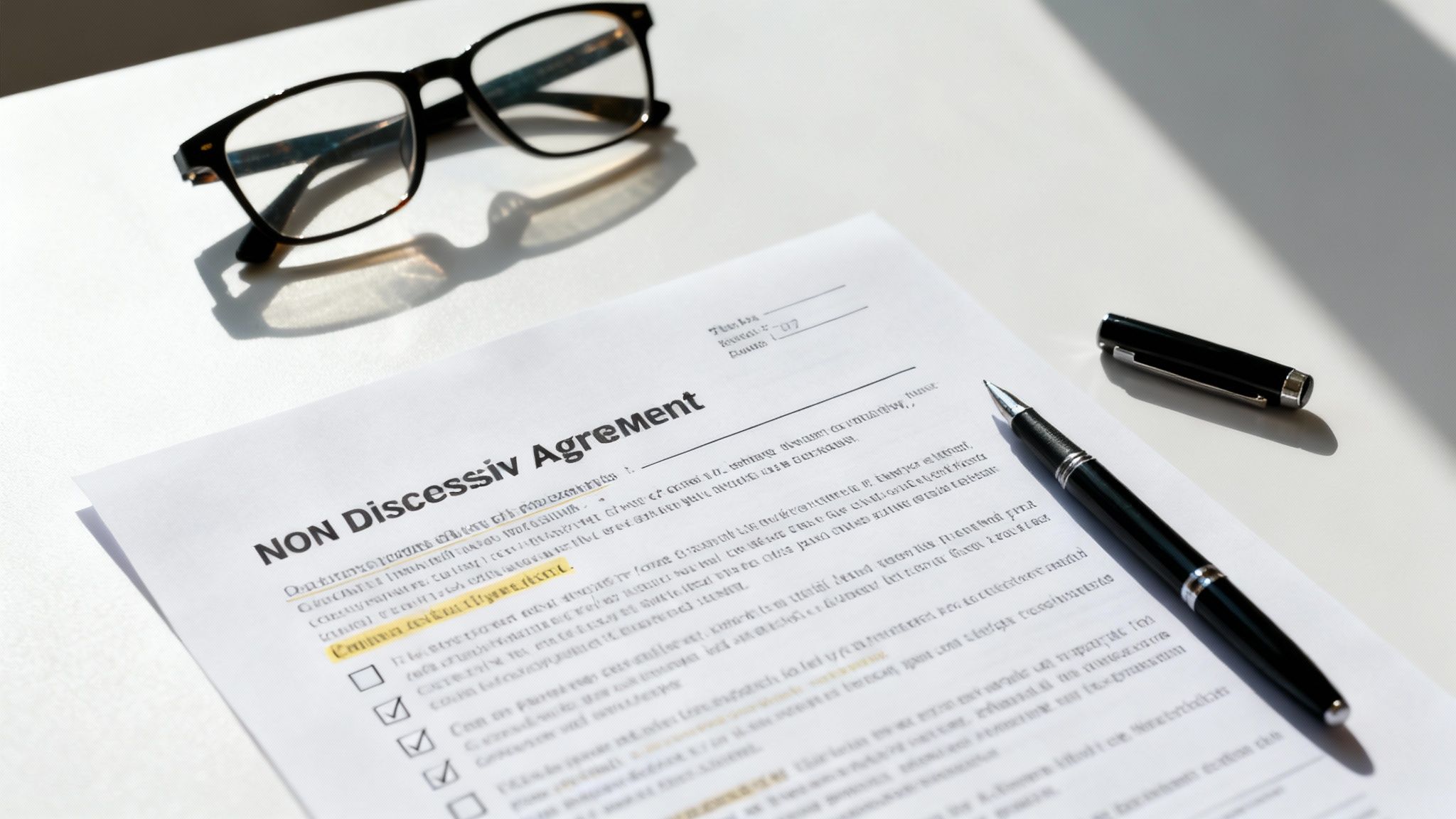
A non-disclosure statement is only as good as the clauses inside it. If these core components are vague or poorly written, the whole agreement might as well be worthless. It gives you a false sense of security, not real legal protection.
Think of it like building a house on a dodgy foundation. It looks fine on the surface, but the moment it’s put under pressure, it’s going to collapse. An NDA with weak, ambiguous terms is exactly the same- it won’t hold up when you need it most.
Let's walk through the essential building blocks that make a non-disclosure statement legally sound and enforceable here in Australia. Getting these right is non-negotiable before you start customising any template.
Identifying the Parties Involved
First things first, you have to nail down exactly who is bound by the agreement. This sounds simple, but it’s amazing how often people get it wrong, potentially voiding the whole document.
Make sure you use the full, correct legal names for every person and business. For a company, that means its registered name (e.g., "Awesome Widgets Pty Ltd"), not just its trading name, along with its Australian Business Number (ABN) or Australian Company Number (ACN).
For example, if you’re a marketing agency hiring a freelance copywriter, you need to list the copywriter’s full legal name (and their business name, if they have one) and your agency’s complete registered details. Zero ambiguity means zero wriggle room later.
Defining What Is Confidential
This is the heart of your NDA. If you get this clause wrong, the rest barely matters. A vague definition of "Confidential Information" is one of the top reasons NDAs get thrown out of court. You have to be crystal clear about what you're protecting.
Your definition needs to be comprehensive, covering things like:
- Business Intel: Financials, client lists, marketing plans, and internal workflows.
- Tech & Data: Source code, proprietary software, product designs, or research findings.
- Intellectual Property: Trade secrets, formulas, patents-in-progress, and any original creative work.
A digital agency, for instance, should spell out that "Confidential Information" includes its specific client acquisition funnel, internal campaign performance data, and the contents of its new business proposals. This level of detail makes it obvious what can’t be shared.
A well-drafted NDA doesn’t just say "keep our stuff secret." It provides a detailed, itemised list of what that "stuff" is, leaving no room for guesswork. Specificity is your greatest asset.
Outlining the Recipient's Obligations
Once you've defined what's confidential, you need to spell out exactly what the person receiving it can and can’t do. This clause lays down the rules of the game.
The core obligations are almost always non-disclosure and non-use. This means the receiving party agrees not to leak the information to anyone else and not to use it for their own benefit or for any reason outside the "Permitted Purpose" you've defined.
This section should also require the recipient to take reasonable steps to keep the information secure- at least to the same standard they would use for their own sensitive data. To really grasp what makes an agreement stick, it helps to understand the fundamental elements of a contract, as these principles form the backbone of any solid NDA.
Specifying Exclusions from Confidentiality
Not every single piece of information can be locked down forever. A fair and reasonable NDA needs to include standard exclusions that define what isn’t considered confidential.
These common "carve-outs" usually include information that:
- Is already in the public domain (through no fault of the recipient).
- The recipient already knew before you shared it with them.
- The recipient developed on their own, without using your confidential info.
- Was given to the recipient by a third party who had a legal right to share it.
Including these exclusions shows you're being balanced and not overreaching. This actually strengthens your NDA in the eyes of a court because it proves you understand the practical realities of how information flows in business.
How to Customise Your NDA, Clause by Clause
Turning a generic NDA template into a legal shield that actually works comes down to getting the details right. A one-size-fits-all approach just doesn't cut it, because no two business situations are the same. Let's walk through how to tailor the most important clauses to fit what you actually need.
Getting these sections right is the difference between a document that’s just a formality and one that gives you real peace of mind. It’s about creating an agreement that’s both strong and fair, and one that will genuinely protect your valuable business information.
Defining the Scope of Confidential Information
The heart of any NDA is the 'Confidential Information' clause. This is where you get specific. A vague definition like "business information" is a recipe for a future argument. You need to spell out exactly what you're protecting.
For instance, a marketing agency sharing its secret sauce shouldn't just say "client data." A much stronger clause would itemise things like:
- Campaign Strategies, including target audience profiles, media buying plans, and creative concepts still under wraps.
- Client Lists and Contacts, right down to the names, contact details, and contract values.
- Performance Analytics, such as internal reports, conversion rates, and cost-per-acquisition data.
- Business Development Materials, like your pitch decks, proposals, and pricing structures.
See the difference? That level of detail leaves zero room for misunderstanding. If you're a software developer bringing on a contractor, you’d focus on things like source code, API keys, database schemas, and user interface designs. The goal is always to be as specific as you can for your industry and the exact information you're sharing.
Think of this clause as drawing a clear, bright line in the sand. Anything you list inside that line is protected. Anything you forget to include might not be.
Setting a Realistic Duration
How long should the secrecy last? This is a critical detail that many templates either leave blank or set for an absurdly long time. The 'Term' or 'Duration' clause specifies the exact period the other party has to keep your information under lock and key.
An indefinite timeframe often won't hold up in an Australian court, as it can be seen as an unfair restriction on someone's ability to do business. What you want is a realistic period that reflects how long the information is actually valuable.
For most commercial discussions, a term of one to three years is pretty standard and considered reasonable. That's usually enough time for project details or strategic plans to become old news. But for genuine trade secrets- think a secret recipe or a unique algorithm- you might specify that the obligation lasts as long as the information legally remains a trade secret.
Clarifying Exclusions from Confidentiality
A good NDA is also a fair one. The 'Exclusions' clause is where you clarify what information is not covered by the agreement, even if it came up in conversation. Including these standard exceptions shows you’re being reasonable, which makes your agreement much stronger if it's ever challenged.
Typically, you'll exclude information that:
- Is or becomes public knowledge (through no fault of the person you shared it with).
- The other party already knew before you told them.
- Is developed independently by the other party, without using your confidential info.
- Is given to them by someone else who had the right to share it.
This clause is all about fairness. It stops the other party from being penalised for information they came across legitimately and helps build trust from the get-go.
Stating the Consequences of a Breach
So, what happens if someone breaks the promise? The 'Remedies' or 'Breach' clause gives your NDA its teeth. This section clearly outlines the actions you can take if your information gets leaked or misused.
Your clause should state that a breach would cause 'irreparable harm' and that money alone might not be enough to fix the damage. That specific wording is crucial because it’s your ticket to getting an injunction from a court. An injunction is a court order that forces the other party to stop what they're doing immediately- which is often way more valuable than suing for damages months down the track.
You can also add that the party in breach has to cover any legal fees you rack up enforcing the agreement. That alone can be a powerful deterrent.
Managing the Return of Information
Once the project is done or the relationship ends, what happens to all your files and data? The 'Return of Information' clause ties up this loose end. It requires the other party to either return or destroy all copies of your confidential information when you ask for it or when the agreement expires.
This covers everything- physical papers, digital files, and even notes they might have made. It’s a simple but vital piece of housekeeping that stops your sensitive data from sitting on someone’s server or in a filing cabinet long after it needs to be.
To help you see how this all comes together, the table below breaks down how different people might tailor these key clauses.
Key NDA Clauses and Customisation Tips
This table summarises the essential clauses and gives you some practical tips on how to tweak them for your specific situation, whether you're running an agency or working as a freelancer.
| Clause | What It Does | Customisation Tip for an Agency | Customisation Tip for a Freelancer |
|---|---|---|---|
| Confidential Information | Defines what is being protected. | Explicitly list client lists, campaign data, and pitch decks. | Specifically name source code, design mockups, or proprietary workflows. |
| Term (Duration) | Sets the time limit for confidentiality. | Use 2-3 years to cover the lifecycle of a typical client project or partnership talk. | Use 1-2 years, aligning with the length of a specific contract or gig. |
| Remedies for Breach | Outlines the consequences of a leak. | Ensure it allows for injunctive relief to stop a competing agency from using your strategy. | Specify that a breach could lead to immediate termination of the contract and legal action. |
| Return of Information | Governs the handling of data after the agreement ends. | Require destruction of all digital campaign assets and client data from their systems. | Mandate the return of all project files and deletion of local copies from their computer. |
As you can see, a few thoughtful customisations turn a standard template into a document that fits your needs perfectly, offering much more robust and practical protection.
Executing and Managing Your Agreements
You’ve gone to the trouble of customising your non-disclosure statement, negotiating the finer points, and getting everyone on the same page. That's great, but a perfectly drafted NDA is completely useless if you can't find it when you actually need it. Once the ink is dry- or the digital signature is applied- your focus needs to shift to proper execution and management. A signed agreement buried in an old email thread or stuffed in a desk drawer offers zero protection.
This is where the rubber hits the road. Getting the execution right ensures your agreement is legally sound from day one, while smart management means you can find and enforce it later on. This isn't just about filing paperwork; it's the final, crucial step in making sure your legal safeguards do their job.
The Shift to Secure Digital Signatures
The old-school routine of printing, signing, scanning, and emailing documents is quickly becoming a thing of the past. Today's businesses need speed and security, which is where digital solutions come in. E-signature platforms offer a legally binding and incredibly efficient way to execute agreements, and they're fully recognised under Australia's Electronic Transactions Acts.
But be aware, not all e-signatures are created equal. A solid system does more than just slap a digitised squiggle on a PDF. What you're really looking for is a comprehensive, cryptographically secure audit trail that meticulously records every part of the signing process.
This trail should capture key details like:
- The IP address of every person who signed.
- Timestamps showing exactly when the document was opened and signed.
- A complete log of all actions each party took.
This level of detail can actually make an e-signature more secure than a traditional one, creating an unchangeable record of who agreed to what and when. Platforms that provide these features turn your NDA into a verifiable legal instrument. If you're looking to bring this into your own workflow, it's worth understanding what a dedicated e-signature solution can do for you.
This infographic breaks down the essential elements you should have already customised in your template before you send it off for signing.
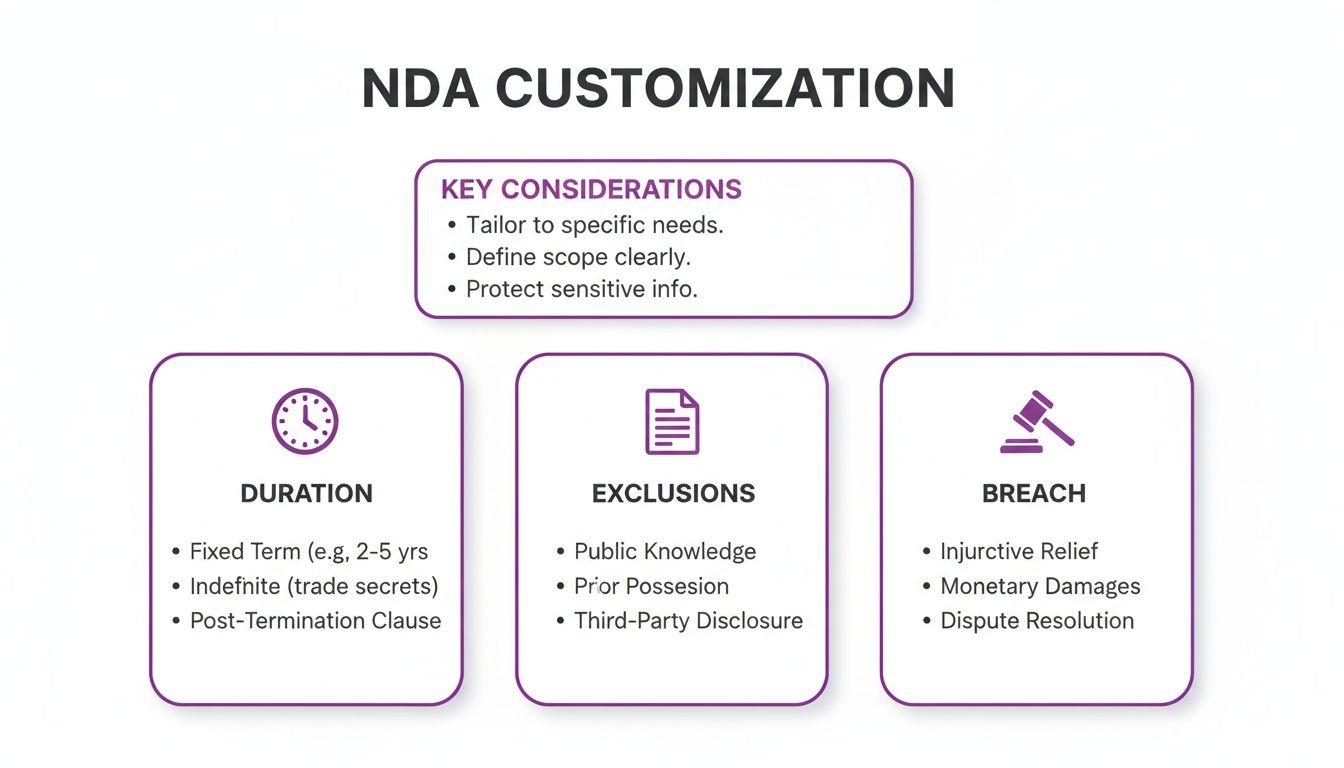
As you can see, the core areas to tailor are always the duration of confidentiality, what information is specifically excluded, and what happens if someone breaches the agreement.
Centralised Storage Is Non-Negotiable
Think of your signed NDA as a valuable company asset, because that’s what it is. Scattering these assets across random email inboxes, personal hard drives, or different desktops is asking for trouble. I’ve seen it happen too many times: a business can't enforce an agreement simply because they can’t find the signed copy when a breach happens.
The answer is a centralised digital storage system. This doesn't need to be some overly complicated, expensive platform. It could be as simple as a dedicated, secure folder in your cloud service or part of a wider document management system you already use.
The goal here is simple: create a single source of truth for all your executed agreements. This way, you or anyone on your team can pull up any NDA in seconds to review its terms and take action if needed.
A well-organised system also helps you keep an eye on important dates, like when an NDA is about to expire. This lets you be proactive. You can decide ahead of time whether you need to renew it, let it lapse, or extend the confidentiality terms with a contractor or partner. This isn’t just good housekeeping; it's fundamental to controlling your intellectual property.
Once your NDA is signed and stored, the diligence continues. Protecting your information often involves your external partners, making robust third-party risk management a crucial part of your overall strategy. By combining secure e-signatures with a disciplined, centralised storage system, you build a complete process that turns your NDA from a piece of paper into a powerful, enforceable asset that actively protects your business.
Common NDA Mistakes and How to Avoid Them
Having a signed non-disclosure statement can make you feel secure, but if it's built on a weak foundation, that feeling is often a false one. So many businesses accidentally rely on agreements riddled with common mistakes, making them difficult- or even impossible- to enforce in an Australian court. These pitfalls can turn what should be a legal shield into little more than a procedural checkbox.
Getting your head around these potential traps is the key to creating an agreement that offers genuine protection. By steering clear of these frequent blunders, you can craft a non-disclosure statement that will actually stand up to scrutiny and safeguard your most valuable information.
Mistake 1: Using Overly Broad Definitions
One of the most frequent errors I see is making the scope of 'Confidential Information' far too broad. It might feel safer to throw in a catch-all phrase like "any and all business information," but this kind of vagueness is a critical weakness. Courts often look unfavourably on clauses so wide they become unreasonable, which can put the entire agreement at risk.
Instead, get specific. If you’re a marketing agency, for example, your NDA should explicitly list things like "client campaign strategies," "internal performance metrics," and "proprietary marketing funnels." The goal is to draw a clear line in the sand around what's protected, leaving no room for ambiguity.
A strong NDA is a precise NDA. Vague terms create loopholes that can be exploited, whereas specificity creates an ironclad agreement that is much easier to defend.
This level of clarity protects both parties. The recipient knows exactly what they can and can’t share, and you have a clear, enforceable list of the specific assets you’re safeguarding.
Mistake 2: Setting an Unrealistic Duration
Another common tripwire is setting an indefinite or ridiculously long timeframe for the confidentiality. An NDA that demands secrecy forever is almost always unenforceable. Australian courts can see this as an unfair restraint of trade, especially when the information naturally loses its commercial value over time.
A much more practical and defensible approach is to tie the duration to the information's relevance.
- For typical project discussions or bringing on a contractor, a period of one to three years is pretty standard.
- For genuine trade secrets, the confidentiality can last as long as the information legally remains a trade secret.
This shows a court that you’ve actually thought about the lifecycle of your information and aren't just trying to unfairly restrict someone's future business activities. A defined, reasonable end date makes your non-disclosure statement significantly stronger.
Mistake 3: Failing to Define What a Breach Looks Like
Your NDA needs to have teeth. It's not enough to just state that information must be kept confidential; you have to spell out what happens if that trust is broken.
A well-drafted agreement should explicitly state that any unauthorised disclosure will cause "irreparable harm" and that financial damages alone may not be a sufficient remedy. This specific legal language is crucial. It opens the door for you to seek an injunction- a court order to immediately stop the leak. Frankly, that’s often far more valuable than chasing money after the damage is done.
By sidestepping these common mistakes, you can turn a generic non-disclosure statement template into a powerful, tailored tool. It becomes a reliable safeguard that actively protects your business secrets, not just a document that gets signed and forgotten.
Your Top NDA Questions Answered
When you're dealing with non-disclosure statements, a lot of questions can pop up. If you're a freelancer or run a small business in Australia, you need clear, practical answers to use these agreements confidently. Let's tackle some of the most common queries I hear.
This isn't about dense legal jargon. It's about giving you straightforward answers so you can understand the finer points and feel secure when you send out an NDA.
When Should I Actually Use a Non-Disclosure Statement?
The simple answer? Any time you're about to share information that could hurt your business if it got into the wrong hands. It’s a crucial step you take before you expose your trade secrets, client lists, or internal strategies.
Think of it as a mandatory ticket to certain conversations. For most Aussie businesses, this looks like:
- Pitching a brilliant new project idea to a potential client.
- Bringing on a contractor or freelancer who needs access to your backend systems or sensitive data.
- Exploring a joint venture or partnership with another company.
- Discussing the potential sale of your business.
In all these cases, an NDA draws a clear line in the sand from the very beginning. Everyone involved knows exactly what’s expected of them.
What’s the Difference Between a One-Way and a Mutual NDA?
It all comes down to the flow of information. A one-way NDA (sometimes called a unilateral NDA) is for when only one person or company is sharing the sensitive stuff. This is super common when you hire a contractor – you're protecting your business information, and they're not really sharing anything confidential back.
A mutual NDA, as the name suggests, is for when both sides are putting confidential information on the table. This is typical when you're exploring a partnership or merger, and you both need to see each other's cards. Our downloadable non-disclosure statement template is built to handle both; you just tweak who you define as the 'Disclosing Party' and 'Receiving Party'.
Are Electronic Signatures Actually Legally Binding in Australia?
Yes, they absolutely are. For most commercial agreements in Australia, including NDAs, electronic signatures are legally sound and enforceable. This is all covered by the Electronic Transactions Acts at both federal and state levels.
For an e-signature to hold up, the method you use has to reliably identify the person signing and show they intended to agree to the terms. This is why a professional e-signature platform is a must-have.
Modern e-signature platforms don't just capture a signature; they create a secure, cryptographic audit trail. This digital log tracks every part of the signing process, which can actually make an e-signature more secure and verifiable than a wet ink signature on paper.
How Long Should an NDA Last?
The duration needs to be realistic and tied to how long the information is actually valuable. A classic mistake is making the term indefinite. An Australian court might see this as an unreasonable restraint of trade and refuse to enforce it.
A term of one to three years is a solid, standard choice for most business dealings. That’s usually enough time for the information to lose its immediate commercial edge. The big exception here is for genuine trade secrets- think a secret recipe or a proprietary algorithm. In that case, the confidentiality can last as long as the information legally remains a trade secret under Australian law.
What Happens if Someone Breaks the NDA?
If someone breaches the agreement and misuses your confidential info, you have options. The 'Remedies' clause in your NDA is your plan of attack. It should state that a breach would cause "irreparable harm," which is legal-speak that opens the door for you to get an injunction.
An injunction is a court order that forces the other party to stop what they're doing immediately. This is often far more valuable than trying to claim monetary damages after the fact. A good NDA will also make it clear that the person who breached it has to cover any legal costs you rack up enforcing the agreement.
Ready to stop juggling different tools for your business admin? Payly brings e-signatures, invoicing, and time tracking together in one simple platform designed for Australian businesses. Forget paying for multiple subscriptions and see how much time and money an all-in-one solution can save you. Start your free 14-day trial today at payly.com.au.
Payly Team
Sharing insights and strategies to help service businesses thrive. Follow Payly for more tips on time tracking, invoicing, and business operations.
Related Articles
Ready to streamline your business?
Join thousands of freelancers and agencies who use Payly to track time, send invoices, and get paid faster.