
Non-Disclosure Agreement Template Australia: Simple, Legal & Secure
Protect confidential info with our non-disclosure agreement template australia. Easy to customize, enforce, and manage.
Payly Team
December 11, 2025

While we provide a simple non-disclosure agreement template for Australia further down, it's crucial to first get a real handle on what an NDA actually is and, more importantly, when you absolutely need one. Think of it as a legal contract, often called a confidentiality agreement, that acts as a shield for the sensitive information you need to share with others. Knowing when to deploy this shield can save your business from a world of trouble.
What Is an NDA and When Do You Really Need One in Australia?
At its core, an NDA is a legally binding promise. It creates a formal obligation for the person receiving your information (the Recipient) to keep it under wraps and not use it for their own gain. Without one, you're essentially handing over your most valuable assets: your groundbreaking ideas, client lists, financial data, and trade secrets, with nothing more than a handshake to protect them.
For Australian businesses, this is a big deal. We don't have a specific "Trade Secrets Act" like some other countries. Instead, NDAs are your go-to tool, fully recognised and enforced under contract law. It’s the primary way you build a legal fence around what makes your business special and keeps you ahead of the competition.

Key Situations Demanding an NDA
So, when should the alarm bells ring, telling you it’s time to get an NDA signed? Certain business interactions are just inherently risky when it comes to keeping secrets. Being proactive in these moments isn't about being paranoid; it's just smart risk management.
To help you identify these moments, here's a quick checklist of common scenarios where an NDA is a must.
Checklist When to Use an NDA in Australia
| Scenario | Why an NDA is Essential | Example |
|---|---|---|
| Pitching to Investors | You're sharing the "secret sauce" of your business: financials, growth plans, and innovative ideas. | You're a tech startup seeking seed funding and need to show investors your proprietary code and user acquisition strategy. |
| Hiring Staff or Contractors | They will get an inside look at your operations, customer data, and internal processes. | You're hiring a freelance marketing consultant who will have access to your entire customer database and upcoming campaign plans. |
| Exploring a Merger or Sale | Both sides must share extremely sensitive financial, operational, and strategic information during due diligence. | Your company is considering acquiring a smaller competitor, requiring a deep dive into their financials and client contracts. |
| Collaborating with Partners | You're working together on a new project and both parties are contributing valuable intellectual property. | You're partnering with another firm to co-develop a new software product, and both engineering teams need to share technical specs. |
Having an NDA in place before these conversations begin ensures everyone is on the same page about confidentiality from the get-go.
An NDA isn't about distrust; it’s about creating a clear, professional boundary. It sets expectations and provides a legal remedy if those boundaries are crossed, giving you peace of mind to share information freely and securely.
The Legal Framework in Australia
In Australia, the power of an NDA comes from common law principles of contract. It’s your formal agreement for protecting business secrets. If someone breaches the agreement, you have a legal path to follow, but you need to act fast.
The statutory limitation periods for taking legal action are typically six years in states like New South Wales and Victoria, but it drops to just three years in the Northern Territory. This highlights just how important it is to address a breach promptly. You can dive deeper into Australian trade secret protections to get a fuller picture of the legal landscape.
Ultimately, an NDA's purpose is to prevent the unauthorised use or disclosure of your confidential information. Without it, trying to prove in court that certain details were meant to be secret can turn into a messy, expensive, and often losing battle. Starting with a solid non-disclosure agreement template in Australia is the first step in formalising this vital protection.
Your Free Australian Non-Disclosure Agreement Template
Here it is: the tool you were looking for. This is a clear, simple, and customisable non-disclosure agreement template, drafted specifically for Australian businesses.
Think of this as your starting point, a solid foundation to build upon. While it covers all the crucial bases, its real value lies in how you adapt it to your specific situation. In the next section, we’ll dive into tailoring the key clauses to make sure it’s a perfect fit.
How to Use This NDA Template
Getting started is easy. Just copy the text below and paste it into your favourite editor, like Google Docs or Microsoft Word. From there, you just need to fill in the information inside the square brackets.
We’ve designed it to be a straightforward and effective base. You’ll need to replace details like [Disclosing Party Name], [Recipient Name], and [Effective Date] with your own specifics. It’s structured to be legally sound for general use across Australia.
A Quick Disclaimer: This template is intended as a guide and isn't a substitute for professional legal advice. It’s always a smart move to have a qualified legal expert look over your NDA to ensure it’s perfectly suited to your business and fully enforceable for your unique circumstances.
Downloadable Non-Disclosure Agreement Template for Australia
NON-DISCLOSURE AGREEMENT (NDA)
Parties:
[Disclosing Party Name] (ABN [Your ABN]), of [Your Business Address] ("the Disclosing Party").
AND
[Recipient Name], of [Recipient's Address] ("the Recipient").
Background:
The Disclosing Party has developed certain confidential information which it wishes to disclose to the Recipient for the purpose of [Specify Purpose, e.g., 'evaluating a potential business relationship'].
Operative Provisions:
-
Definition of Confidential Information: "Confidential Information" means any data or information that is proprietary to the Disclosing Party and not generally known to the public, whether in tangible or intangible form, whenever and however disclosed, including but not limited to:
- (a) business plans, financial information, customer lists;
- (b) concepts, designs, drawings, specifications, techniques, models, data;
- (c) any other information identified as confidential by the Disclosing Party.
-
Obligations of the Recipient: The Recipient shall hold and maintain the Confidential Information in strict confidence for the sole and exclusive benefit of the Disclosing Party.
-
Term: The confidentiality obligations of this Agreement shall remain in effect until [Specify Term, e.g., 'three (3) years'] from the Effective Date.
-
Governing Law: This Agreement shall be governed by the laws of [Specify State/Territory, e.g., 'New South Wales'], Australia.
Executed as an agreement:
Signed for and on behalf of [Disclosing Party Name]:
(Signature)
Name:
Date:
Signed by [Recipient Name]:
(Signature)
Name:
Date:
Once you've tailored it to your needs, you'll need a secure and legally recognised way to get it signed. Using a trusted platform for e-signatures in Australia is the modern way to do this. It gives you a clean, time-stamped audit trail, which can make the agreement much easier to enforce down the track if you ever need to.
How to Customise Your Australian NDA Clause by Clause
An NDA template is a great starting point, but it’s not a finished product. Think of it as a blueprint; its real strength comes from tailoring it to your specific situation. Just using a generic, off-the-shelf template without making any changes is a huge risk. It’s like using a standard key for a custom-built lock; it just won't offer the protection you need.
Let's walk through the most important clauses you'll need to adjust. I'll break down the legalese into plain English so you can feel confident you're creating a document that actually works for you.
Getting these details right is what turns a piece of paper into a proper legal shield. It’s all about clearly defining what’s protected, setting sensible boundaries, and making sure the agreement is a perfect fit for your business needs.
This flowchart maps out the simple decision-making process when you're working with an NDA template in Australia.
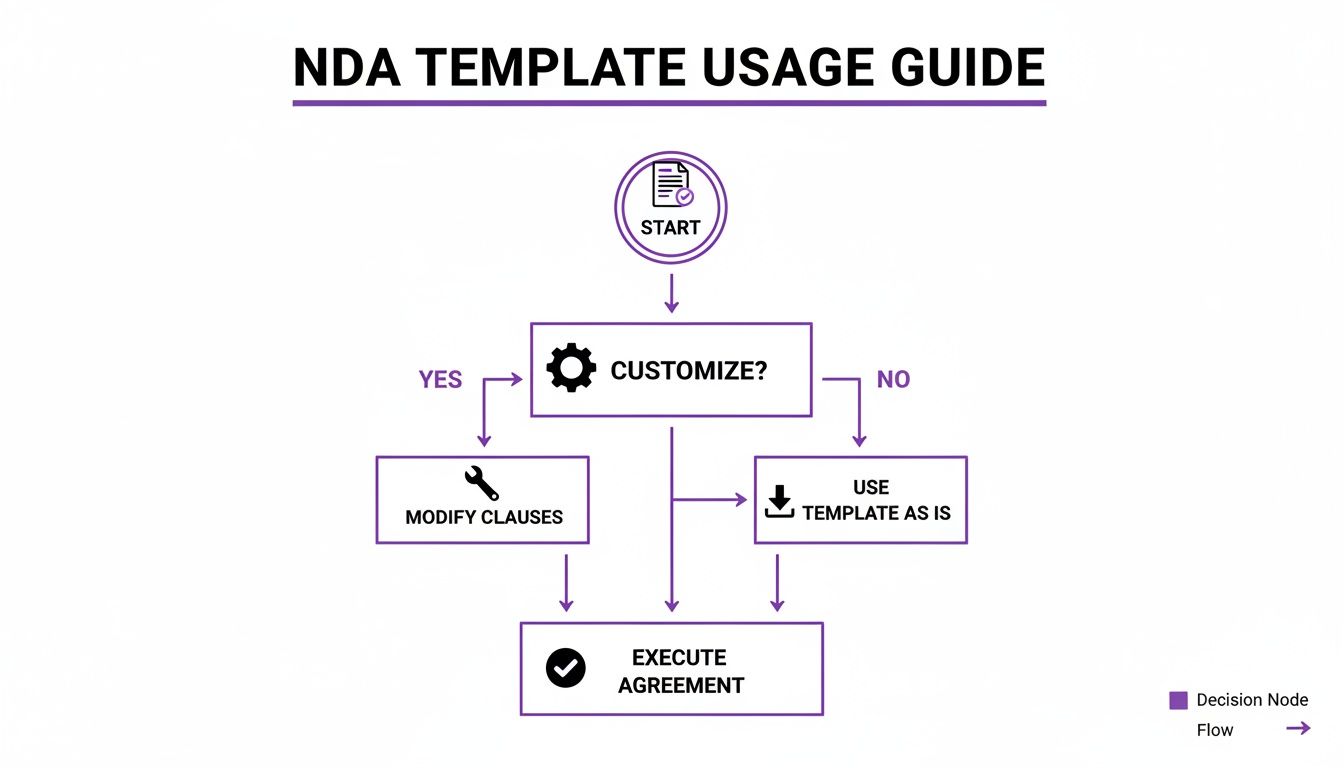
As you can see, the critical step between finding a template and signing it is thoughtful customisation. Don’t skip it.
Unilateral vs Mutual NDA: Which One Do You Need?
Your first big decision is whether you need a unilateral or a mutual agreement. This choice fundamentally shapes the NDA, determining who has the obligation to keep secrets. Getting this wrong can leave you exposed or, on the other hand, create unnecessary complexity in your relationship.
A unilateral NDA, often called a one-way agreement, is what you use when only one party is sharing sensitive information. The person receiving the info (the recipient) promises to keep it under wraps. This is by far the most common type of NDA you'll come across.
Then you have the mutual NDA, or a two-way agreement. This is for situations where both parties are bringing confidential information to the table. Both sides agree to protect what the other shares.
To make it even clearer, here's a quick comparison to help you decide.
| Characteristic | Unilateral NDA (One-Way) | Mutual NDA (Two-Way) |
|---|---|---|
| Information Flow | Information flows from one Disclosing Party to one Recipient. | Information flows back and forth between both parties. |
| Primary Use Case | When you're sharing your information with someone who isn't sharing anything sensitive in return. | When both parties are sharing proprietary information as part of a collaboration or negotiation. |
| Common Scenarios | Hiring a contractor, pitching an investor, showing a new product to a potential client. | Exploring a business merger, forming a joint venture, co-developing a product. |
| Example | A software company shows its proprietary code to a potential investor. Only the investor is bound to secrecy. | Two creative agencies discuss a potential merger and share their client lists and financial data with each other. |
Nailing this choice from the outset ensures your entire agreement is built on the right foundation.
Defining "Confidential Information" With Precision
This clause is the absolute heart of your NDA. If you're too vague here, a court could decide it’s unenforceable. But if you’re too narrow, you might accidentally leave your most valuable information unprotected. The goal is to be specific without boxing yourself in.
Don't just use a generic, catch-all definition. Instead, actually list the types of information you want to protect. Take a moment to think about what gives your business its competitive edge.
- For a software startup: Your definition should explicitly mention things like "source code, algorithms, user data, software architecture, and development roadmaps."
- For a creative agency: You'd want to include "client campaign strategies, pitch decks, creative concepts, pricing structures, and prospective client lists."
The key is to be descriptive. A well-drafted clause leaves no room for misinterpretation. The other party will know exactly what they can and cannot share. You're not just protecting 'data'; you're protecting the specific assets that make your business tick.
It's also a smart move to include a sentence requiring sensitive documents to be physically or digitally marked as "Confidential." This simple habit can be a lifesaver if a dispute ever goes to court, as it shows you actively took steps to identify and flag your protected information.
Setting a Realistic Term of Agreement
So, how long should the obligation to keep your secrets last? It can be tempting to write "forever," but Australian courts often see indefinite terms as unreasonable. This could lead to the entire clause being struck out, leaving you with no protection at all.
A much safer and more defensible timeframe is typically between two and five years. The right duration really depends on the information itself.
- Fast-moving industries: For a tech startup where information can become obsolete in a flash, a shorter term of 1-3 years is often more than enough.
- Stable industries: For a business with long-term trade secrets, like a secret recipe or a unique manufacturing process, a longer term of 5 years or more can be perfectly justifiable.
Your term should reflect the commercial lifespan of the information. Just ask yourself: "How long will this information actually stay valuable and secret?" The answer will point you toward a duration that is both reasonable and, most importantly, enforceable.
Understanding Exclusions: What Cannot Be Kept Secret
Not everything can legally be called confidential. To be seen as fair and reasonable by a court, your NDA must include some standard exclusions. These carve-outs cover information that:
- Is already public knowledge: You can't make someone promise to keep a secret that everyone already knows.
- Becomes public knowledge through no fault of the recipient: If the information leaks from somewhere else, the recipient is off the hook.
- Was already in the recipient's possession: They can't be forced to protect information they lawfully had before you shared it with them.
- Is disclosed due to a legal requirement: A court order or government regulation can force disclosure, and an NDA can't stand in the way of the law.
Including these standard exclusions doesn't weaken your agreement; it actually strengthens it. It shows you understand the legal landscape and makes it more likely a court will uphold the core confidentiality obligations if they're ever challenged. It's a hallmark of a professional approach to drafting your non-disclosure agreement template for Australia.
Will Your NDA Hold Up in Court? Making it Enforceable in Australia
Having a signed non-disclosure agreement is one thing; having one that will actually protect you when things go wrong is another entirely. An NDA that won't hold up in court is just an expensive piece of paper. To make sure your agreement has real legal teeth, it needs to be built on a few core principles that Australian courts look for.
At its heart, an NDA is a contract. For any contract to be legally binding, it has to include a few key things, but the most crucial for an NDA is consideration. This is just a legal term for a fair exchange; each party has to give something of value. For the person receiving your secrets, the "value" is getting access to your confidential information. For you, the value is their promise to keep it quiet.
This two-way street is fundamental. Without that exchange, the agreement can look like a one-sided demand rather than a genuine contract. It's worth getting your head around the basic elements of a contract to really understand why this matters so much.
Protecting a Legitimate Interest
For an Australian court to take your NDA seriously, you must be able to prove you have a legitimate commercial interest in protecting the information. You can't just slap a "confidential" label on everything and hope for the best. You need a genuine, business-related reason.
So, what counts as a legitimate interest? It could be:
- A unique manufacturing process that gives you a market edge.
- The client list you’ve poured years into building.
- Sensitive financial data that could be damaging in a competitor's hands.
What doesn't count is simply trying to stop a former employee from getting another job in the same industry. The goal has to be about protecting specific, valuable assets, not just stifling fair competition.
A judge will always cut to the chase: "What is the genuine business asset being protected here?" If you don't have a clear, compelling answer, your NDA is on very shaky ground. The agreement must protect your business, not unfairly prevent someone from earning a living.
Don't Get Greedy: Keep it Reasonable
One of the quickest ways to get an NDA thrown out of court is by making it ridiculously broad. Australian courts are very cautious about anything that looks like a "restraint of trade." This means your clauses have to be carefully limited in both their scope and how long they last.
Scope: Your definition of "Confidential Information" needs to be specific. An agreement that tries to cover "any and all information" about the business is almost guaranteed to fail. It should be directly relevant to the reason you're sharing the information in the first place.
Duration: The time frame must make commercial sense. A five-year term might be perfectly fine for a secret recipe, but it's completely over the top for a marketing strategy that will be irrelevant in six months. The term has to match the information's shelf life.
State Laws and Recent Workplace Changes
While contract law is mostly consistent across Australia, there are minor differences between states and territories that can impact how an NDA is enforced. Your non-disclosure agreement template for Australia should have a "governing law" clause that clearly states which jurisdiction applies, usually wherever your business is based.
It's also crucial to remember that the law isn't set in stone. NDAs have been under a lot of scrutiny lately, especially in employment situations. Regulators are cracking down on confidentiality clauses being used to cover up unlawful behaviour or silence whistleblowers.
For example, the Fair Work Legislation Amendment (Secure Jobs, Better Pay) Act has changed the game for NDAs in workplace misconduct cases. Blanket confidentiality clauses that could stop someone from reporting illegal activity are now heavily discouraged by Australian regulators. As you can read in more detail in these updates on NDA regulations on cockatoo.com.au, you have to draft your NDA carefully to ensure it doesn't cross these new legal lines.
Common Mistakes to Avoid When Using an NDA Template
Grabbing an NDA template for your Australian business can feel like a smart, time-saving move. But if you’re not careful, that simple oversight could make the whole document worthless. The biggest mistake I see people make is treating a template as a one-size-fits-all document; it's just not.
An NDA is only ever as strong as its weakest link. A definition that’s too vague or a clause that’s completely unrealistic is all it takes for a court to throw it out, leaving your most valuable information wide open.
Let's walk through some of the most common traps businesses fall into, and more importantly, how you can sidestep them.

Defining "Confidential Information" Too Broadly
It’s tempting to write a definition that covers every single thing under the sun, but this is a classic rookie error. A clause trying to protect "all business information" is often viewed by Australian courts as an unreasonable restraint of trade. A judge is going to question its purpose, and you could see the entire agreement deemed unenforceable.
Your definition has to be specific. It needs to be directly relevant to why you're sharing the information in the first place. Instead of a vague catch-all, get granular and list the actual categories of information you need to protect.
- Vague: "All data, plans, and strategies."
- Specific: "User acquisition data from Q4 2024, the source code for Project Phoenix, and the marketing strategy presented on May 15th."
Being precise shows the court you have a legitimate business interest to protect, not that you're just trying to stifle fair competition.
Setting an Unrealistic Time Limit
Another common pitfall is picking a confidentiality period that’s far too long. Sure, you might want your secrets kept forever, but an indefinite term is a massive red flag for the courts in Australia. The duration must be reasonable and actually reflect the commercial lifespan of the information.
Think about it: how long will your information genuinely remain sensitive? For a fast-moving tech product, a two-year term might be plenty. But for a proprietary manufacturing process that will be relevant for a decade, a five or even ten-year term could be perfectly justifiable. The key is to have a solid commercial reason for the timeframe you land on.
A critical mistake is forgetting the lifecycle of your data. An NDA’s term should align with how long the information holds value. An unreasonable timeframe doesn't offer more protection; it risks offering none at all.
Overlooking the Return of Information Clause
So, what happens to all your confidential documents when the agreement wraps up? It’s amazing how many templates either forget this clause entirely or just make it too vague. A solid NDA has to clearly state that the recipient is obligated to either return or destroy all confidential materials.
This isn't just about paper. You need to cover everything:
- Physical documents: All printed reports, handwritten notes, and any hard copies.
- Digital files: All emails, data files, and digital copies sitting on servers, laptops, or USB sticks.
Forgetting to specify this process leaves a dangerous loose end. It's also worth thinking about how you'll manage this securely. For instance, you can encrypt and protect your PDFs to ensure that data is handled safely from start to finish.
Misunderstanding the Power and Limits of NDAs
Finally, you have to be realistic about what an NDA can and cannot do. This is especially true in sensitive areas like workplace disputes. Research shows NDAs are frequently used in sexual harassment settlements in Australia, with about 75% of lawyers reporting they’d never finalise such a case without one.
However, this practice is under heavy scrutiny for its potential to hide misconduct and silence victims. As a report from Bargon and Featherstone highlights, this legal culture is being challenged for potentially enabling repeat offenders. You can read the full findings on how NDAs are used in sexual harassment cases on wwcsa.org.au. Crucially, an NDA can never be used to cover up illegal activities or stop someone from reporting a crime to the police.
Unpacking Common Questions About Australian NDAs
When you get down to the brass tacks of using a non-disclosure agreement in Australia, a few practical questions always seem to pop up. Let's walk through some of the most common ones I hear from clients, so you can feel more confident when it's time to get your agreement signed and stored.
Are Digital Signatures on an NDA Actually Legal in Australia?
Yes, they absolutely are. Thanks to the Electronic Transactions Acts in place across all Australian states and territories, an e-signature carries the same legal weight as one signed with a pen.
The real key here is to use a trustworthy platform. You need to be able to prove who signed the document and show they genuinely intended to be bound by its terms. A system that provides a clear, detailed audit trail is your best friend, as it gives you solid evidence if you ever need it.
What Happens if Someone Breaks an NDA in Australia?
If the worst happens and someone breaches the agreement, you have a few legal avenues to explore. Your first port of call is usually seeking an injunction from the court. This is a powerful order that immediately stops them from sharing any more of your confidential information.
From there, you can also sue for financial damages to cover any losses your business has taken as a result of the breach. In some situations, a court might even force the breaching party to hand over any profits they made from using your information improperly.
Remember, an NDA isn't just a gentleman's agreement; it's a legally enforceable contract. A breach gives you the right to take action through the Australian courts to protect your hard-earned commercial interests.
Can an NDA Really Protect a Business Idea?
This is a great question, and the answer is nuanced. An NDA is fantastic at protecting the concrete details that make up your business idea. Think about things like your financial projections, specific marketing strategies, customer lists, or the source code for your app.
What it can't do is protect a vague, abstract concept. For an NDA to have any real teeth, you must clearly define what specific, tangible information about your idea is being kept under wraps. The more detail, the better.
Ready to manage your business operations seamlessly? Payly combines e-signatures, invoicing, and time tracking into one platform designed for Australian businesses. Streamline your workflow and secure your agreements today. Explore Payly now.
Payly Team
Sharing insights and strategies to help service businesses thrive. Follow Payly for more tips on time tracking, invoicing, and business operations.
Related Articles
Ready to streamline your business?
Join thousands of freelancers and agencies who use Payly to track time, send invoices, and get paid faster.