
Legal Practice Management Software Australia: A Practical Guide for Law Firms
Explore how legal practice management software australia can streamline workflows, boost compliance, and enhance client service for Australian law firms.
Payly Team
January 17, 2026

Picking the right legal practice management software in Australia is a make-or-break decision for any modern law firm. It's about moving on from clunky manual processes to a smarter, more compliant way of working. The best systems are built for our local market, handling essentials like Australian trust accounting, GST, and linking up with platforms like Xero and MYOB.
Choosing Your Firm's Legal Practice Management Software

Moving to a new practice management system is a huge step. It’s a promise to bring all your case files into one place, get your billing automated, and keep client data locked down. Let's be clear: adopting the right technology isn't just an option anymore; it’s central to how a firm grows and stays profitable.
You only have to look at the numbers to see how big this is. The legal services sector in Australia is expected to hit a market size of $35.8 billion by 2026, with over 25,000 businesses in the mix. A lot of these are small firms and sole practitioners, where tools that boost efficiency are absolutely vital to stay competitive.
Why Generic Software Falls Short in Australia
Trying to shoehorn generic, international software into an Australian legal practice usually causes more headaches than it cures. These platforms just don't have the specific features needed to navigate our local legal landscape, which opens you up to compliance risks and administrative nightmares.
There are a few key areas where these one-size-fits-all systems just don't cut it:
- Trust Accounting Compliance: Every Australian state has its own strict, non-negotiable rules for managing trust money. Generic software simply can't get this right.
- GST and Tax Invoicing: Correctly calculating and reporting Goods and Services Tax (GST) is a must, but it's a feature that's often botched or completely missing in non-local systems.
- Local Integrations: You need a smooth connection to Australian accounting mainstays like Xero and MYOB. It's fundamental for keeping the books accurate and the workflow seamless.
By choosing a system designed from the ground up for the Australian market, firms can be confident they’re meeting regulatory requirements right out of the box. This saves you from expensive workarounds and potential penalties, letting you focus on your clients instead of fighting with your software.
The aim here is to find a platform that feels like it was built just for your firm. The right legal practice management software in Australia should make your daily tasks simpler, not more complicated. This guide gives you a clear roadmap for weighing up your options, so you can pick a solution that truly fits your firm’s needs and future goals, especially if you're exploring efficient solutions for legal firms.
What Australian Law Firms Really Need in Their Software
Choosing the right practice management software isn't about ticking off boxes on a feature list. It's about finding a system that understands and solves the real-world operational and compliance headaches Australian law firms deal with every single day. These core features are the very engine of your practice, keeping things efficient, accurate, and secure.
The magic happens when these features talk to each other. Think of matter management as the central nervous system of a case, connecting every document, email, and billable minute. When that system is properly linked to your time tracking and billing, you finally get to wave goodbye to the tedious, error-filled process of manually compiling invoices from random notes and spreadsheets.
This integration is where you'll find genuine efficiency gains. So, let’s look at the absolute non-negotiables every Australian firm should expect from its software.
H3: Matter and Client Management
At the most basic level, your software needs to be the single source of truth for every case. This goes far beyond just storing a client's phone number. You need a centralised hub that tracks everything about a matter, from the very first phone call right through to the final invoice.
A solid matter management system lets you:
- Track critical dates and deadlines so you never miss a court filing or a limitation period.
- Organise every conversation, linking emails and phone notes directly to the right matter.
- Assign tasks and see who’s doing what, giving you clear oversight and keeping the team accountable.
A crucial part of this is getting the client relationship started correctly. Finding the best client intake software can make a huge difference here, ensuring you capture all the vital information accurately right from the beginning.
H3: Time Tracking and Billing
We all know it: time is money. Accurate time recording is fundamental not just for getting paid, but for actually understanding your firm’s profitability and where your team's hours are going. The software you choose must make it dead simple for solicitors to capture every six-minute unit, whether they're at their desk or on their phone.
Make sure the system can handle the various ways Australian firms bill, including fixed fees, hourly rates, and retainers. It absolutely must calculate and apply GST correctly on invoices, and it should connect with local payment gateways to make it easier for clients to pay you.
The real game-changer is turning tracked time directly into a professional, compliant invoice with just a couple of clicks. This one piece of automation can save dozens of admin hours every month and seriously shrink your billing cycle, which does wonders for your firm's cash flow.
H3: Document Management and Security
A modern law firm is built on a mountain of digital documents. A good system isn't just a cloud folder; it's a secure, organised, and searchable library for every contract, letter of advice, and piece of discovery. For a deeper look at this, check out our guide to document management software in Australia.
You’ll want to look for a few key things:
- Version control to stop people from accidentally working on an old draft.
- Powerful search tools that can find specific phrases inside documents, not just in the filename.
- Secure client portals for sharing sensitive files without resorting to risky email attachments.
H3: Trust Accounting and Australian Compliance
This is, without a doubt, the most critical feature for any legal software in Australia. The rules around trust accounts are incredibly strict and differ between states. Your standard business accounting package like Xero or MYOB simply isn’t built for this, and trying to make it work puts your firm at enormous risk.
A purpose-built legal platform automates your trust accounting records, generates the reports you need for your annual audit, and ensures every transaction complies with your local Law Society's regulations. This isn't just a nice-to-have; it's a fundamental requirement for practising legally and ethically in Australia. Skimping on this is a risk no firm can afford to take.
Comparing the Top Legal Software Platforms
Choosing the right legal practice management software in Australia means looking past the glossy brochures and feature lists. You need a genuine, sleeves-rolled-up comparison of how these platforms actually work in a real law firm. The user experience, mobile access, reporting, and how the software can be moulded to your firm's processes are what truly matter.
After all, the "best" choice is entirely contextual. A fast-growing commercial litigation firm has completely different needs than a boutique family law practice. The first might be desperate for powerful document review and e-discovery tools, while the second needs a compassionate client portal and flexible billing options. A one-size-fits-all recommendation just doesn't work; the real skill is in matching the software’s strengths to your firm's unique rhythm.
The Australian legal software market is thriving because firms are finally demanding these kinds of tailored efficiencies. The landscape is dominated by small and medium practices, with 25,203 legal services businesses operating in 2024. For these firms, affordable, easy-to-use solutions are non-negotiable, which is why cloud-based systems that automate the drudgery of admin and billing are becoming the standard.
This decision tree helps visualise how a firm's biggest pain point, be it case files, billing, or compliance, should steer the software selection process.
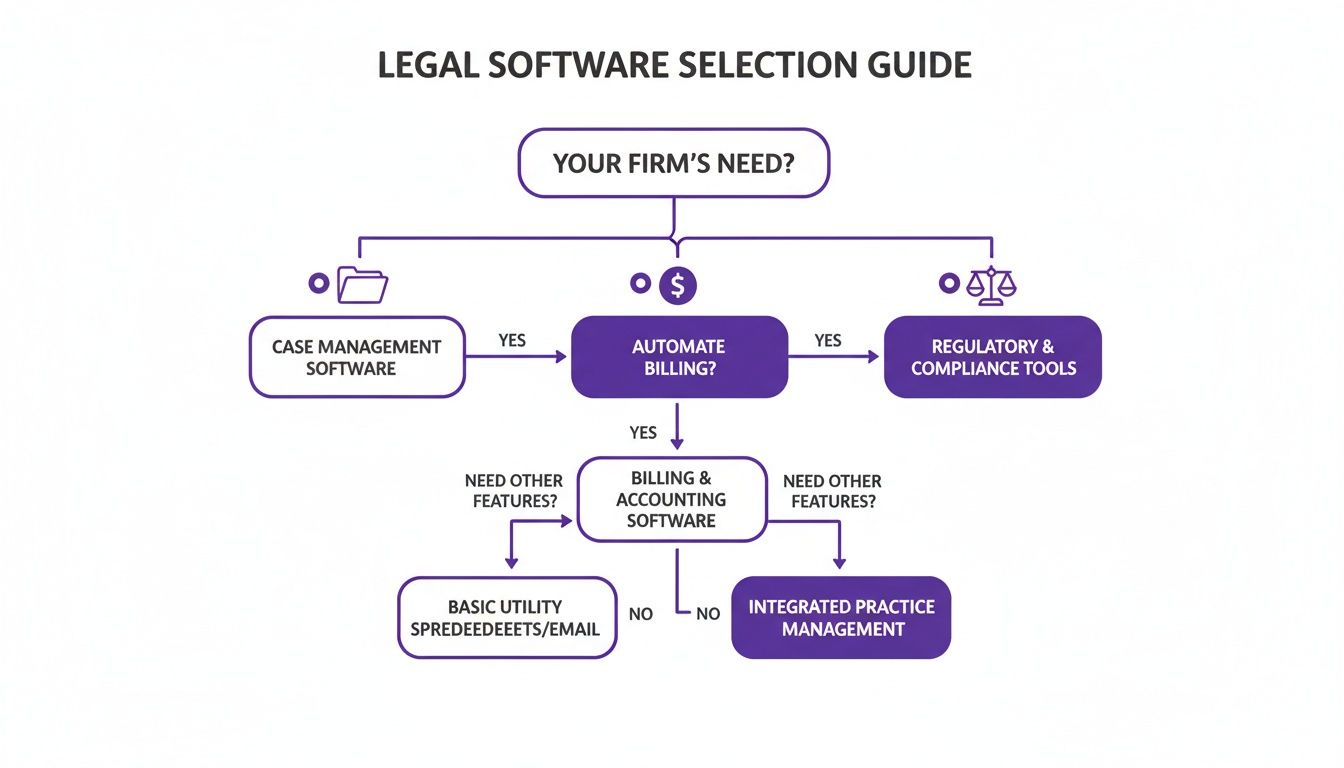
As you can see, the right platform is the one that solves your most critical operational bottleneck. It proves there's no single "best" solution for every firm out there.
User Experience and Onboarding
Let's be blunt: the most powerful software in the world is useless if your team hates using it. A platform's user experience (UX) will make or break its adoption in your firm and, ultimately, your return on investment. Some systems are celebrated for their clean, modern interfaces that feel intuitive from day one, making them perfect for smaller firms without a dedicated IT guru.
Others are incredibly powerful and customisable but come with a much steeper learning curve. These are often a better fit for larger firms that can dedicate real time to proper onboarding and have the resources to fine-tune the software to their exact needs.
Imagine this very real scenario: a solicitor needs to pull up a crucial case detail while standing in court.
- Platform A: Has a slick, intuitive mobile app. The solicitor finds the document in under 30 seconds.
- Platform B: Offers a clunky, desktop-first interface that’s a nightmare on a phone. Accessing the same file means fighting with a slow web portal, wasting precious time and adding stress.
For any firm with lawyers regularly out of the office, Platform A's superior mobile UX is the clear winner, even if Platform B boasts more features on paper.
Mobile Access for the Modern Solicitor
The days of being chained to a desk are long gone. Modern solicitors manage matters, track time, and talk to clients from everywhere: the courthouse steps, a cafe, or their home office. Because of this, the quality of a platform's mobile access has become a critical point of difference.
And I don't just mean a website that squishes down to fit a phone screen. I'm talking about a dedicated, native app that offers:
- Offline access to key documents and case notes.
- Effortless time tracking you can start and stop with a single tap.
- Secure client messaging through a built-in portal.
- Dictation features that turn voice notes into text and file them to the right matter.
A platform with strong mobile capabilities gives your team the power to be productive on the move. It helps capture billable hours that would otherwise vanish and allows for the kind of immediate client response that builds loyalty.
Your legal practice management software should be a true partner to your firm, bending to how your team actually works. If your solicitors are frequently out and about, prioritising a platform with exceptional mobile access isn't a luxury; it's a strategic necessity.
Reporting and Analytics Depth
Your firm's data is one of its most valuable, yet underused, assets. The ability to generate genuinely insightful reports is what separates a basic piece of software from a powerful business intelligence tool. Sure, most platforms can spit out a report on billable hours and revenue, but the top-tier solutions go much, much deeper.
Look for a platform that gives you proper analytics on:
- Firm Profitability: Can you easily see which matter types, clients, or individual solicitors are driving your profits? This is key to knowing where to focus your energy.
- Staff Performance: Are you able to track key metrics like utilisation and realisation rates to manage your team's productivity without micromanaging?
- Cash Flow Projections: Does the system use your historical data to help you forecast future revenue and proactively manage your firm's financial health?
A managing partner, for example, could use a profitability report to discover that their fixed-fee conveyancing matters are consistently outperforming everything else. Armed with that data, they can make a strategic decision to grow that side of the practice. To see what the market leaders are offering, it's worth checking expert roundups like this list of the 12 Best Case Management Software for Attorneys in 2025.
Customisation and Scalability
Your firm has its own way of doing things, and your software should reflect that. The ability to customise fields, workflows, and document templates is vital for making a platform feel like your own. A boutique immigration practice needs entirely different data fields and document templates than a commercial law firm does, and the right software should accommodate that easily.
Scalability is just as important. The software that’s perfect for a sole practitioner might buckle under the strain of a 20-lawyer firm. As you assess your options, think about how the platform will grow with you. Does the pricing become eye-watering as you add more users? Can the system handle a massive increase in data without slowing to a crawl? Choosing a scalable platform from the outset saves you from the massive headache and cost of having to migrate to a new system in a few years.
Understanding Pricing Models and Integration Needs
Figuring out the real cost of legal practice management software in Australia is about more than just the advertised monthly price. The true cost of ownership is wrapped up in complex pricing models and a bunch of potential hidden fees. If you get this wrong, you can easily blow your budget and end up with a poor return on your investment.
Just as important is how well a platform talks to the tools your firm already uses every day. A system that can't connect seamlessly with your existing tech creates frustrating data silos and forces manual workarounds, which completely defeats the purpose of upgrading. Let's break down both of these areas so you can make a choice that’s both financially smart and technically sound.
Decoding Software Pricing Structures
Most legal software in Australia works on a subscription, but the way that subscription is calculated can differ wildly. Getting your head around these models is the first step to accurately forecasting what you'll actually spend.
You’ll typically come across a few common models:
- Per-User, Per-Month: This is the standard. You pay a set fee for every person on your team who needs access. It's predictable, but the costs can quickly climb as your firm grows.
- Tiered Plans: Providers often package features into different levels, like a Basic, Pro, or Enterprise plan. This is great for smaller firms, as you can start on an affordable plan and only upgrade when you genuinely need the more advanced features.
- Flat-Rate or Per-Account: Some platforms, like Payly, charge one single flat fee for the whole firm, no matter how many users you have. This model offers fantastic value and predictability, especially for teams that plan on expanding. You can find more details on our simple pricing structure here.
Watch out for the hidden costs that aren't advertised upfront. These often pop up as fees for migrating data from your old system, mandatory onboarding and training packages, or access to premium customer support. Always ask for a full cost breakdown before you sign anything.
The Power of Australian Integrations
The real test of any legal practice management software in Australia is how well it plays with your other essential business tools. Good integrations are a force multiplier, automating workflows and killing off the double-handling of data that slows so many firms down.
For any Australian practice, seamless connections to local accounting platforms are simply non-negotiable.
- Xero & MYOB: A direct link to Xero or MYOB is crucial. It means when you create an invoice in your practice management system, the financial data automatically flows into your accounting ledger. Your books stay accurate without any manual entry, which makes GST reporting a whole lot easier.
- Stripe for Payments: Integrating with a payment gateway like Stripe lets clients pay your invoices online instantly with a credit card. This simple convenience can drastically speed up your payment times and improve your firm’s cash flow.
These connections do more than save time. They create a single source of truth for your firm's finances. You eliminate the risk of human error that comes with manual reconciliation and get a live, accurate picture of your firm's financial health. When you're comparing software, don't think of these integrations as optional extras. They are fundamental requirements for running a modern, efficient practice.
Simpler Alternatives for Small Law Firms

For sole practitioners and small Australian law firms, a full-scale legal practice management suite can feel like using a sledgehammer to crack a nut. These powerful, all-in-one platforms are undeniably impressive, but they often come with a steep learning curve and a price tag that makes more sense for a large, multi-partner firm.
The reality is, complex features like advanced trust accounting or intricate case-flow automation are often unnecessary for a practice that’s tightly focused on a specific legal niche. This is where a more targeted, simpler alternative presents a much smarter path. Why pay for a dozen features you’ll never touch when a focused solution gives you exactly what you need to run your firm efficiently?
A Smarter Way to Manage Core Operations
Instead of trying to be everything to everyone, a more agile approach is to adopt an integrated platform that nails the absolute essentials of running the business side of your practice. Think of these systems not as direct competitors to the big legal suites, but as intelligent tools for firms that need to manage their workflow without getting bogged down in complexity.
The whole idea is to bring together the core, everyday tasks that actually keep a small practice humming:
- Integrated Time Tracking: Easily capture every billable minute from any device, so revenue never gets lost in the shuffle.
- Smart Invoicing: Turn your tracked time into professional, branded invoices in a few clicks, and set up automatic reminders to get paid faster.
- Secure Document Management: Keep all your critical files organised, secure, and accessible in one place, complete with proper version control.
- Legally Binding e-Signatures: Get documents signed and returned quickly and securely, backed by a full cryptographic audit trail for compliance.
This approach stops you from having to juggle multiple, disconnected subscriptions for time tracking, invoicing, and e-signatures, which quickly becomes both expensive and messy.
For a small firm, the goal isn't just to find software; it's to find a business partner that simplifies operations. An all-in-one platform focused on core business functions provides this clarity, allowing practitioners to focus on client work instead of administrative tasks.
Australian-Centric Features and Predictable Pricing
When looking at alternatives to traditional legal practice management software in Australia, it’s crucial to pick a platform designed for the local market. This is about more than just a familiar interface; it means practical features that align with how Australian businesses operate.
Make sure any tool you choose has native support for Australian Dollars (AUD) and automates GST calculation on every invoice. These are foundational features that prevent common accounting headaches and ensure your financial records are always accurate and compliant with Australian tax law.
But perhaps the biggest win for smaller firms is the pricing model. Platforms like Payly offer predictable, account-based pricing instead of the usual per-user fees charged by most legal software providers. This flat-rate structure can lead to huge savings, especially as your team grows. You’re not penalised for adding a paralegal or an admin assistant, making it a genuinely cost-effective solution that scales with your ambition, not your headcount. This financial predictability makes budgeting far easier and delivers a much clearer return on your investment.
Executing a Seamless Software Migration
Getting new software up and running is less about the technology itself and more about your people and your processes. A clear, well-managed migration plan is what stands between a smooth changeover and months of operational headaches. It’s how you minimise disruption, get your team on board, and see a return on your investment sooner rather than later.
Your first move should always be a thorough data migration strategy. Before you do anything else, you need to conduct a complete audit of your existing data. Figure out exactly what needs to be moved, what can be archived, and what’s just digital clutter that can be deleted. Think of it as a much-needed digital spring clean.
You can't go it alone, either. A smooth transition hinges on having solid support from your vendor. They should provide a dedicated migration specialist who knows the ins and outs of shifting data from one system to another, especially for law firms.
A Phased Rollout for Higher Adoption
Instead of flipping a switch and moving everyone over at once (a "big bang" launch), a phased approach nearly always works better. You'll see much higher user adoption by starting small with a tech-savvy pilot group to test the new system in a real-world environment. This lets you find and fix any problems on a much smaller scale.
Here are the key steps for a successful rollout:
- Run a Pilot Program: Choose a small team or a single practice area to use the new software exclusively for a limited time.
- Gather Feedback: Actively ask the pilot group what's working and what isn't. This feedback is gold for refining workflows before everyone else comes on board.
- Develop Usage Protocols: Create simple, clear guides for how your team should handle core tasks like time tracking and saving documents in the new system.
A well-run pilot program doesn't just iron out technical kinks; it creates internal champions for the new software. These early adopters become your best advocates, helping to train and encourage their colleagues during the firm-wide launch.
Finally, don’t skimp on training. Use every resource your software provider offers, from live webinars to on-demand video tutorials and knowledge bases. Proper onboarding is the best way to overcome that natural resistance to change, empowering your team to get the most out of the new legal practice management software in Australia right from day one.
Frequently Asked Questions
Choosing the right legal practice management software in Australia is a big decision. To help you work through the final details, we've answered a few of the questions that pop up most often.
How Long Does It Take to Implement New Software?
The timeline really depends on the size of your firm and the complexity of your data. A solo practitioner or a small firm might get everything moved over and be ready to go in a few days.
For larger practices with years of case files and client data, you might be looking at a few weeks. The key to a smooth transition is having a solid migration plan and working with a software provider who's responsive and ready to help.
Is My Firm's Data Secure in the Cloud?
Leading cloud-based platforms invest a huge amount into their security infrastructure. You'll want to look for providers that offer bank-level encryption, conduct regular security audits, and are fully compliant with Australian data sovereignty laws. This level of protection ensures your sensitive client data is incredibly well-guarded, often far more securely than a server sitting in your office.
It's a common myth that on-site servers are automatically safer. In reality, dedicated cloud platforms have entire teams and infrastructure focused on security, something most small law firms simply can't resource themselves.
What Is the Most Important Feature for a Small Firm?
For most small firms, it boils down to the link between time tracking and billing. When you can effortlessly turn your billable hours into accurate, GST-compliant invoices, you're saving a massive amount of admin time. This has a direct and immediate impact on your cash flow, which is the lifeblood of any small practice.
Just as critical is a reliable, built-in trust accounting module that's fully compliant with your state's law society rules. For any Australian firm, this is non-negotiable.
Do I Need Specific Legal Software for Trust Accounting?
Yes, you absolutely do. Standard accounting packages like Xero or MYOB just aren't built to handle the complex and rigid regulations surrounding legal trust accounts in Australia. Trying to manage it with generic software opens your firm up to serious compliance risks. Purpose-built legal software is designed to automate this and keep you on the right side of the law.
Ready to simplify your firm's operations without the complexity and high cost of traditional legal software? Payly combines time tracking, smart invoicing, document management, and e-signatures into one streamlined platform built for Australian businesses. Start your free 14-day trial today.
Payly Team
Sharing insights and strategies to help service businesses thrive. Follow Payly for more tips on time tracking, invoicing, and business operations.
Related Articles



Ready to streamline your business?
Join thousands of freelancers and agencies who use Payly to track time, send invoices, and get paid faster.