
How to calculate hourly rate: Freelancer pricing guide
Learn how to calculate hourly rate for freelancers: cover salary, costs, and profit with a smart pricing plan.
Payly Team
November 30, 2025

Figuring out your ideal hourly rate comes down to a simple, yet crucial, formula. You need to add up your desired annual salary, superannuation, and leave entitlements, then divide that total by the actual number of hours you can realistically bill in a year. This is your baseline, it’s the number that ensures your personal costs are covered before you even start thinking about business expenses or profit.
Your Hourly Rate Is More Than Just a Number
Let’s be honest, far too many Australian freelancers and agency owners simply pluck a number out of thin air. They pick a rate that ‘feels right’, which often means they’re massively undervaluing their expertise and leaving a lot of money on the table. It’s a risky game because it completely ignores the real, often hidden, costs of running a business.
Think of your hourly rate as the financial engine of your entire operation. It's the strategic figure that powers everything, covering not just your take-home pay but all the essential components that keep your business healthy and growing.
Why a Formula Beats Guesswork
Relying on guesswork is a fast track to cash flow problems. When you calculate your rate properly, you're creating a financial roadmap for your business. It’s the only way to make sure you're accounting for everything you need to be profitable.
A solid calculation covers all your bases:
- Your Personal Income: The salary you actually need to live your life.
- Essential Benefits: You don’t have an employer paying your super, sick leave, or annual holidays. That's on you now.
- Business Overheads: All the costs of doing business, from software subscriptions and insurance to marketing and accounting fees.
- Profit and Growth: The extra funds you need to reinvest, survive the quiet periods, and maybe even expand your services one day.
By treating your rate as a business calculation rather than just a personal number, you shift your mindset from merely earning a wage to building a truly profitable enterprise. This is the key to quoting new projects with confidence.
Ultimately, knowing how to calculate your hourly rate correctly gives you the power to justify your pricing and build a business that doesn't just survive, but actually thrives. For more essential tools and tips, check out the resources we offer for freelancers on our site. Now, let’s walk through the exact formulas you need to find the number that truly reflects your value.
Calculating Your Foundational Hourly Rate
To figure out an hourly rate that actually sustains you, we need to start with the real cost of employing yourself. This isn't just about plucking a dream salary out of thin air. It’s about building a solid financial baseline that includes all the things a traditional employer in Australia would normally cover for you.
Think of this as calculating your personal "cost of employment". This foundational number needs to account for your target salary, your superannuation, and time off for holidays and sick days. Skipping these is one of the most common, and costly, mistakes freelancers make, leaving them short-changed down the track.
Start with Your Desired Salary
First things first, what do you actually need to earn? Before tax, what’s the annual income that will let you live your life?
Let's walk through this with a real-world example. Imagine you're a freelance graphic designer in Melbourne, and you want to bring in a pre-tax salary of $80,000 a year. That figure is our starting block.
This little infographic perfectly sums up the journey from just guessing your rate to actually knowing your numbers and building for growth.
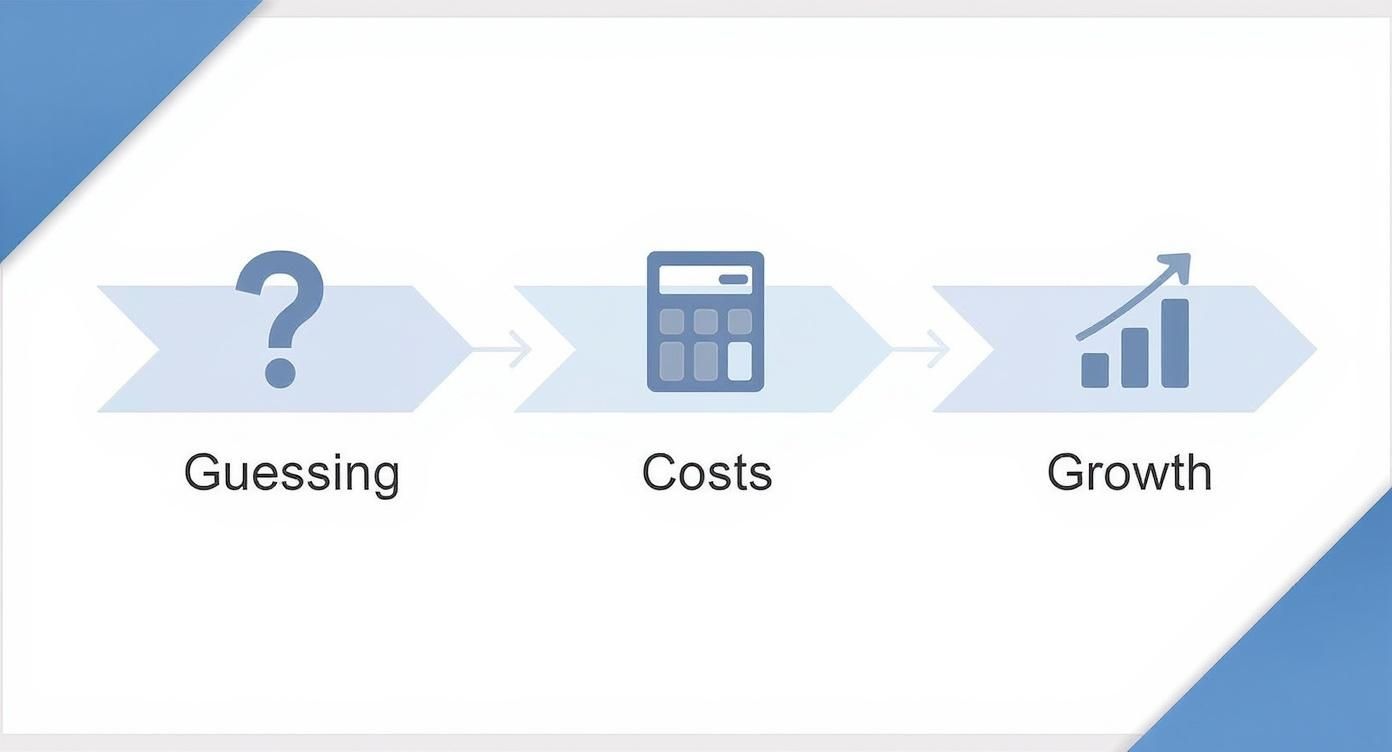
As you can see, a structured approach is the only way to build a rate that actually supports your business ambitions.
Add Superannuation and Leave Costs
Right, now we add the costs a boss would normally pay on your behalf. As a sole trader, you're the boss, so these are on you.
- Superannuation: The current super guarantee is 11%. On an $80,000 salary, that’s another $8,800 you need to put away ($80,000 x 0.11).
- Annual Leave: A standard full-time gig gets four weeks of paid holidays. To give yourself the same, you need to budget for four weeks of your salary. That comes to about $6,154 ($80,000 / 52 weeks x 4 weeks).
- Sick Leave: You’re going to get sick. It happens. Let’s be conservative and plan for two weeks of personal/carer's leave. That adds another $3,077 to the pot ($80,000 / 52 weeks x 2 weeks).
Your Total Personal Cost is what you get when you add all that up. In our designer's case: $80,000 (Salary) + $8,800 (Super) + $6,154 (Annual Leave) + $3,077 (Sick Leave) = $98,031. This is the absolute minimum your business has to earn in a year just to pay you properly.
Determine Your Billable Hours
This next part is crucial, and it’s where a lot of people go wrong. You have to work out how many hours you can realistically bill in a year. The trap is to assume you can bill for every single hour you're at your desk. You can't. You'll spend a huge chunk of your time on non-billable (but essential) tasks like marketing, admin, chasing invoices, and professional development.
A standard working year is roughly 2,080 hours (40 hours x 52 weeks). Now, let's subtract all the time you're not working.
- Annual Leave: 4 weeks (160 hours)
- Sick Leave: 2 weeks (80 hours)
- Public Holidays: About 2 weeks, depending on your state (80 hours)
That leaves you with 1,760 potential work hours. But remember, not all of that is client work. A realistic utilisation rate, the percentage of your time that's actually billable, is often around 70%. This means your true annual billable hours are closer to 1,232 (1,760 x 0.70).
If you want to play around with these numbers, a good hourly to salary converter can be a handy tool for quick checks.
Now we can finally put it all together.
Foundational Hourly Rate = Total Personal Cost / Annual Billable Hours
For our Melbourne designer:
$98,031 / 1,232 hours = $79.57 per hour
This is your baseline. It's not the final rate you'll charge clients; we haven't even added business overheads or profit yet. But it’s the non-negotiable minimum you must earn per billable hour just to cover your own salary and entitlements.
Factoring in Business Overheads and Your Utilisation Rate
Right, that foundational rate we just calculated is a great start, but it only covers you. It doesn't yet account for the real costs of keeping the lights on in your business. These expenses, what we call business overheads, are all the things you pay for that aren't tied to one specific client job but are absolutely essential to operate.
Ignoring these is a one-way ticket to trouble. Your hourly rate has to absorb these costs so your business, not just your personal bank account, stays healthy. Think of it like this: your salary pays for your life, while overheads pay for your business's life.

Identifying Your Annual Business Costs
To get a clear picture, you need to add up every single business expense for the year. The best way to do this is to get forensic with your bank statements, credit card bills, and receipts.
For most Australian freelancers and service businesses, the usual suspects include:
- Software & Subscriptions: Think Adobe Creative Cloud, Xero, project management tools, and web hosting.
- Insurance: Professional indemnity and public liability are the big ones.
- Marketing & Advertising: Your website costs, any ads you run, or even memberships for networking groups.
- Professional Services: What you pay your accountant or a lawyer for advice.
- Home Office Utilities: A percentage of your internet, power, and phone bills.
- Equipment: The annual depreciation or cost of your computer, desk, and other gear.
Let's go back to our Melbourne designer. After a thorough review, their annual overheads come to $12,000. We now add this to their total personal cost: $98,031 + $12,000 = $110,031. This is the new, more realistic revenue target needed to cover everything.
Understanding Your Utilisation Rate
This brings us to one of the most powerful, and most frequently missed, parts of this whole equation: the utilisation rate. In simple terms, this is the percentage of your total working time that you actually spend on billable client work.
A 100% utilisation rate is pure fantasy. Nobody spends every single minute of their workday on tasks a client is paying for. All that time spent on marketing, admin, sales calls, and professional development is vital but non-billable. You must account for it.
For a well-run service business, a realistic utilisation rate is usually somewhere between 60% and 80%. The rest of the time is spent running and growing the business itself. The only way to know your true rate is to track your time meticulously. For some pointers on getting this right, check out our guide on time tracking best practices.
Let's look at how this dramatically changes the required hourly rate. The impact of your non-billable time is huge, and the table below shows just how much your rate needs to climb as your available billable hours shrink.
Impact of Utilisation Rate on Required Hourly Rate
| Utilisation Rate | Total Billable Hours (Annual) | Required Hourly Rate (Example) |
|---|---|---|
| 90% | 1,584 | $69.46 |
| 80% | 1,408 | $78.15 |
| 70% | 1,232 | $89.31 |
| 60% | 1,056 | $104.20 |
As you can see, dropping from a lofty (and probably unrealistic) 90% utilisation to a more standard 70% means your hourly rate needs to be almost $20 higher just to earn the same amount of money.
Let’s apply this to our designer. We calculated they have 1,760 available work hours a year. A 70% utilisation rate means they only actually have 1,232 hours to sell to clients. This is the number that matters.
Adjusted Hourly Rate = (Total Personal Cost + Annual Overheads) / Annual Billable Hours
For our designer, that looks like:
$110,031 / 1,232 hours = $89.31 per hour
Now we’re getting much closer to a rate that is truly sustainable. This figure ensures that every billable hour you clock also helps pay for your software, insurance, marketing, and all that crucial non-billable time that keeps your business running.
Adding Your Profit Margin and Factoring in GST
So far, the rate we've calculated gets you paid and covers your business costs. That’s a great start, but a business that only breaks even isn’t really a business at all; it’s just a job with more paperwork. It's time to add the final, crucial layers that turn your hard work into a resilient, profitable operation.
This is where we add a profit margin and, if you're registered, account for the Goods and Services Tax (GST). It’s easy to get these two mixed up, but they serve very different purposes.

Why a Profit Margin Isn't Just 'Extra Cash'
One of the biggest mental hurdles for freelancers is separating their salary from their business's profit. Your salary is what you earn for doing the work. The profit is what your business keeps after every single expense, including your wage, has been paid.
Thinking of this as greed is a trap. It's not. It's a strategic fund that protects and grows your business.
- Your Financial Buffer: It's the safety net for when a client pays late or you hit an unavoidable quiet patch.
- Your Investment Fund: It’s how you’ll afford that new laptop, that industry course you’ve been eyeing, or the software that will make you more efficient.
- Your Growth Capital: This is the money you'll use to expand, bring on a subcontractor, or launch that new service you've been dreaming about.
For a service-based business, a healthy profit margin is typically somewhere between 15% and 30%.
Let’s go back to our Melbourne designer, whose adjusted rate was $89.31. If we add a solid 20% profit margin, the calculation looks like this:
$89.31 x 1.20 = $107.17 per hour
This is the rate that allows the business to thrive, not just survive. As you gain more experience and your business matures, you should revisit this margin. It also pays to keep an eye on the wider economy; understanding shifts in the national Wage Price Index helps you make informed decisions about your own pricing. You can dig into these trends yourself by checking out the latest Australian wage growth data on Trading Economics.
The Final Piece of the Puzzle: Adding GST
If your Australian business turns over $75,000 or more in a year, you’re required to register for GST. This is the very last step in figuring out what to charge your clients.
It's absolutely critical to remember that GST is not your money. It’s a 10% tax you collect for the Australian Taxation Office (ATO). You simply add it to your final rate, collect it from your client, and then pass it straight on to the tax man.
Let’s finalise our designer’s hourly rate:
Final Hourly Rate (ex. GST): $107.17
GST (10%): $10.72
Total Hourly Rate to Quote Client (inc. GST): $117.89
This is it. This is the all-inclusive number you put on a quote.
In the real world, many people would just round that up to a clean figure like $120 per hour to keep things simple. Now you have a final number built on a solid foundation, knowing your salary, business costs, and future growth are all covered. You can finally price your work with complete confidence.
When to Adjust Your Rate for Different Projects
https://www.youtube.com/embed/yZdMfc8v5yc
Once you've calculated your billable hourly rate, think of it as your financial bedrock, not a cage. It’s the number that ensures you’re profitable. But the most successful freelancers and agencies I know treat this rate as a baseline, not a rigid rule they apply to every single project that comes their way.
Strategic flexibility is what really separates stagnant earners from high-growth businesses. Knowing when to hold firm and when to adjust your pricing is a skill, and it’s a powerful one. Your standard rate is perfect for the bread-and-butter work, but special circumstances often call for a completely different approach.
Shifting to Value-Based Pricing
Here’s a big one: moving beyond simply trading time for money. This is the whole idea behind value-based pricing. Instead of just charging for the hours you put in, you set a price based on the real-world business impact your work will deliver to the client.
Let’s look at a classic example. Say you're a web developer.
- Project A: A simple brochure website for a local cafe. It might take you 20 hours. At $120/hour, that’s a $2,400 project. Fair enough.
- Project B: An e-commerce system for a growing online retailer. This also takes you 20 hours, but this system is projected to generate $50,000 in new sales for the client in its first year alone.
Does it make sense to charge $2,400 for both? Absolutely not. The e-commerce project delivers exponentially more value, and your price should reflect that. This approach anchors your fee to the client's return on investment, not just your time and effort.
Charging based on value allows you to capture a fair share of the success you create for your clients. It shifts the conversation from "How much do you cost?" to "What results can you deliver?"
Adjusting Your Rate for Specific Scenarios
Beyond the big picture of value-based pricing, there are plenty of everyday situations where tweaking your standard rate is not just acceptable, but expected.
You should definitely consider charging a premium for things like:
- Urgent Rush Jobs: The client needs it yesterday? That means you’re probably bumping other work or cancelling weekend plans. A rush fee of 25-50% is standard practice to compensate for that disruption.
- Highly Specialised Skills: If a project requires a rare skill that very few people have, your rate needs to reflect that scarcity and deep expertise. Don't be shy about it.
On the flip side, you might offer a slight discount for:
- Long-Term Retainers: A client committing to six or twelve months of consistent work is gold. That’s predictable income you can count on. Offering a 5-10% discount is a smart way to lock in that stability.
Researching Competitor Rates Strategically
It’s always a good idea to know what others in your field are charging, but not so you can copy them or get into a price war. That’s a race to the bottom.
Instead, the goal is to position yourself strategically within the market. This context is especially important when you factor in broader economic trends here in Australia. For example, recent wage data shows that industries like IT are seeing much higher wage growth than others. Knowing this helps you understand the baseline rate expectations in your sector.
You can dig into a deeper breakdown of these Australian wage dynamics on aigroup.com.au. Understanding these trends helps you position your own rate with confidence, ensuring it’s both profitable for you and competitive in your specific market.
Got Your Rate? Here’s What Happens Next
So, you’ve done the hard yards and calculated an hourly rate that truly reflects your worth. That's a huge step. But as you know, running a business throws up all sorts of practical, real-world questions. Now it’s time to take that number from your spreadsheet and confidently apply it to your business.
Let’s tackle some of the most common questions that pop up once you've got your new rate sorted. This is where your financial planning meets the day-to-day reality of client work and communication.
How Often Should I Recalculate My Hourly Rate?
As a rule of thumb, you should revisit your rate at least once a year. Think of it as an annual financial health check. This gives you a chance to factor in inflation, your growing experience, and any shifts in your business expenses. A small, steady annual increase is pretty standard across most industries, so clients generally expect it.
But life happens, and sometimes you can't wait for the annual review. Certain business milestones should prompt you to pull out the calculator straight away:
- Your costs have jumped: Did you just sign up for expensive new software, or maybe move into a co-working space? Your rate needs to absorb these new overheads.
- You've seriously upskilled: Just finished a new certification or course that makes you a bigger asset to your clients? That added value should absolutely be reflected in your price.
- You're turning work away: If you're constantly booked out months in advance and have a waiting list, that's the market screaming that your skills are in high demand. It's the perfect signal to raise your rates.
Should I Put My Hourly Rate on My Website?
Ah, the classic question. And honestly, there’s no single right answer here; it really comes down to your business model and who you're trying to attract.
If you offer well-defined, standardised services where the scope is predictable (think a "one-hour brand strategy session" or a "basic website audit"), then publishing your rate can be a brilliant move. It acts as an instant filter, weeding out tyre-kickers and ensuring that anyone who gets in touch is already comfortable with your pricing. It saves you a massive amount of time on discovery calls that go nowhere.
On the other hand, for complex, custom projects where the scope can vary wildly, it’s almost always better to provide a tailored quote after you've had a proper chat with the client.
Even if you decide against publishing your rate, having that number nailed down is non-negotiable. It becomes your internal North Star, helping you whip up accurate, consistent, and profitable project quotes without pulling numbers out of thin air.
How Do I Tell My Existing Clients I'm Increasing My Rate?
This is the one that makes a lot of freelancers nervous, but it doesn't have to be a big deal. The trick is to be professional, confident, and fair. The most important thing is to give your clients plenty of warning; 30 to 60 days is a good amount of time for them to adjust their budgets.
Frame the increase as a positive. It's not just a price hike; it's a reflection of the better service and greater value you now provide. You can link it to your improved skills, your deeper expertise, or even just the rising costs of doing business that allow you to maintain the quality they rely on. Whatever you do, don't apologise for it. You’ve earned it.
A simple, direct, and appreciative email usually does the job perfectly. Something like this works well: "Just a heads-up that to continue delivering the quality of work you expect, my hourly rate will be adjusted to [New Rate] from [Date]. I really appreciate our partnership and look forward to continuing our work together."
Trying to manage all this, from tracking your hours to sending invoices and chasing payments, can feel like a full-time job in itself. Payly is built to fix that. It brings time tracking, smart invoicing, and document management together in one simple platform designed specifically for Australian service businesses. Stop juggling five different apps and see what it's like when everything just works together. Start your free 14-day trial today.
Payly Team
Sharing insights and strategies to help service businesses thrive. Follow Payly for more tips on time tracking, invoicing, and business operations.
Related Articles



Ready to streamline your business?
Join thousands of freelancers and agencies who use Payly to track time, send invoices, and get paid faster.