
How Many Business Days in a Year Australia Ultimate Guide
Calculate the business days in a year Australia with our guide. See state-by-state breakdowns to manage payroll, invoicing, and deadlines accurately.
Payly Team
January 3, 2026

So, how many business days are there in an Australian year?
On average, you’re looking at between 250 and 253 business days. But that's just a ballpark figure; the exact number really depends on which state or territory you call home.
A standard year gives us a baseline of 260 or 261 weekdays. From there, we have to subtract all the national and state-specific public holidays to get the real count of working days. Let's break down exactly how to find the number that matters for your business.
Your Quick Guide to Australian Business Days

Working out the number of business days in a year might seem like a small bit of admin, but for freelancers and small businesses, it's a number that carries a lot of weight. This figure is the bedrock of good project planning, fair client invoicing, and correct payroll. If you get it wrong, you can end up with missed deadlines, payment disputes, and a whole lot of operational headaches.
Think of it like building a house. You wouldn’t pour the slab without knowing the exact dimensions of your foundation. In the same way, you can't run your business effectively without knowing your true operational capacity. The total number of available workdays is your business's foundation for the entire year.
To get a clearer picture, here’s a quick summary of how an average Australian year breaks down.
Australian Business Days at a Glance
| Metric | Average Number of Days |
|---|---|
| Total Days in a Year | 365 (or 366 in a leap year) |
| Weekend Days | 104 |
| Weekdays (Monday to Friday) | 261 (or 262 in a leap year) |
| National Public Holidays | 7 |
| State/Territory Public Holidays | 4-7 (varies by location) |
| Typical Business Days | ~250-253 |
This table gives you a starting point, but the real devil is in the detail of those state and territory holidays.
Why This Number Matters
Knowing your exact working day count isn’t just about being organised; it directly impacts your bottom line and efficiency. It’s the key to answering critical questions that shape how you operate and whether you turn a profit.
Getting this calculation right is vital for:
- Accurate Project Timelines: Set realistic deadlines that account for every non-working day, especially those unique to your state.
- Fair Client Invoicing: Make sure your quotes and invoices are based on the actual days you can work, so you're paid what you're worth.
- Compliant Payroll and Leave: Manage employee entitlements with precision, helping you avoid costly mistakes and stay on the right side of the law.
The real challenge comes from Australia's federated system. Public holidays aren't the same everywhere. A day off in Victoria might be a normal workday in New South Wales, which can create a tricky puzzle for businesses that operate nationally or have remote teams.
This guide is your map for navigating that complexity. We'll walk you through the formula, look at the state-by-state differences, and give you practical examples to help you lock in the right number for your business. It's all about operating with clarity and confidence.
The Simple Formula for Calculating Your Working Days
Figuring out the exact number of business days in an Australian year isn't as daunting as it might sound. The secret is to think of it as a process of elimination. You start with the total number of days in the year and simply carve away all the non-working days: the weekends and public holidays.
It’s a straightforward method that turns a potentially messy calculation into a few simple steps. By following this logic, you can easily land on a precise number that works for your business.
Starting With the Total Days
First things first, you need a starting point: the total number of days in the calendar year. For most years, that’s 365 days. But don't forget about leap years, which pop up every four years and give us 366 days.
From there, we get rid of the biggest chunk of non-working time: the weekends. A standard year has 52 full weeks, which means there are 104 weekend days (52 Saturdays and 52 Sundays) to subtract. Just like that, a 365-day year is already down to 261 weekdays.
The Core Formula: Total Days in Year – Weekend Days – National Public Holidays – State/Territory Public Holidays = Total Business Days. That's it. This simple equation is all you need to get an accurate count.
Subtracting Public Holidays
With the weekends out of the way, the next step is to account for public holidays. This is where things get a bit more specific to Australia, as you need to subtract holidays in two stages.
- National Public Holidays: Start by removing the holidays observed by everyone across the country. These are the big ones like New Year’s Day, Australia Day, Good Friday, Easter Monday, Anzac Day, Christmas Day, and Boxing Day.
- State and Territory Holidays: Next, you subtract the public holidays that are unique to your state or territory. This includes days like Labour Day (which falls on different dates depending on where you are), the King's Birthday, or local show days and regional holidays like Melbourne Cup Day in Victoria.
Nailing this final step is what gives you a truly accurate count for your business. If you want to skip the manual maths, our free working days calculator does all the heavy lifting for you, instantly factoring in all state-specific holidays. While we’re focused on Australia, this general guide on how many working days in a year are calculated offers a great overview of the basic principles used worldwide.
Why Public Holidays Create a State-by-State Puzzle
While Australia has a handful of national public holidays that everyone shares, the real trick to calculating business days lies in the unique holiday calendar of each state and territory. This is where a seemingly simple task can become a logistical headache, especially if your business operates across state lines.
Think of it like this: national holidays such as Christmas Day and Anzac Day are the common threads woven through every state's calendar. But then each state adds its own distinct pattern, like Melbourne Cup Day in Victoria, different dates for Labour Day, or the Royal Queensland Show day in Brisbane. This creates a patchwork of working schedules across the country.
This simple flowchart breaks down the process of whittling down the calendar to find your true number of working days.
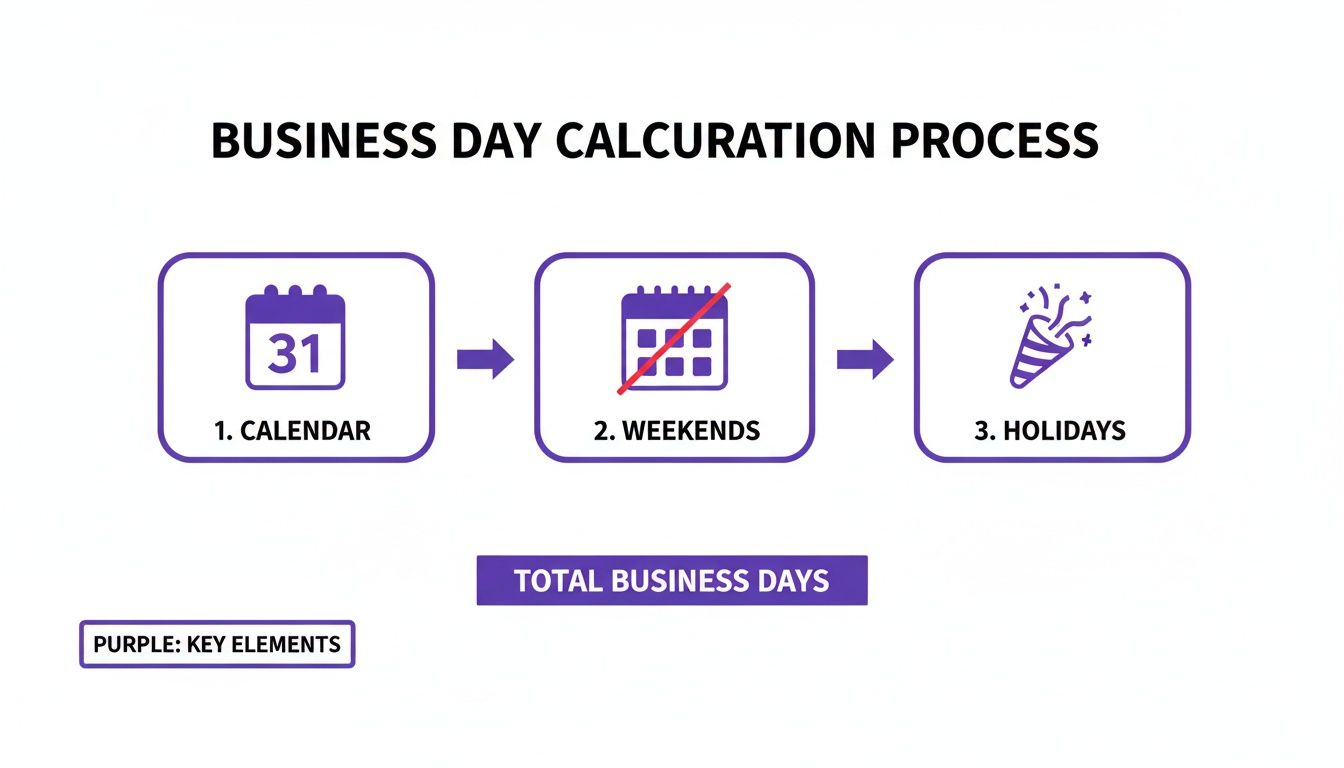
You start with the full 365 (or 366) days, strip out the weekends, and then subtract the relevant public holidays. What's left is your total number of business days.
The Impact on National Businesses
For a business with staff in both Sydney and Perth, or a freelancer invoicing clients nationwide, this holiday patchwork presents a very real operational challenge. It directly affects project timelines, payroll accuracy, and simple team coordination. A day off in one state can easily throw a spanner in the works for a team in another state that's business as usual.
Imagine a remote team pushing to meet a tight deadline. The graphic designer in Melbourne is offline for the Melbourne Cup, but the project manager in Sydney is waiting on final assets. That single-day delay can create a bottleneck, pushing back the entire project and affecting client delivery.
This is precisely why you can't just assume everyone is working on the same schedule. A location-aware approach to planning isn't just a nice-to-have; it's essential for any modern Australian business.
The number of business days in a year isn't one single figure for Australia; it's a range. Getting it wrong can lead to payroll compliance issues and misaligned client expectations, hitting both your reputation and your bottom line.
State Variations in Action
To give you a clearer picture, let's look at how the numbers can vary from one capital to another in any given year.
Example Business Day Count by State (Hypothetical Year)
| State/Territory | Total Weekdays | Public Holidays | Total Business Days |
|---|---|---|---|
| New South Wales (NSW) | 260 | 11 | 249 |
| Victoria (VIC) | 260 | 13 | 247 |
| Queensland (QLD) | 260 | 11 | 249 |
| Western Australia (WA) | 260 | 11 | 249 |
| South Australia (SA) | 260 | 11 | 249 |
| Tasmania (TAS) | 260 | 12 | 248 |
| ACT | 260 | 12 | 248 |
| Northern Territory (NT) | 260 | 11 | 249 |
As you can see, even with the same number of weekdays to start, the final count of business days can differ. A couple of days might not sound like much, but it can make all the difference in tight project schedules or payroll runs.
Keeping track of each state's specific days off is crucial. This is where our up-to-date Australian public holiday calendars can make your life a lot easier, ensuring your planning is always accurate, no matter where your team or clients are based.
Putting Your Business Day Count into Practice
Knowing the exact number of business days is a great start, but the real magic happens when you apply that number to your daily operations. This isn't just about ticking boxes; it's a powerful tool for sharpening your financial accuracy and making your business run smoother. Once you understand your true capacity for work, you can manage everything with far more precision and confidence.
For many small business owners and freelancers, this simple calculation is the key to unlocking more predictable revenue and seamless project delivery. It transforms abstract plans into concrete, actionable steps. Let's look at how you can put this knowledge to work.
Set Realistic Project Deadlines
One of the most immediate wins is setting project deadlines you can actually hit. A classic mistake is planning timelines using calendar days, which completely ignores weekends and that tricky patchwork of state-specific public holidays. This oversight often leads to missed targets, rushed work, and unhappy clients.
Picture this: you've quoted a client a "15-day turnaround" for a project kicking off in late March. If you haven't factored in the four-day Easter long weekend, you've already lost nearly a week of productive time before you've even begun.
By building your project plans around the actual number of business days in a year in Australia, you create a timeline that reflects reality. This simple shift helps prevent last-minute panic, builds trust with your clients, and protects your hard-earned reputation.
Craft Accurate Quotes and Invoices
As a business owner, your available workdays are your most valuable asset. When you quote for a project or send an invoice, you need to be certain it accurately reflects the time and effort you're putting in. Basing your estimates on a precise business day count ensures you get paid fairly for every hour you work.
Think about a freelancer who charges a daily rate. If their annual income goal is based on 260 weekdays, they're guaranteed to fall short because they’ve completely ignored at least ten public holidays.
A correct business day count allows you to calculate the true daily rate you need to meet your financial targets. It's the difference between hitting your goals and wondering why you're consistently underpaid.
This same logic applies to fixed-price projects. Knowing you have, say, 249 business days in NSW for a particular year helps you assess how many projects you can realistically take on without burning out.
Manage Payroll and Leave with Precision
For any business with employees, getting the business day count right is essential for compliance. Payroll calculations, leave entitlements, and pro-rata payments for part-time staff all hinge on an accurate understanding of available working days. A miscalculation can lead to payroll errors, which are not only costly to fix but can seriously damage team morale.
According to the Australian Bureau of Statistics, the average full-time Aussie logs around 38 hours a week. This lines up with a capacity of roughly 250 business days a year when you're forecasting labour costs. You can explore the ABS findings on working conditions for more on these labour statistics. To manage your team’s hours effectively, dedicated software can be a lifesaver. You can find out more in our guide on tracking employee time accurately.
How the Modern Work Week Is Changing the Game
Let's be honest, the classic Monday to Friday, nine-to-five grind isn't the only way to work anymore. Here in Australia, what we consider a 'business day' is getting a major rethink, thanks to the rise of everything from compressed four-day weeks to fully remote teams working whenever they're most productive.
This isn't just a minor tweak; it's a fundamental shift in thinking. We're moving away from simply counting heads in the office. The new focus is all about outcomes, productivity, and the actual hours logged on a project, no matter when or where that work gets done.
For anyone running a business, this means it's time to adapt how you plan projects, track progress, and even bill your clients. The old-school method of just counting days on a calendar is quickly becoming outdated in a world where results, not just presence, are what truly count.
The Rise of Flexible and Hybrid Models
The way we work is evolving fast. These new trends are a clear sign that Aussies are embracing a much more flexible approach, and that has a direct impact on how we calculate the number of business days in a year in Australia.
And this isn't just a gut feeling; the data backs it up. A recent study revealed that 30% of workers believe a four-day week will be standard in their industry within the next five years. It's not just a future dream, either, as 11% of employees are already on a four-day schedule to help manage their mental health. You can dig into the specifics in the full report on the four-day work week.
As the work week becomes more fluid, the emphasis shifts from a rigid day-count to a more dynamic measure of effort and output. Businesses must now think in terms of available work hours, not just days.
Adapting Your Business Operations
In this new environment, you need a fresh mindset for planning and invoicing. If your business still relies heavily on daily rates or timelines measured in traditional business days, it’s time for a rethink to stay accurate and competitive.
Think about the practical side of things:
- Project Planning: Instead of saying a project will take "10 business days," it's far more precise to estimate it in total hours. For example, "80 hours" gives everyone clarity and accommodates flexible schedules.
- Client Invoicing: Meticulously tracking billable hours is now more crucial than ever. It’s the only way to ensure you're paid fairly when your team is working outside the conventional 9-to-5 box.
- Team Management: With remote or hybrid teams, the focus has to be on tracking output and maintaining crystal-clear communication, especially when not everyone is online at the same time.
As the work week continues to evolve, mastering effective work-life planning strategies is key to making your business day calculations work within a balanced schedule. This forward-thinking approach will help you stay ahead of the curve as the world of work keeps changing.
Frequently Asked Questions
Got a few lingering questions about how business days work in Australia? Let's clear up some of the most common ones we hear from freelancers and business owners.
How Many Business Days Are in an Australian Financial Year?
This is a great question, and the answer changes every year. A financial year runs from 1 July to 30 June, and the exact number of business days depends on where the weekends fall and which public holidays apply in your state.
As a rough guide, you’re usually looking at somewhere between 250 and 253 business days. But for anything important like financial reporting or payroll, you really need to calculate it for the specific year you're dealing with.
Do Part-Time Schedules Affect the Business Day Count?
Nope, a part-timer's schedule doesn't change the official count of business days in a year. A 'business day' is simply a standard Monday-to-Friday that isn’t a public holiday. Think of it as a universal constant for the year, regardless of individual work patterns.
When it comes to payroll or leave, you’ll calculate that person's entitlements based on their specific roster within those available business days. So, if a year has 252 business days, an employee working three days a week will have around 151 working days on the books.
How Should I Manage Public Holidays for a Remote Team?
This one trips a lot of people up! When you have a team scattered across different states, you have to follow the public holiday calendar for the state where each employee actually lives and works. This isn't just good practice; it's a legal requirement for pay and leave.
The simplest way to stay on top of this is to use a system that handles it for you. Good payroll or time-tracking software can automatically apply the right public holidays for each person, which saves a massive compliance headache.
Is It Better to Quote Projects in Business Days or Calendar Days?
Always, always quote in business days. It’s the professional standard for a reason. It immediately sets a realistic timeframe by accounting for weekends and public holidays, which means no nasty surprises for you or your client.
If you quote in calendar days, you're setting yourself up for confusion, especially if your project timeline crosses over a big holiday period like Easter or Christmas. Using business days just makes expectations crystal clear from the get-go.
Stop juggling spreadsheets and manually tracking holidays. Payly combines smart invoicing, time tracking, and document management into one simple platform built for Australian businesses. Streamline your operations and get paid faster. Start your free 14-day trial on payly.com.au.
Payly Team
Sharing insights and strategies to help service businesses thrive. Follow Payly for more tips on time tracking, invoicing, and business operations.
Related Articles



Ready to streamline your business?
Join thousands of freelancers and agencies who use Payly to track time, send invoices, and get paid faster.